Phantom and Admission, Movie Review
Every Monday is two for one DVD night at our local video
store. Sometimes I pick my movie based on the number of tomatoes it earns on
rottentomatoes.com's "tomato meter". Other times, I do not. Either
the movie did not turn up on my tomato meter radar (I only read the reviews of
movies that make more than 90 percent at rotten tomatoes), or, at the store, I
cannot remember how well it did.

At such times, I have to rely only on the
blurb on the back of the box -- our video store prints it out in large, senior
friendly letters on the back of their boxes. The letters are so large that
sometimes, when I forget my glasses, I can still, with effort, make out what
the blurb has to say about the movie.
Last night, my double feature consisted of Phantom, a
submarine drama, and Admission, which is billed as a light, romcom. Phantom I
could not recall seeing at tomatoes. So I had only this:
"A submarine captain
suffering from mind-altering seizures (Which are identified in the movie as
epilepsy. Why not use the word?) is forced to leave his family when he is
rushed into a classified mission. (As opposed to all the submarine crew who do
not leave their families?) Haunted by his past and challenged by a rogue KGB
group bent on seizing control of the ship's nuclear missile, the fate of
humanity rests in the captain's hands when he discovers he was chosen for the
mission in the belief he would fail."
I picked this film because I do not like to be bored at my
double feature; it looked exiting, an action movie. It worked quite well, the
male lead was impressive and carried it well. It seemed realistic, considering
that the movie, while based on real events, is utter speculation from start to
finish. All we really know is that a Soviet submarine sank in the late 1960's.
That is all historians really can be sure of, so top secret was the mission,
then and now. If everything in the sub happened as in the movie, we would all
owe our lives to this submarine captain who saved civilization from nuclear
annihilation.
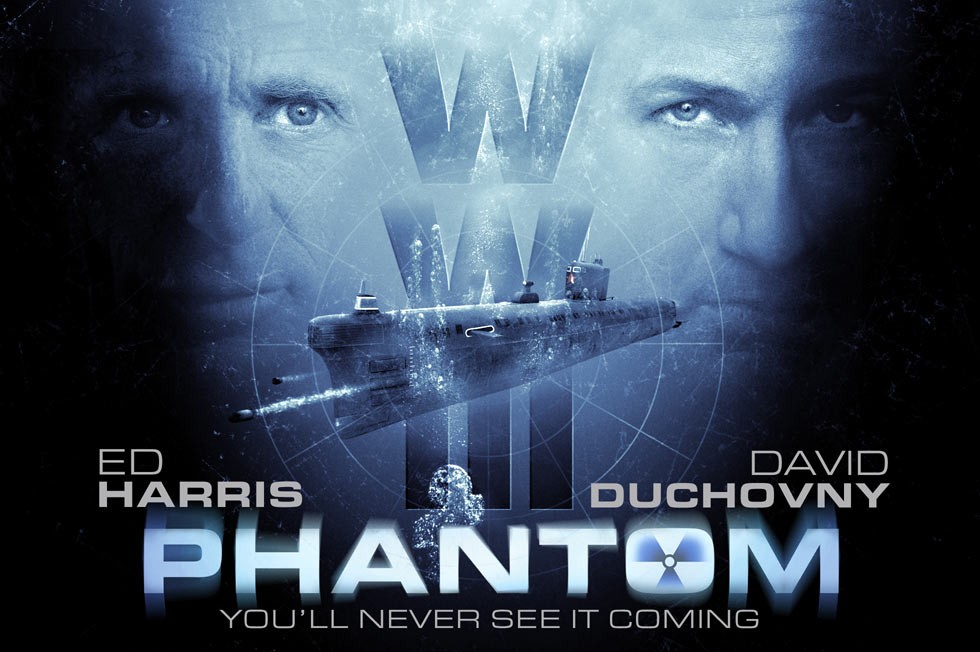
It was not hard to lose yourself in the film, so realistic
are the sets and sounds, but you have to get used to hearing supposedly Russian
crewmen speaking American accented English. I thought that they could at least
have pronounced the names in the Russian way. It is jarring to hear the name
"Vladimir" mangled in the American way, instead of the guttural
expletive that Russian mouths spit out. The crew, using an old-even-then diesel
submarine, seem impressively competent. The ending is strange, they seem to
dredge the sub home to Russia, though the ending titles explain that the sub,
or at least its top secret "phantom" cloaking device, remains in
American hands.
Admission is a Tina Fay vehicle that, I recalled, did fairly
well on the Tomato meter. Still, the story of a university admissions officer,
named Portia, no less? How romantic or even interesting can that be? Indeed,
one adolescent character, who is forced to travel the world with his adoptive
father, romanticizes Portia's boring existence.
Not so much boring, actually, as superfluous.
Admissions officers should not even exist. Universities get
to cherry-pick who their students are going to be? Is not that like letting
doctors pick only healthy people to cure? Or hiring cops only for places where
no crime takes place?
Actually, one character, Portia's romantic rival, picks up on
that feeling. She says to Portia something like, "In England our
universities do not use the broad criteria of American colleges. We pick
students only based on marks. For us, it is the gray cells that matter."
Here am I thinking, is that better, or worse? If you have students so smart
that you do not really have to teach them, will that not tempt the school not
to bother about teaching at all?
Imagine a police department that has few criminals to deal
with, and which also is tasked with criminology research. Which is likely to be
emphasized, crime fighting or research? Which enhances the reputation of a
school like Portia's Stanford, teaching or research? If she does her job well
they will not have to worry much about teaching; all the students will teach
themselves. They will enter the elite and give full credit to the brand's
degree.
There should be a name for this sort of movie, ones that bill
themselves as romantic comedies but which are really something else. In this
case, Admission is too humorless to be a comedy, and not serious enough to be a
drama. Call it an "anomie" flick.
In spite of the lead actor's proven amiability and skill, it is
very hard to sympathize with Tina Fey's Portia. She lives with a man for I
forget how many years, then when he leaves her for another woman, she can only
pretend to care about it. She is depressed, but not primarily because of her
relationships. She sees the futility of her work, but does not seek for more.
She does find it useful, though, to pretend she is living a tragedy, to play on the pity that her breakup arouses
in rivals and colleagues, and turn it to her own ends. She is no motherly type, but the only passion that
she shows is for a boy that she thinks is her son. When it turns out that he is
not, really, by then the viewer is past caring.
So lacking in
commitment is Portia that nothing works out for her, and ultimately, she does
not much care. So, why should we?
The feeling you get at the end is a mild sort of fleeting
melancholy. Mild because her anomie is just what she has sown and reaped. In
the same way, failure to even address its job as an institution of learning is
what Stanford seeks and finds. Finally, Portia stands up for a student who
seems actually to need to be taught. She pulls a fast one and gets him
accepted, even at the price of being fired. Ironically, though, this boy is an
autodidact, someone who educated himself. Even more than other applicants, he
does not need to go to school in order to learn. He says that he saw early on
that he had lousy teachers and role models, so he decided to teach himself. The ideal candidate, actually, for a lousy but high
status school. Just what the elite schools seek, someone who requires as little teaching and guidance as possible. Clearly, Portia should not have been fired for picking him, because she was hired to do just this. Anyone
who needs good teaching in order to progress, that is the student that needs to be weeded out.
In a sane world, institutions of learning would never get to
pick the students they teach, any more than police departments can pick the
neighbourhood they patrol, or doctors can weed out sick patients. There would
be a separate admissions body that would assign applicants to a school based on
sortition (that is, a completely random choice of individuals by lottery).
First of all, it would eliminate students who are not capable of higher
education. How long does it take for a computer to sort that out, a split
second?
Then, everyone would be a candidate.
That is, Stanford would be assigned kids that are rich,
middle class and poor, youths with high, middling and low marks, all based on
clear statistical criteria. It would be forced to do its job, teaching.
Education is a long term thing, but it would only take a generation or two
using sortitioning to find out which schools really are elite schools, and
which really do deserve to be at the bottom of the heap. The result would be a less elitist, a more democratic society.
----
Postscript: Not many movie reviews have a postscript, but
this one does. I just read Leo Tolstoy’s assessment of the novels of Guy de
Maupassant, and here he lays out three “conditions of a true artistic
production,” it needs,
1. the correct, that is, the moral, relation of the author to the
subject,
2. the beauty of form, and
3. sincerity, that is, love for what the author describes.
He goes on to point out that when approaching such a work of
art, once it has passed these three tests, is to ask, what does the artist have
to say that is new?

This movie was clearly written by someone very familiar with
the subject matter, that is, the life of an admissions officer. That was new,
for me. But beyond that, the artistic value of this film is its statement that
it is unlikely that correctness, beauty and sincerity are even possible in
today’s moral climate. There is no tragedy in a relationship breaking up that
neither party committed to in the first place. Personal anguish, perhaps, but
no tragedy. Tragedy and drama require more of the individual than the
characters in this film are willing to give. All we can hope for is an
ungainly, unpretty, unfunny comedy.


