Showing posts with label p29. Show all posts

Monday, January 07, 2013

First Futurist

Pythagoras, the First Futurist

By John Taylor; 2013 Jan 07, 169 BE


Last month I finished reading a rather disappointing book about the influence of the sun on history. It is called the "petulant sun hypothesis," or something, the idea that sunspots and solar flares have influenced climate and just about every other aspect of our world more than we tend to think.

Its author describes himself as a futurist. Instead of paying his dues by researching this promising thesis thoroughly, though, he relies on his sense of humour to get him through some three hundred pages of fluff. The jokes I found distracting and less than amusing. This is not the only futurist who disappointed me. If, as Bacon put it, some books are to be tasted and some digested, futurists, at least those I have read, are windblown foam that I would not put in my mouth.

Yet the subject itself is so important and fascinating!

The talent pool for futurists seems to be the dubious demimonde of fads and punditry. Instead, I think the ideal place for a futurist to start when exploring the future is in philosophy and the history of ideas. Here, are those ideas most likely to last into the future. Here, you become familiar with those that have been discredited so you can recognize them when they crop up again in disguise. And, not least important, you can give credit where credit is due when an old, profound truth raises its head. It is in this spirit that I wrote the following about the real Pythagorean theorem.

 ==========

The Real Pythagorean Proof; Pythagoras and our Object as Humans

clip_image001


It is now established that the proof of Pythagoras was known by the Babylonians many centuries before his birth; indeed, they understood the theorem much better. We should therefore call that right angled triangle relation, which some say is the most important theorem in mathematics, the "Babylonian Proof" instead of the Pythagorean. Nonetheless, there remains a Pythagorean proof that should be far better known as such than it is. Arguably, it is even more important that the mathematical contribution of Pythagoras and his followers.

==========

What is our goal as human beings? Pythagoras of Samos (about 570-495 BCE), travelled the known world, from Europe to Asia, from Egypt to India and back, in search of an answer, and his discovery still stands today. He found that our object, our raison d'etre as human beings, is knowledge. Not only that, he found that knowledge has three aspects, just as triangles have three sides, or our world has three dimensions. These are knowledge of self, of the universe and of God. Once we grasp these, truth will empower and set us free, in and of itself. Pythagoras has been credited with this statement:

"Man, know thyself; then thou shalt know the Universe and God... No one is free who has not obtained the empire of himself. No man is free who cannot command himself." (Pythagoras <http://www.experiencefestival.com/pythagoras_quotes>)

This unites theory and action, East and West, and all that we now call science, religion and politics. It is still repeated by pundits of all stripes, hundreds of centuries afterwards. The same advice, "Know Thyself," was posted above the Oracle of Delphi. In Shakespeare's Hamlet, a father repeats it to his departing son,

"This above all: to thine ownself be true,

And it must follow, as the night the day,

Thou canst not then be false to any man."(Shakespeare, Hamlet, Act I, Sc. 3)

Ideally, everyone would succeed in this sublime quest to know oneself comprehensively, to rule over oneself with perfect love, justice and wisdom. If we could, we would know and grow smoothly, all the time. Like his right angled triangle, we would grasp the hidden unknowns and progress steadily through each stage of our development, from early youth to old age. We would not need laws, rules or outside compulsion. It would be a libertarian paradise.

Unfortunately, life is imperfect. Self-knowledge tends to fail. Much as we would like it to be, the right angle is not always exactly 90 degrees. We misunderstand. We forget. We change, the environment changes and society grows. The universe is expanding. Knowledge itself is incomplete, by its very nature. We lose hold of our freedom. Rule over self lapses. To adapt, we must be tentative, and continually upgrade what we know, even of one's self.

Pythagoras recognized this when he coined the word "philosopher" to take the place of the much older "elder" or "wise man."

"Pythagoras is said to have been the first to assume the title of Philosopher (lover of wisdom) in place of the name Sophos (wise), by which the sages had before been known." <http://www.nndb.com/people/773/000087512/>

Wise men think they own wisdom, an impossible expectation in this growing, expanding universe. All that imperfect beings dare aspire to is to be seekers after wisdom, to adore wisdom but never possess her. At our best, we are lovers who revere knowledge, and humbly court wisdom. A philosopher does not presume to be wise already. He is tolerant, tentative and evolutionary. Such is the station of a philosopher.

Pythagoras was among the first to notice that this station points in three direction, like a right angled triangle. There is not, and cannot be, only one path to truth. There are three ways of knowing and growing because knowledge starts with knowing the self, then it proceeds to the universe and to God. We have three main motives or reasons for being, which he illustrated by the three types of people who turn up at a sporting event.


clip_image002


"Pythagoras argued that there are three kinds of men, just as there are three classes of strangers who come to the Olympic Games. The lowest consists of those who come to buy and sell, and next above them are those who come to compete. Best of all are those who simply come to look on. Men may be classified accordingly as lovers of wisdom, lovers of honor, and lovers of gain." ("Pythagoras," Internet Encyclopedia of Philosophy, http://www.iep.utm.edu/pythagor/)

Thursday, August 30, 2012

September Philosopher's Cafe

This month’s topic for the Wainfleet Philosopher's Cafe:


“Conscience & the Search for Truth”


Thursday, September 13


6:30 p.m. in the Library’s meeting room


clip_image001[4]

Thursday, September 01, 2011

Wednesday, March 02, 2011

March discussion


Philosopher’s Café


clip_image001


This month’s topic of discussion:

“Knowledge and World View”


Thursday, March 10

6:30 p.m. in the Library’s meeting room

clip_image002


Every second Thursday of the month. Everyone is welcome. Drop in for a lively discussion. There is no fee to participate. No formal philosophy training required; real life experience desired.


Wainfleet Township Public Library

19M9 Park Street, P.O. Box 118

Wainfleet, ON L0S 1V0

905-899-1277 www.wainfleetlibrary.ca

Monday, February 07, 2011

Chapter Seven; Cosmopolis Earth

Law and the Socratic Dialectician


By John Taylor; 2011 Feb 07, Mulk 01, 167 BE


Ancient Athens attracted many geniuses, including the first philosophers, Socrates, Plato and Aristotle. They witnessed Lycurgus's attempt in Sparta to establish equality, and Pericles' experimentation in Athens with democracy and liberty. They analyzed why both of these failed to last, and speculated on how they might be improved upon.


In his great work, the Republic, Plato held that at its best kingship, the rule of an individual, would be ideal. A ruling individual does not contradict himself as polyarchies do. Unfortunately, few if any mortals can wield power for long without being corrupted by hubris. Only a true philosopher dare aspire to that. Unfortunately, philosopher kings are rarer than the philosopher's stone. Kings rarely aspire to becoming philosophers, and few philosophers even want to be kings. Similar weaknesses arise from rule of the few, aristocracy, and rule of the people, democracy. Failing the ideal, our best hope is to combine and balance the best features of all three possible types of government, royalism, aristocracy and democracy. Fuse them into a single entity and you get the public thing, the Res Publica or Republic.


clip_image001


In my opinion, though, Plato's greatest masterpiece was his last work, the Laws. We think of sustainability as a modern invention, but Plato held this up as the highest object of all reform. We need to create a polity with the longevity, robustness and stability of Egyptian civilization, which was ancient even in Plato's time. In order to do that, we must strike a measure of justice and right perspective within, and then translate that into good laws.


"If one neglects the rule of due measure, and gives things too great in power to things too small -- sails to ships, food to bodies, offices of rule to souls -- then everything is upset, and they run, through excess of insolence, some to bodily disorders, others to that offspring of insolence, injustice." [Plato, Laws, 691c, <http://www.perseus.tufts.edu/hopper/text?doc=Perseus%3Atext%3A1999.01.0166%3Abook%3D3%3Apage%3D691>]

The process of corruption begins, Plato's Athenian Stranger tells us, in pride, which distorts pain and pleasure. We must respond to the two basic human motivations in the right way. If the ruling principle, our reason or wisdom, controls feelings of fear and hope, or better still, directs our fears and hopes towards what we should fear and hope for, then the outcome is good laws.


==========


"Well then we may take it that any human being is one person?"

"Of course."

"But one person has within himself a pair of unwise and conflicting counselors, whose names are pleasure and pain?"

"The fact is as you say."

"He has, besides, anticipations of the future, and these of two sorts. The common name for both sorts is expectation, the special name for anticipation of pain being fear, and for anticipation of its opposite, confidence. And on the top of all, there is judgment, to discern which of these states is better or worse, and when judgment takes the form of a public decision of a city, it has the name of law." (Plato, Laws, 644d, Collected Writings, p. 1244)

==========


Law, then, is the product of many minds undergoing, apart and together, what Socrates, Plato's beloved teacher, had called dialectic. Dialectic is a creative conversation where the learner goes from an idea or thesis, feeling confidence, and that is contradicted and refined by antithesis (fear), and finally the seeker arrives at a consensus, synthesis or reasoned judgment. In the collective sense, the ultimate outcome is law.


clip_image002


We should not concentrate, therefore, on the particular design of a Republic; the most important thing is the legislation that holds it together and gives it life. Make adjustments to the laws, understand the spirit of law, and good leaders and upstanding citizens will arise naturally.


As enough seekers of truth learn to apply dialectic successfully, the polity will hit what we now call a Goldilocks zone, a point of moderation where there is just enough intimate contact among members for equality and freedom to play off on one another. The right amount of equality and inequality comes first. Non-equals naturally want to emulate their betters. Peers want to vie with peers by maintaining a reputation for uprightness and vigour in good works. In order to do this, there must optimum personal freedom so that each can work out his or her own contribution. As Plato puts it in the Laws,


"There is indeed no such boon for a society as this familiar knowledge of citizen by citizen. For where men have no light on each other's characters, but are dark on the subject, no one will ever reach the rank or station that he deserves, or get the justice which is his proper due. Hence in every society it should always be the endeavor of every citizen, before anything else, to prove himself to all his neighbors no counterfeit, but a man of sterling sincerity, and not to be imposed upon by any counterfeiting by others." (Laws, 738e, pp. 1323-1324)


There cannot be so much closeness and unbounded intimacy in a society that outside opinions will dominate personal search. This is imitation, and it intrudes upon the integrity of the individual's dialectic. The tyranny of others' opinions stifles creativity and ultimately kills the polity as well. The way to destroy imitation is through carefully directed conversation, dialectic, which irritates but also leads to a profound realization of what freedom and equality really mean.


Next time I will discuss how Plato's theory might be combined with the Chinese neighborhood helper and Comenius's three magistrates into a new, practical profession called the dialectician.

Monday, December 13, 2010

The Epidemiology of Corruption

Plato, Power and Corruption

clip_image001

Proportion Prevents Corruption

Absolute or disproportionate power leads inevitably to corruption. As Lord Acton famously put it, "Power tends to corrupt and absolute power corrupts absolutely." In this short sentence Acton sums up succinctly the thesis of Plato's much maligned final masterpiece, the Laws. In earlier works, Plato had held that the virtue of individuals is writ large in the state. In the Laws, he pictures law as a sort of writing tool to improve the state by bettering its citizenry, and vice versa. What stands in the way of this, Plato holds, is "absolute and irresponsible power," which always leads to corruption. Corruption destroys the body politic by stripping leaders of their principles, and citizens of their virtue,

"... if he (a leader) be possessed of absolute and irresponsible power, he will never remain firm in his principles or persist in regarding the public good as primary in the state, and the private good as secondary. Human nature will be always drawing him into avarice and selfishness, avoiding pain and pursuing Pleasure without any reason, and will bring these to the front, obscuring the juster and better; and so working darkness in his soul will at last fill with evils both him and the whole city." (Plato, Laws, Book 9)

Power corrupts not because it is bad in itself but because in concentrated form it distorts vision, eradicates the sense of balance and upsets the natural order of things. Power, like a powerful drug, is a good only when meted out in carefully prescribed doses. Small and diffuse measures of power allow the metabolism of imperfect humans to bear under without being poisoned. He writes,

clip_image002

"If we disregard due proportion by giving anything what is too much for it, too much canvass to a boat, too much nutriment to a body, too much authority to a soul, the consequence is always shipwreck; rankness runs in the one case to disease, in the other to presumption, and its issue is crime." (Plato, Laws, 691c, Collected Writings, p. 1286)

Here he compares political corruption to inappropriate technology and to overeating. With startling prescience this predicts what is happening right now.

A sailing ship with too large a sail will be manhandled by the slightest contrary breeze, and a stronger wind will upend it. Similarly, the energy that present-day technology uses is derived from the combustion of hydrocarbons, a practice that experts and leaders have known since the 1980's releases greenhouse gasses that cause global warming. Worse, the knowledge of how dangerous this is seems only to have stiffened opposition to change, and worsened our dependency. Our addiction to burning shows that technology could not be further from Plato's "due proportion."

As for "too much nutriment to the body," obesity is the emblematic illness of the past half century. It spread so quickly that in most nations, poor and wealthy, a large majority are now clinically overweight. When Plato says that "rankness runs ... to disease" in the body, he may have been referring to the now familiar tendency for the obese to succumb to a disease that was not named "cancer" until modern times. In any case, the intent of Plato's metaphor is clear.

"Rankness," translated into political language, is "partisanship," "rebellion," "war" and "treason." Unrestrained power in any one place metastasizes like a tumor, from one location to the entire organism. The malignancy grows without restraint, infiltrating and allocating precious bodily resources to resistless expansion. What it cannot grow into it poisons. In the same way, elites take more than their fair share of power and wealth, and thus spread envy and wrongdoing among have-nots.

The third disproportion that causes the ship of state to founder is what Plato calls "giving too much authority to the soul." The terminology of Abrahamic religions describes this as an idol, icon or image, anything that arrogates to itself the total adoration and absolute sovereignty that are the exclusive domains of God.

clip_image003

Indirect, Participatory Democracy

What would avoid concentration of power? How is this even possible? The answer that Plato puts forward in the Laws is an improved version of Athenian democracy that might be termed indirect, participatory democracy.

Many, basing their judgment solely on the Republic and earlier dialogues, imagine that Plato, himself a member of an aristocratic family, was against democracy. It is true that he held a grudge for many years against the democratic regime that executed his beloved teacher, Socrates. However, a careful reading of the Laws shows that Plato would have retained many elements of his native city's democratic experiment in his ideal lawmaking process.

Lawmakers, judges and even school trustees, he held, should be chosen by a combination of rotation by lot and indirect election. By election, he meant a nomination-free vote that chooses the hundred or so whose names that appear most often on the city's ballots. These elected citizens in turn serve in a ruling counsel on a rotating basis; they also actively serve themselves, rotating on a weekly or monthly basis. In order to reduce bribery, the citizen who serves at any particular time is determined at random, by drawing lots.

This combination of rotation and indirect elections would involve the entire population in maintaining justice.

Universal participation in the process would spread power into as many hands as possible. Those who do have power would not keep it long, nor could they predict when they will have it in future. They would, however, benefit from experience, both practical (as judges, say) and in a management capacity (as lawmakers and members of the ruling counsel).

The first job of lawmakers, then, is to immunize the population from corruption, since once it catches hold it becomes almost impossible to eradicate. Plato's way of preventing power from concentrating reminds me of a modern technique of epidemiologists.

clip_image004

Only about a hundred years have we known that diseases like malaria are caused by mosquito bites. Since then we have learned that an effective way of reducing the incidence of mosquito-born epidemics is to see to it that water cannot collect after a rain. By eliminating standing water wherever it is found, mosquito larvae cannot breed, and the disease vector stops dead.

In the same way, a better lawmaking process would edify the citizenry by encouraging them to participate directly in the lawmaking process. At the same time, the dangerous, addictive sort of power broker -- which Plato called drones -- would not have enough access to power to be able to breed and spread corruption.

We shall discuss Plato's suggested structure of direct democracy in greater detail in the third volume of Cosmopolitan Earth.

Sunday, December 05, 2010

Philosopher’s Café: Advice

This month’s topic of discussion:
“Advice”

Thursday, December 9
6:30 p.m. in the Library’s meeting room

Wainfleet Township Public Library

19M9 Park Street, P.O. Box 118
Wainfleet, ON L0S 1V0
905-899-1277 www.wainfleetlibrary.ca

Philosopher’sCafé• Everyone welcome. Drop in for a lively
discussion.


• There is no fee to participate.
• No formal philosophy training required;
real life experience desired.


A second Thursday of the month destination
for provocative, insightful discussion
around ideas and issues that matter.

Thursday, September 30, 2010

Plato, Power and Corruption

By John Taylor; 2010 Sep 30, Mashiyyat 04, 167 BE

In Panorthosia, Comenius put great stock in the Biblical admonitions not to "respect persons" and to "call no man master." (Matt 23:10) Corruption, in Comenius' view, is an inevitable consequence of disobeying the divine commands not only to call nobody master but also to "seek and ye shall find," never to delegate one's own obligation to search and serve to anyone else. He built the entire structure of Panorthosia on this egalitarian imperative, which he considered to be of the essence of faith. Before continuing with our discussion of Comenius, I want to explore this crucial issue of power and corruption further. Since it is discussed in detail in Plato's Laws, I will concentrate upon that work in particular.

image

Generally speaking, it is a bad idea to invest too much in any one individual or elite. The most familiar caveat is Lord Acton's saying that, "Power tends to corrupt and absolute power corrupts absolutely." Acton thus linked power with corruption after observing a Vatican counsel, but it applies to any concentrated knowledge, influence or power. The sad history of charismatic dictators and authoritarian regimes shows how dangerous inordinate power is when concentrated inordinately into one person, one profession, class or any other homogeneous group.

In his final work, the Laws, Plato holds that power is a good if and only if it is an outcome of wisdom. We call someone a good person if he or she maintains good relationships; this ability to be good to others is the same thing for an individual that we call wisdom in the state. "One needs to reflect that wisdom and friendship, when stated to be the aim in view, are not really different aims, but identical..." (Laws, 693c, R.G. Bury, tr.) Wisdom, then, is when society has a sense of due proportion; and that can only come out of temperance and moderation, which allow us to see holistically the entirety of life.

Power corrupts, therefore, not because it is bad in itself but because it can distort vision, break a just balance and destroy the natural order. Power needs to be given in prescribed doses that are small and diffuse enough that imperfect human beings can bear under it. He writes,

"If we disregard due proportion by giving anything what is too much for it, too much canvass to a boat, too much nutriment to a body, too much authority to a soul, the consequence is always shipwreck; rankness runs in the one case to disease, in the other to presumption, and its issue is crime." (Plato, Laws, 691c, Collected Writings, p. 1286)

Plato's comparison of political corruption to inappropriate technology and to overeating is highly significant in view of recent trends. Obesity is the emblematic illness of the past half century. It has spread to a large proportion of the population. In many nations, both wealthy and poor, a majority are now clinically overweight. Similarly, our technology, powered as it is by burning hydrocarbons, could not be further from due proportion. It became known to experts and leaders in the late 1980's that this combustion was causing global warming, but that knowledge seems only to have accelerated our dependency upon what Plato calls a sailing ship with far to large a sail. This "rankness" in our bodies and our technology clearly is a result of the third factor that Plato mentions here, giving too much authority to the soul. Later in the Laws, Plato explains how the fall of individuals is writ in larger letters in the decline of the state.

"... if he be possessed of absolute and irresponsible power, he will never remain firm in his principles or persist in regarding the public good as primary in the state, and the private good as secondary. Human nature will be always drawing him into avarice and selfishness, avoiding pain and pursuing Pleasure without any reason, and will bring these to the front, obscuring the juster and better; and so working darkness in his soul will at last fill with evils both him and the whole city." (Plato, Laws, Book 9)

The question then arises: how can we devise a government that does not allow anyone -- or any segment of society -- to possess "absolute and irresponsible power"? Comenius' answer was to establish an entire new philosophy designed to remove the dissension and divisions that sicken and weaken most of the body politic.

"Therefore the new philosophy will have as its new ultimate goal the reconciliation of disagreements by discovering, establishing, and bringing to light true ideas of everything, and by referring every particular thing to these, elements of agreement and disagreement should be readily revealed, so pointing the way of return to agreement." (Panorthosia, Ch. 11, para 5, p. 176)

In order to do this, he set up a new division of labour in both leadership and "followership." He envisioned a set of three institutions -- instead of the monolithic political structures we now have -- that are designed from the ground up to prevent absolutism, to be responsible yet as local, non-centralized and non-specialized as possible. Next time we will look at them in more detail.

::

Thursday, April 15, 2010

My short daily walk with God


A Giant Step With the Short Oblig


By John Taylor; 2010 April 14, Jalal 06, 167 BE


My ten-year-old son Thomas came up with the following two aphorisms this morning as he was preparing to go to school.

 
"An apple a day keeps the teacher at bay."
"In the early stages you cannot tell the difference between a sneeze and a yawn."


Myself, I have been able to come up with nothing these past days, so let me offer this spontaneous commentary on the Short Obligatory prayer. (Baha'u'llah, Prayers and Meditations, CLXXXI, p. 313) I have been swimming around in the gap between the first and the second sentence of this prayer all my Baha'i life.


"I bear witness, O my God, that Thou hast created me to know Thee and to worship Thee."


So, let me see, we have been created to know an Unknowable Essence, to do something that is by definition utterly impossible. Our reason for being is permanently beyond our grasp. How about worship then. But if I cannot know Him how is it that I am expected to love Him? Another utter impossibility. You can only love what you are intimate contact with.

Okay, true, the teaching is that we can know and love God virtually. You can know and worship by means of His Proxy, the Manifestation. Even so, it is a pretty tall order.


This first sentence is like the first half of a step forward. As you are walking, you realize that you are almost falling, until the other foot hits the ground. Here comes the other foot.


"I testify, at this moment, to my powerlessness and to Thy might, to my poverty and to Thy wealth."


So let me get this straight. My destination is an unattainable one and I have no power to get there with. Nor do I have any spending money to burn on the way. I am chasing an impossible dream, with no means, no energy, no hope.


But all I need is enough impetus to drive me forward to the next step. What little I can know, what little I can worship only needs to be powerful enough to carry me forward to the next step. So I slap my foot down.


"There is none other God but Thee, the Help in Peril, the Self-Subsisting."


`No other God but God.' Hmm. Nothing else in this universe is going to help me fulfil this daunting purpose. At least I know that, discouraging as standing here is, I am facing in the only direction with any hope of getting me there.

`Help in Peril' My shortcoming must be there for a reason, to bring out this attribute of my Creator. If He manages to make me succeed, it will be for His greater glory. My purpose is to highlight His power, wealth and helpfulness.

`The Self-subsisting' Another virtue I can now appreciate better now than before I set out on this unending quest. God has enough to subsist for Himself, and He has plenty left over for my substance as well. Maybe I am not as far off from my Object as I thought.


::

Tuesday, April 06, 2010

Age of Wisdom


An Age of Wisdom


"Not I, but the city, teaches." - attributed to Socrates


Today, I want to trace the roots of Comenian world governance into Plato's idea of the nature of wisdom.


By John Taylor; 2010 April 05, Ala' 16, 166 BE


The Moravian educational reformer Jan Amos Comenius wrote in 1644 that "he who would not seriously wish well to the whole of the human race, injures the whole human race." Good to his word, almost thirty years later on his deathbed Comenius put the finishing touches on Panorthosia, Universal Reform, his masterpiece. Panorthosia proposes nothing less than the total reform of earth and its citizens, and includes detailed plans for a world government. It carries through on his conviction that only a holistic approach to world order will assure the well-being of any or all. As we all enter into this perspective, humanity will prove itself mature.


"For in the final age of the World man must come to the highest stage of all. Therefore philosophy, or the love of wisdom, is not sufficient; wisdom itself must be present, and not its shadow but its body, and its body in whole and not in part; therefore it is not merely wisdom, but Universal Wisdom, that we need." (Panorthosia II, Ch. 10, para 43, p. 170)


Comenius is referring to the notion in Plato's Symposium that God does not need to seek out wisdom, He already has it. Only we finite mortals need to seek out wisdom, that is, we aspire to be philosophers or lovers of wisdom, but can never actually be wise.

What then is wisdom?

Wisdom, in Plato's view, is the virtue of reason, of our ruling faculty. Wisdom sets up a harmony between the whole and its parts, and the parts and their whole. In the Republic, he says, "Him we call wise who has in him that little part which rules, (which has) a knowledge of what is for the interest of each of the three parts and of the whole." These three parts are found in both the soul and the state, and each is a reflection of the other. In either the soul or the state, "how can there be the least shadow of wisdom where there is no harmony?" (Plato, Laws) Thus wisdom is a question of obedience, but a conformity based on love, not force. Both the whole and the part obey the reasoning faculty implicitly, in a spirit of what can only be called radiant acquiescence.

Comenius agrees that wisdom is a sort of harmony among the institutional parts of a world government. Wisdom, then, will mark our collective attainment of the final stage of human evolution, a time when opposition and competition will fall away and all will abide in love. A world government, then, will not be merely philosophical, rather it will take the harmony of wisdom right into its very structure. As a result, planetary governance is instantiated wisdom, built on a rock-like foundation of harmonious love. It therefore will not be concerned with mere technical problems,


"Similarly politics or poliarchy (skill in governing cities or kingdoms) is not enough; this final age requires Universal Rule, or wisdom in maintaining any human society at any time in peace and prosperity. Lastly, religion is not sufficient; what we need is Universal Religion, binding all souls to God in every way with all His virtues. For just as our eternal Father's works of Creation appeared in the end to be very good (Genesis 1:31), so the work of the Son and the Holy Spirit must be excellent in the end." (Panorthosia II, Id.)


There is a difference in kind between being a philosopher, citizen and believer of the ordinary sort, and of the universal variety. I may have a particular set of ideas, live in a particular country and follow a particular religion, but a universal philosophy, a common order and a common faith will link me to all other human beings. If each and all work on a universal philosophy, universal rule and universal belief, certain attributes will become inherent to our collective thinking. The body politic will be universalized, just as a common DNA code in the nucleus of the cell makes each cell a member of a single organism. In this way the nature of the body determines, without struggle or conflict, the role and structure of each cell.

This common code building makes humanity one organism. A divine, universal wisdom can thus integrate and amplify the forces of good so that under such a world government everybody will have his or her own particular interests and expressions, but in what is relevant to the whole, each thinks, acts and believes in the same manner.

This unity will unleash tremendous power to act together. We will be, Comenius says, like a large river with three sources that join into a single flood wiping away obstacles from its path. He invokes a favourite example, the river Alpheus, which Hercules in his fifth labour redirected to clean out the Augean stables (http://en.wikipedia.org/wiki/Augeas),


"I think that it is clear from my Universal Wisdom that it is possible for these fountains of God to combine into one torrent like the Alpheus, thus integrating everything that the world possesses and the mind of man dictates and the word of God expresses, in such a way that any seeker after knowledge may find it in full, anyone searching for forms and standards of self-government may find them ready-made, and anyone desiring God may see His presence everywhere, and hear, taste and touch Him and feel His binding influence." (Comenius, Panorthosia II, Ch. 3, para 38, p. 80)


This points right at what my book-in-progress, People Without Borders, predicts will happen next. As the Internet becomes more integrated into our lives, we will work out what Comenius calls "forms and standards," that is, open life-planning software. This will be part of our common human inheritance. It will harmoniously direct our progress, both together in groups and apart as individuals. Gradually these standards for self-improvement will be worked into the very architecture of our built world, and into the natural areas surrounding and pervading the built world.


::

Tuesday, March 30, 2010

The Noam Chomsky Show

What about a talk show styled after Jerry Springer

hosted by Noam Chomsky. Here it is.


;:

Thursday, January 28, 2010

Invitation to the Monthly Meeting that I Animate

Philosopher’s Café

A second Thursday of the month destination for provocative, insightful discussion around ideas and issues that matter.

Thursday, February 11 6:30 p.m. in the Library’s meeting room
Topic for discussion:

“Responsibility”


•    Everyone welcome. Drop in for refreshments and a lively discussion.

•    There is no fee to participate.

•    No formal philosophy training required; real life experience desired.

Wainfleet Township Public Library
19M9 Park Street, P.O. Box 118 Wainfleet, ON L0S 1V0 905-899-1277 www.wainfleetlibrary.ca

Sunday, October 26, 2008

Plato's Cave or Den

Posted by Picasa

Tuesday, October 07, 2008

strife is justice

Heraclitus; Dike eris, "strife is justice"

By John Taylor; 2008 Oct 07, 10 Mashiyyat 165 BE

John the Evangelist, known to early Christians as the beloved disciple, gained profound insight into the Message of Jesus not only by his long, close and direct personal relationship with the Master Himself, but also by his evident familiarity with the fragmentary writings of the Ephesian pre-Socratic philosopher Heraclitus. Being thus intimate with Biblical and philosophic traditions, John was in a position to combine the core teachings of both in the famous opening of his gospel,

"In the beginning was the Word, and the Word was with God, and the Word was God."

This idea of Word, or Logos, as the creative, divine essence of all things in the universe combined the religious genesis myth with the best that natural philosophy (known after the mid-19th Century as science) could offer. Indeed science has hardly gone beyond this Logos concept even today. More than a few physicists point to the implication of quantum mechanics that the entire universe is a giant calculating machine, performing essentially what Heraclitus saw as the task of Logos, what Baha'is call the Manifestation of God. In John's statement that "the Logos was with God, the Logos was God" we see the first glimmering of the Baha'i principle of harmony between science and religion.

The idea of Logos is characteristic of the many profound insights of Heraclitus, of which we only have snippets. I have unbounded admiration for him; I think he is among the greatest geniuses ever, and that he probably ranks as a minor prophet. Without his pioneering of terms like justice and "Logos," the Baha'i idea of the Manifestation of God would be incomprehensible. Baha'u'llah, for example, uses the idea of Logos, or "first Word," in the following meditation:

"I testify that no sooner had the First Word proceeded, through the potency of Thy will and purpose, out of His mouth, and the First Call gone forth from His lips than the whole creation was revolutionized, and all that are in the heavens and all that are on earth were stirred to the depths." (Baha'u'llah, Prayers and Meditations, CLXXVIII, p. 295)

Heraclitus did not use the Logos in isolation. It is inherent to his concept of justice. This in turn is part of the best known idea of Heraclitus, that everything is in flux, that the universe is ever changing,

"For, it is impossible to step twice in the same river." (Heraclitus, fr. 91)

Heraclitus's universe is a calculating machine, working according to binary principles, just like our computers of today. Just as a computer calculates with numbers that are no more than strings of ones and zeros, the stuff of the universe is ever leaning into existence and then quickly flaring off into nothingness. This is Heraclitus's concept of Dike Eris, or "strife is justice." Dike (meaning right) was a daughter of Zeus who sat at his right hand distributing justice; Eris or strife was the twin sister of the god of war, symbolizing the divisive words and attitudes that are the preconditions of physical confrontation. Thus justice is the one and strife the zero of the ever fluctuating binary processes of existence and non-being in the universe. Yet in the end, after all the ones and zeros are gone, what remains? Nothing. Hence, as Plato cited Heraclitus, "All things going and remaining not at all." The Wikipedia article on Dike eris further explains,

"Heraclitus here references the Scythian bow, the horns of which pointed forward unstrung but back strung, or the deformation of the cross-bar of the lyre under string tension. The palintropos of an object would therefore be its stinting from the growth of the current instant by the decay of the object of the previous. This identity-not-identity accounts for such statements as:[44]

"It is one and the same thing to be living and dead, awake or asleep, young or old."

"A change is the result of a change in balance."

"Cold things become warm, and what is warm cools; what is wet dries, and the parched is moistened."

Yet beyond this impersonal flux is a higher justice, a greater intelligence whose love infuses all with purpose and meaning. The great computer has a Programmer. Baha'u'llah uses very Heraclitean language in the continuation of the mediation begun above.

"Through that Word the realities of all created things were shaken, were divided, separated, scattered, combined and reunited, disclosing, in both the contingent world and the heavenly kingdom, entities of a new creation, and revealing, in the unseen realms, the signs and tokens of Thy unity and oneness." (Baha'u'llah, Prayers and Meditations, CLXXVIII, p. 295)

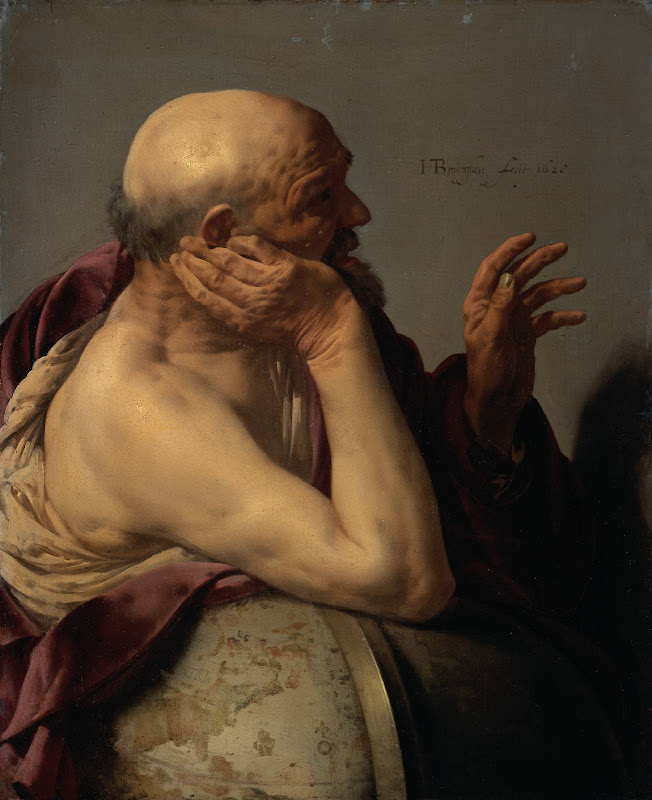
Heraclitus

From Badi Blog

Hendrick ter Brugghen's depiction of prophet, genius, hero and philosopher Heraclitus.

Tuesday, September 30, 2008

What happens when you mention the cogito in a Baha'i Children's Class

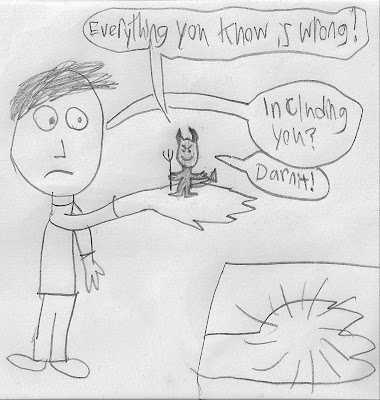
Silvie did this cartoon during our children's study session last night.
I offhandedly mentioned the Cogito, how Descartes posited a daemon who deceives him about the whole world, until Rene finally decides that "I think, therefore I am," and that cannot be doubted. Silvie asks here, what if Descartes had in turn instilled doubt into the daemon? End of daemon. He would just flare out.

From The Badi Blog