Wednesday, September 08, 2010

Worker's Union

Flora Tristan's Worker's Union


Flora Tristan's Worker's Union vs. the Communist Manifesto

By John Taylor; 2010 Sep 08, Asma 16, 167 BE


Strategic position of female householders

Female leadership, when allowed to express itself has traditionally acted as a centripetal force balancing out the centrifugal force of hierarchical leadership. The 31st Chapter of the Book of Proverbs describes how motherly power works in a well run household. Reading this encomium to womanly responsibility gives one a sense of why wisdom is traditionally personified as a woman (Sophia, in Greek). Without the female half of humanity being fully developed, it is difficult to imagine the human race attaining the harmonious balance that is needed to reach its full potential. If we are ever to have an efficient world government without toppling into tyranny or bureaucracy, neighbourhoods will have to hold many independent, well run households, involving both men and women, that are not unlike the one described in this chapter of the Bible.

It is no coincidence, therefore, that some of the most insightful pioneers of citizens as local planners have been women. One was Jane Jacobs, whom we have already mentioned, and the other was Flora Tristan. Tristan made an early (1843) proposal for French workers to come together.


"I come to you to propose a general union among working men and women, regardless of trade, who reside in the same region -- a union which would have as its goal the CONSOLIDATION OF THE WORKING CLASS and the construction of several establishments (Workers' Union palaces), distributed evenly throughout France. Children of both sexes six to eighteen would be raised there; and sick or disabled workers as well as the elderly would be admitted. Listen to the numbers and you will have an idea of what can be done with the union." (The Workers' Union, pp. 38-39)


As an expression of their solidarity the workers should pass the hat and build what she called workers' palaces, that is, social support institutions. These buildings would be paid directly out of their own wages, without government acting as middleman. She called them palaces because just as kings and magnates build palaces as gilded showpieces of wealth and power, so the proletariat should build visible symbols of the dignity of manual labour.
In "The Worker's Union," she pointed out that the 1789 French Revolution, although it pretended to uphold universal human rights, really was a revolt of business classes (bourgeois) against kings and aristocrats. They were looking out for their own interests and ignored completely the rights of women and the working class. A workers' union, she hoped, would not ignore the rights of women.


"Workers, perhaps in three or four years you will have your first palace, ready to admit six hundred old persons and six hundred children. Well! Proclaim through your statutes, which will become your charter, the rights of women for equality. Let it be written in your charter that an equal number of girls and boys will be admitted to the Workers' Union palace to receive intellectual and vocational training." (Flora Tristan, The Worker's Union, Translated by Beverly Livingston, University of Illinois Press, Urbana, 1983, p. 88)


Flora Tristan got the idea that she was destined for great things when in England, visiting the insane asylum of Bedlam. Here she met a French inmate who proclaimed that she [Tristan] had been sent by God. Tristan became persuaded -- at least five years before Marx and Engels wrote the Communist Manifesto -- that she was a "modern female savior committed to rescuing the working poor from their intolerable circumstances." The year after she wrote Worker's Union, she followed the example of the newly apprenticed tradesman, who traditionally took a "French tour" of the country -- which for most journeymen involved more carousing than professional development. Tristan took her mission deadly seriously, though, striving to persuade the proletariat of France to unite, organized and build their own palaces. On April 12, 1844 she officially began her "French tour" leaving from Paris.

On her first stop, Auterre, she wrote in her diary that "I felt in me something like a divine grace enveloping, magnetizing, and transporting me into another life." (Le Tour, P. 38, cited in Workers' Union, Translator's Introduction, xv) After six months she fell ill and had to stop her tour. She died soon afterwards.
Flora Tristan's idea was taken up four years after her death in the form of the much better known Communist Manifesto. Although they were atheists, Marx and Engels were evidently inspired by Tristan's martyrdom.

Like her, they believed that the poverty-stricken, exploited workers of the world should take their fate into their own hands. Only instead of fighting poverty and ignorance, which Tristan considered to be the real enemy, and building for themselves the cooperative enterprises for their own advancement, a truculent Communist Manifesto held that a united working class is not enough. The exploiting capitalists, after all, own the means of production. They are not likely to give that up without a fight. Only a declaration of war pitting oppressed proletarians against their vicious oppressors, the bourgeoisie, would solve their problems. The two are meant, by nature, to fight an endless death struggle. As a recent reader of the Manifesto remarked, it is hard to read this stirring tract without wanting to go out and shoot a businessman.

The Manifesto ends by twisting Flora Tristan's words into a manifest lie, "Workers of the world unite, the only thing you have to lose are your chains." For one thing, workers can lose their lives, their families and their tiny but living wage. Even if they did have nothing to lose, a peaceful world would be lost if we engaged in perpetual class struggle. What Marx and Engels had in mind when they spoke of chains was a singular event that took place some forty five years earlier in the French colony of Saint-Domingue. There, for the first time since Moses, a successful slave revolt took place.

After a long series of bloody slave uprisings the French controlled half of the island of Hispaniola was renamed by the victorious former slaves: "Haiti." Marx and Engels were right in one way. This event, where slaves really did throw off their chains, sent a chill down the necks of the ownership class. Unfortunately for it, Haiti was cursed by the fact that it was the wealthiest colony in the Americas. This inspired the great Western powers, France, England and America, to combine in crippling the new nation by imposing a huge reparation debt to France compensate her for "lost property," that is, the self-liberated slaves. It took over a century, but finally Haiti was forced to pay the staggering sum. Today Haiti is the poorest country in the Americas, and even after a devastating earthquake in 2010, France still stubbornly refuses to consider paying back Haiti's crippling reparation debt.

So, what the Communist Manifesto was saying was: Workers are slaves. They think slavishly. The only way for them to liberate themselves is by a violent slave revolt like that of Haiti. Flora Tristan, on the other hand, treated workers like free men, capable of carrying their own weight and building social supports on their own. Ignorance, iniquity and class differences would vanish as soon as labourers gain the knowledge and wealth to be a worker, an entrepreneur and an owner, all at once. When resources and means of production are owned by all people, wealth would be distributed equitably, without violent struggle or confrontation. Slaves, including wage slaves, would be liberated without bloodshed; they would educate their own children and cast off indigence in a generation or two.

If Flora Tristan had lived long enough to forge a Worker's Union there would have been no bitter aftertaste, no war, no endless struggle. The entire society would have been invested in the liberation of the worker because she was actively seeking contributions for the union not only from tradespersons but also the king, the nobility and the business class. They would have been wise had they listened to her appeals.

What is more, her plan for worker's palaces was, to the modern eye, astonishingly sustainable. They had their own farm to feed the children and the aged, as well as their own school. She even insisted that all employees of the Union be paid equally, be they native born or foreign. So called "undocumented workers" would be unknown today if she had had her way.


::

Tuesday, September 07, 2010

Proportions of Harm and Need

Harm and Need


The Principles of Harm and Need

By John Taylor; 2010 Sep 03, Asma 16, 167 BE


The cosmopolitan condition marks the end of an age of ideology and the beginning of the age of principle. Today let us discuss the principles of harm and need.
 
Stoic philosophers taught that we should do what we love and are good at doing, but only if it does not harm others. This duty to "do no harm" is part of the famous Hippocratic Oath; where at the beginning of a medical career physicians swear that treatment will before all else "do no harm." In a cosmopolitan condition this principle is universalized. Every apprentice will swear to avoid harm. This determination will be reinforced by a workplace constitution which assures that every job adheres to the principle of harm. Since everyone learns a trade in elementary school, everyone offers the oath at least once.


Going to the Greatest Need

The harm principle has a positive corollary, the principle of need. This imperative to "seek out the greatest need" is also known as the service principle. Each worker has a duty to make himself useful. Each job is a service to self, God and humanity; it follows the Golden Rule by filling a real need. Again, when labour fails to serve it becomes a form of corruption that spreads harm.

In plying a trade, then, I should avoid activity without real benefit. My duty is actively to seek out services that make a difference both in the short and the long term. A trade, then, is not a mere set of skills to be used for good or evil; it is part of a coherent career, a lifelong entrepreneurial initiative to root out needs and invent new ways to fill them.
 
The need principle has a technical and a moral side. Technical need is a test of skill. An expert demonstrates expertise by performing work that colleagues consider a challenge to the characteristic knowledge of their trade or profession. The limits of technical need are summed up in a common saying: "A man with a hammer sees everything as a nail."
 
Moral need is a kind of triage. The prime obligation of moral need is to address problems without respect to how well prepared the expert is to solve them. In a flood, the first task is to get people out of the water, not to show off one's skills in carpentry or medicine. Moral need takes critical cases before urgent ones. What we know and can do well is placed second to what the situation requires us to do.

A career can be meaningful only if it is balanced, if the worker attempts all three, to avoid harm and to serve both elements of need, technical and moral. These must be harmonious with one another, as Plato's Athenian stranger says in the Laws,


"If we disregard due proportion by giving anything what is too much for it, too much canvas to a boat, too much nutriment to a body, too much authority to a soul, the consequence is always shipwreck; rankness runs in the one case to disease, in the other to presumption, and its issue is crime. ... No soul of man, while young or accountable to no control, will ever be able to bear the burden of supreme social authority without taking the taint of the worst spiritual disease, folly, and so becoming estranged from its dearest intimates. (Laws, 691c, from Plato, Collected Writings, p. 1286)


The question is, what "due proportion" is appropriate for each trade, profession or job?


Undoubtedly this will become clearer with experience in the cosmopolitan condition. Gradually, the incentives of computer games will be integrated into the world of work, engaging every worker in applying the principles of harm and technical and moral need. Another help will be the three Comenian polities of light, peace and holiness, which break up what Plato called the "overpowerful and unmixed sovereignties" that throw the proportions of life out of whack. In order to do this, each job in the workplace will take time to serve each of the three institutions, the college, dicastery and the consistory.

As Plato says, it takes tremendous foresight and power "to limit the sovereignties and make one of three..." (Laws, 692c, from Plato, Collected Writings, p. 1287) However, since each of the three institutions uses its own currency, it is as easy as looking into one's bank account to know which of the three "sovereignties" needs improvement in order to regain an overall balance and harmony.


::

Saturday, September 04, 2010

What Choosing Life Really Means

September 04, 2010


This is a rewrite of an early chapter in the infrastructure section of Citizens Without Borders


Progress in Nature and Culture


By John Taylor; 2010 Sep 04, Asma 15, 167 BE


My ten-year-old son requested that I read the Book of Genesis as part of our daily study session. I had read the book before of course, silently, but never aloud to an audience unfamiliar with the text. I was quite surprised at their reaction to that obscure passage between Eden and the advent of Noah with that seemingly endless list of prodigiously long-lived and long-named patriarchs, each living for an age and then dropping out with the formula, "...and then he died." My small audience reacted with increasing puzzlement, then hilarity at the glum quietus each suffered. Humour is not something I expected to find in Genesis; it sounds like material for somebody's Ph.D. thesis...


Increase is a Meter of Obedience


Another surprise on this reading was that the formula, "be fruitful and multiply" is not confined to one passage, it is repeated throughout Genesis. God says it at the first creation, Eden, and at the second creation, after Noah. It goes out at the start of every revelation. It surely led to the principle that Baha'is call "universal education."


Some Biblical translations say, "Be fruitful and increase in number," since the mathematical idea of multiplication is a recent development. But even if it somehow did mean "multiply," God was pointing to nature in general, not to exploding the human population until ecosystems collapse and all die together. That would hardly be increase, would it? Surely what is meant is the reverse of our cancerous increase at all costs. If so, Genesis is talking about what biology now calls "species diversity," as well as what is called "biomass," the total weight of living creatures.


Saving the Oceans


I just listened to a distressing new TED speech about the harm that we are doing to the world's oceans through neglect, overfishing and pollution. The talk took place before the BP oil disaster in the Gulf of Mexico, so it is worse now. It struck me even harder how unjust it is for some to place the blame for all this frenetic destruction on the divine dictum. God is pointing right at nature, He is telling us to take it upon ourselves to see that nature prospers.


The implication is that the number of plants and animals acts as an indicator of whether we are corrupt or pure in our obedience to God. God ended the first creation with a flood because, God asserts, men had become "corrupt." As this oceanographer points out in his speech, we have dredged the sea bottom to the point where over huge areas the beautiful coral now literally looks brown, like some desolate farmer's plowed field. If the land under the seas were visible as the land is to us, we would be very afraid. We have done all we could to destroy the oceans, in disobedience of divine decree.


High Surface Area Natural Spaces


Let us be optimistic. It would not be too difficult to reverse our disobedience of God's first command, to be fruitful and multiply.


The cosmopolitan condition would make it simple to reverse the depredation of the oceans. We could start by ending the corrupt subsidies that Portugal and other small countries hand out to their fishermen to underwrite dredging operations on the sea bottom. We could halt other maritime disasters as well, like ending offshore drilling for oil. By electrifying industry we would not need super tankers to ship oil around the world, ending the danger of oil spills. By switching to organic urbiculture we would end the growing dead zones caused by runoff of agricultural chemicals.


Aside from ending destructive policies, there are many positive measures that we could then take to obey God's command to increase biomass and undersea species diversity


Divers have long observed that sunken ships vastly increase the number of plants and fish just by increasing the available surface area. Wrecks and uneven ground provide hiding places for many plants, herbivores and carnivores. Artificial reefs could be built by dumping decommissioned ships and just about any other large object into coastal areas. In places where this has been tried, both species diversity and the harvest from coastal fisheries increased dramatically. With a world government this could be done on a much larger scale.


One recent proposal is to use sand structures. Researchers, including Jason De Jong at the Soil Interactions Laboratory, at UC Davis (http://www.sil.ucdavis.edu/people-jason.htm) and Stefano Ciurli of the University of Bologna have discovered that a common swamp bacterium, Bacillus Pasteurii, can initiate a biochemical reaction that changes sand into sandstone in as little as twenty-four hours. Amazingly, a sort of three-dimensional printer directed by CAD/CAM software can direct these bacteria to sculpt sand dunes into any shape they please. Magnus Larsson (http://www.magnuslarsson.com/architecture/dune.asp) has proposed that this technique be used in the Green Wall Sahara initiative, a shelterbelt of trees that is being planted across twenty-four African countries in order to hold back the spread of the Sahara. The technique may be adapted to the formation of artificial reefs as well. It would make it cheap and easy to form the sea floor into whatever surface oceanographers deem most likely propagate life under the waves.


So, instead of subsidizing fishermen to destroy the oceans, why not hire the same workers to sail along the coasts of every continent in super tankers full of sand, dumping behind huge artificial structures that sink onto the sea floor to form artificial reefs. After plying the seas this way for a few years, who knows how much biomass the oceans would support?


And why confine ourselves to the seas?


We could enlist these sandstone manufacturing bacteria to create habitats with vastly greater surface area than is usually found in nature. That way we could turn boring prairies into hilly, sculpted surfaces of whatever shape ecologists deem desirable for species diversity. With research and experience, we could replenish natural areas that now are languishing. In fact, we could probably actually create greater biomass and biodiversity than before humans took over.


More is understood now about the importance of fungi as the foundation of forest ecosystems. Armed with this knowledge, we could sculpt the forest floor specifically for the support of mushrooms and other fungi. This would make trees stronger and healthier, and supercharge the number and diversity of species living in the forest.


This way we could fulfill the prime divine order, to multiply the fruits of nature. But why restrict ourselves to nature? Christ's parable of the talents intensified the first commandment, shifting it to the human world. The parable implies that God not only gets quite irate when we fail to multiply natural diversity, He is also less than pleased when we neglect to develop our human talent as well.


Human Diversity


In order to increase human diversity, we could mix cities with supercharged rural and natural areas. Done wisely, this would increase the fruitfulness of both the human and the natural world at once. For example, occasional exposure to nature has a healing effect on the human psyche. Studies show that a five minute walk in a forest path while in conversation or solving a puzzle has a more powerful effect on our well-being than a dose of antidepressant. Hospital patients who convalesce in natural surroundings heal much faster than those in an artificial environment. By mixing nature into all landscapes we would increase human happiness to heights never before attained.


::

Thursday, September 02, 2010

Infrastructure Introduction


Introducing Section Two

By John Taylor; 2010 Sep 02, Asma 13, 167 BE


Here is a new draft of the introduction to the second part of Citizens Without Borders, which is about infrastructure in the cosmopolitan condition.

==========
The Infrastructure of a Cosmopolis
==========

Introduction

==========


A world authority would be a tool with which to halt the corruption eating away at citizenship, civilization and, increasingly, the very systems in nature that maintain life on earth.

In the first section we outlined the first detailed design for an instrument to remove corruption, the democratic, decentralized world government designed by John Amos Comenius in the 18th Century. His world government would not only be democratic but also inherently decentralized, certain never to degrade into the sort of global tyranny that would only make things worse than they already are. We also discussed the crucial temporal element of Comenian governance, a recapitulating decade plan to make universal, planetary needs the intimate concern of each world citizen. Borrowing a term used by Immanuel Kant, I will call this the "Cosmopolitan Condition."

Unfortunately, an effective instrument alone is not necessarily enough. There is no guarantee that we will use it, or use it well. The cosmopolitan condition must cut out the cancer and set our patient, the human race, on its feet. Then we must rescue the ecologies whose biodiversity sustains life on earth. That means acting decisively, but with restraint and moderation.

Our family just attended a Chinese "Terracotta Soldiers" exhibit at Toronto's Royal Ontario Museum. It seems to me that there is a cautionary tale in the story of Empirer Xin, who after many centuries of war among many rival kingdoms finally united them in the second century BCE. The result was the single nation of China, which of course is named after this man. Unfortunately, Xin then became too ambitious, perhaps because he was suffering from mental illness. The new emperor took on three or four megaprojects at once, including this buried terracotta army, only some of which could be put on display in Toronto. He also undertook the better known re-construction of the Great Wall. Within a few short years Xin had decimated his army and bankrupted the nation.

Many radical mega-projects have been proposed over the centuries, most of which ended up discarded on the scrapheap of history. Some, such as the tunnel under the English Channel, were finally successfully completed, albeit after centuries of delay. Others only an Empiror Xin would consider. These were either too expensive or so ambitious that they bordered on the physically impossible. To mention only those put forward by Buckminster Fuller, these include floating cities, domed cities and even flying cities. Others were practicable but there existed neither money nor the political will to implement them. In a multinational world, as in the warring kingdoms phase in China, the threat of attack from other nations is much more immediate. Military spending and arms aquisition bleed off funds that could go to human betterment.

This second section of Citizens Without Borders discusses how to use the wonderful new instrument of a democratic world government. On one hand, it would be foolish to follow Xin's example and take on more than we have the resources to deal with. On the other, it is already evident that only a crisis of unprecedented proportions will ever prompt the powers that be to hand over the reins to the peoples of the world. Ancient languages and cultures fade and entire species dying out, and earth's atmosphere and biospheres degrade with every minute that we delay to form a world government. Only decisive action can end our addiction to petroleum and combustion of carbon; only a strong will is likely to prompt entire industries to convert to renewable sources of energy. As sea levels rise, millions, perhaps billions of island and coastal dwellers will become homeless, jobless refugees. In such a dire situation a dawdling world democracy might prove almost as deadly as a global tyranny.

I am not suggesting several separate mega-projects but a single initiative integrating many ideas for a new physical infrastructure. They can be rolled out gradually, in a manner that not only pays for itself but actually creates wealth, if it is all done as part of the repeating decade plan. Unlike Xin's arbitrary measures that moved quickly at the price of massive enslavement and starvation of peasants through corvee labour, this megaproject begins with a single, merciful goal: to accommodate climate refugees and put them to work constructively, rebuilding their own lives while populating the deserts. In the end, we can expect that these cosmopolitan pioneers will invent an integrated infrastructure for a borderless planet.

I have sorted through the scrap heap of rejected pipe dreams and chosen those which I think might be helpful to re-introduce during the crisis that will inevitably come out of global warming. Combined, they amount to something that is both sustainable and worthy of what an entire united planet can aspire to.


::

Sunday, August 29, 2010

Theatres of Wisdom

August 29, 2010

Theatres of Wisdom

(More from section two of Citizens Without Borders)

We have seen that Comenius proposed hiring coaches and advisors to assure that each and all do the right thing at the right time. Like Plato, he thought that wisdom is best taught through the arts. Comenius suggested for this what he called "theatres of wisdom,"

"I mean that all men should be wisely guided from the earliest age and constantly thereafter through the theatres of wisdom, and should all have endless opportunities of exercising their senses, their reason, and their faith." (Comenius, Panorthosia II, Ch. 9, para 11, pp. 146-147)

These theatres seem to be combination of drama, simulations, games and experiments designed to allow each new generation to see the world with all their faculties of sense, mind and faith. Once we see all aspects of life from a balanced perspective, wisdom will come naturally. In that way, theatres of wisdom would inculcate an intimate appreciation of what he called pansophy, being universally wise.

Since Comenius' time, Buckminster Fuller experimented with what he called the World Game, a simulation using data about global resources designed to help youth grasp the complexities of running an entire planet. More recently, Jane McGonigal, director of games research for Institute for the Future at Palo Alto, California, has suggested that we tap into the vast pool of time and talent expended by gamers -- according to her there are now half a billion gamers who average 25 hours a week solving difficult problems. (Serious Fun, by Samantha Murphy, New Scientist, 22 May, 2010, p. 37)

McGonigal points out that we would do well to tap the resource of games and the vast army of gamers who have sprung up along with computers and the Internet, to solve some of the technical challenges of the present hour. For example, stopping climate change demands painful sacrifices -- right now -- for benefits that are long delayed, uncertain and all but invisible. This demands major lifestyle adjustments and offers few immediate rewards.

This problem was mastered long ago by the authors of computer games. They know how to tie long term needs with short term incentives in very compelling ways. So effective are their techniques that many find the games addictive.

Some computer and video games are already available specially designed for directly solving global problems. These include "Chore Wars," an online game designed to bring the clever incentives of computer games to the domestic problem of persuading family members to help with housework. Other games in the works include World Without Oil, which helps people think how to adapt to oil shortages, Food Force, for disaster relief, and Fate of the World, where players steer the planet through 200 years of a warming planet.

Undoubtedly, this is an excellent suggestion. Enlisting a vast army of clever problem solvers may well help alleviate some of the dilemmas caused by creeping climate de-stabilization. But the problem is that they attack a purely technical aspect of the problem. We cannot ignore Plato's crucial point in "The Laws" that we must above all concentrate upon becoming wise.

Once we grasp the harmonies of wisdom, we find joy in implementing justice. Long term thinking will become the default.

What is Wisdom?

Wisdom describes what happens when how fits why, when partial knowledge somehow comes together to form a harmonious whole. For most of us, an entire lifetime is barely enough to learn wisdom.

Wisdom is also a positive force, an energy source that induces love, attraction between the whole and its parts, between each part and its whole. In the Republic, Plato says, "Him we call wise who has in him that little part which rules, (which has) knowledge of what is for the interest of each of the three parts and of the whole." These three parts are found in both the soul and the state, and each must reflect the other in order for there to be life. "How can there be the least shadow of wisdom where there is no harmony?" Wisdom takes us beyond questions of directives and obedience; rather than force, its watchword is love and common feeling, the conformity of the dancer to the music.

Towards an Infrastructure of Wisdom

The next section of People Without Borders will be about the infrastructure that will result from the foundation of a democratic world republic. The first object of such a government will be to house every human being, and to see to it that everybody has all the necessities of life at hand. In order to do this they must initiate a globe-encircling building project with wisdom designed into the very brick and mortar of every home, structure and road. In order for this transformation to come about, we must be very clear on what wisdom is, and what wise leadership implies.

Why Elders are Excluded

In the West we tend to value the energy and skills of young people while marginalizing the old. We arrogantly proclaim that the reason we do this is because we put such a high value on technological progress. Old folks value a past that is dead and gone while young people break the bounds of what used to be thought impossible.

While nobody can deny that knowledge is exploding, or argue that technical progress is not proceeding faster than ever before, the fact is that we are not doing what we must to survive. We can make our handcart to hell move faster, but we have no control over its direction. Leaders refuse to respond to the destruction of the biosphere that keeps us alive and the heating up of the planet's climate. Instead of banning burning and all use of hydrocarbons outright, as a wise, sane leadership would do, we sit back and watch as our world leaders dither and stall in summits and international climate talks.

Why are we so paralyzed when survival requires quick, decisive action? I would argue that the real reason we have been putting young people first and ignoring the lessons of our seniors is simply that we are corrupt. The first sign of a corrupt society is to value youth before age, technicians before statespersons. A wise elder knows that it is foolish to concentrate power and wealth into the hands of a very few. A sage would suggest democracy. The wise, who ask "why" instead of "how," are the last people an oligarchy wants to set the agenda.

We associate wisdom with the sunset of life because in retirement a certain calm often sets in. We see what is otherwise obscure. The turbulent waves beating the pond of life settle into a smooth surface that reflects the whole of experience. Plotinus wrote that,

"Wisdom is a condition in a being that possesses repose. Think what happens when one has accomplished the reasoning process; as soon as we have discovered the right course, we cease to reason. We rest because we have come to wisdom." (Plotinus, qi Wisdom, Mortimer Adler, the Great Ideas, p. 939)

However, it would be a mistake to think that because the weak, sickly and old become wise that wisdom is weak, or a sign of weakness. The reverse is the case. Wisdom, like the sunlight hitting the earth, could -- if only we learn to use it -- become a far more powerful energy source than the dirty hydrocarbons we now burn.

Theatres of Wisdom


Theatres of Wisdom


(More from section two of Citizens Without Borders)


We have seen that Comenius proposed hiring coaches and advisors to assure that each and all do the right thing at the right time. Like Plato, he thought that wisdom is best taught through the arts. Comenius suggested for this what he called "theatres of wisdom,"


"I mean that all men should be wisely guided from the earliest age and constantly thereafter through the theatres of wisdom, and should all have endless opportunities of exercising their senses, their reason, and their faith." (Comenius, Panorthosia II, Ch. 9, para 11, pp. 146-147)


These theatres seem to be combination of drama, simulations, games and experiments designed to allow each new generation to see the world with all their faculties of sense, mind and faith. Once we see all aspects of life from a balanced perspective, wisdom will come naturally. In that way, theatres of wisdom would inculcate an intimate appreciation of what he called pansophy, being universally wise.

Since Comenius' time, Buckminster Fuller experimented with what he called the World Game, a simulation using data about global resources designed to help youth grasp the complexities of running an entire planet. More recently, Jane McGonigal, director of games research for Institute for the Future at Palo Alto, California, has suggested that we tap into the vast pool of time and talent expended by gamers -- according to her there are now half a billion gamers who average 25 hours a week solving difficult problems. (Serious Fun, by Samantha Murphy, New Scientist, 22 May, 2010, p. 37)

McGonigal points out that we would do well to tap the resource of games and the vast army of gamers who have sprung up along with computers and the Internet, to solve some of the technical challenges of the present hour. For example, stopping climate change demands painful sacrifices  rightnow for benefits that are  long delayed, uncertain and all but invisible. This demands major lifestyle adjustments and offers few immediate rewards.

This problem was mastered long ago by the authors of computer games. They know how to tie long term needs with short term incentives in very compelling ways. So effective are their techniques that many find the games addictive.

Some computer and video games are already available specially designed for directly solving global problems. These include "Chore Wars," an online game designed to bring the clever incentives of computer games to the domestic problem of persuading family members to help with housework. Other games in the works include World Without Oil, which helps people think how to adapt to oil shortages, Food Force, for disaster relief, and Fate of the World, where players steer the planet through 200 years of a warming planet.

Undoubtedly, this is an excellent suggestion. Enlisting a vast army of clever problem solvers may well help alleviate some of the dilemmas caused by creeping climate de-stabilization. But the problem is that they attack a purely technical aspect of the problem. We cannot ignore Plato's crucial point in "The Laws" that we must above all concentrate upon becoming wise.

Once we grasp the harmonies of wisdom, we find joy in implementing justice. Long term thinking will become the default.


What is Wisdom?

Wisdom describes what happens when how fits why, when partial knowledge somehow comes together to form a harmonious whole. For most of us, an entire lifetime is barely enough to learn wisdom.

Wisdom is also a positive force, an energy source that induces love, attraction between the whole and its parts, between each part and its whole. In the Republic, Plato says, "Him we call wise who has in him that little part which rules, (which has) a knowledge of what is for the interest of each of the three parts and of the whole." These three parts are found in both the soul and the state, and each must reflect the other in order for there to be life. "How can there be the least shadow of wisdom where there is no harmony?" Wisdom takes us beyond questions of directives and obedience; rather than force, its watchword is love and common feeling, the conformity of the dancer to the music.


Towards an Infrastructure of Wisdom

The next section of People Without Borders will be about the infrastructure that will result from the foundation of a democratic world republic. The first object of such a government will be to house every human being, and to see to it that everybody has all the necessities of life at hand. In order to do this they must initiate a globe-encircling building project with wisdom designed into the very brick and mortar of every home, structure and road. In order for this transformation to come about, we must be very clear on what wisdom is, and what wise leadership implies.


Why Elders are Excluded

In the West we tend to value the energy and skills of young people while marginalizing the old. We arrogantly proclaim that the reason we do this is because we put such a high value on technological progress. Old folks value a past that is dead and gone while young people break the bounds of what used to be thought impossible.
While nobody can deny that knowledge is exploding, or argue that technical progress is not proceding faster than ever before, the fact is that we are not doing what we must to survive. We can make our handcart to hell move faster, but we have no control over its direction. Leaders refuse to respond to the destruction of the biosphere that keeps us alive and the heating up of the planet's climate. Instead of banning burning and all use of hydrocarbons outright, as a wise, sane leadership would do, we sit back and watch as our world leaders dither and stall in summits and international climate talks.

Why are we so paralyzed when survival requires quick, decisive action? I would argue that the real reason we have been putting young people first and ignoring the lessons of our seniors is simply that we are corrupt. The first sign of a corrupt society is to value youth before age, technicians before statespersons. A wise elder knows that it is foolish to concentrate power and wealth into the hands of a very few. A sage would suggest democracy. The wise, who ask "why" instead of "how," are the last people an oligarchy wants to set the agenda.

We associate wisdom with the sunset of life because in retirement a certain calm often sets in. We see what is otherwise obscure. The turbulent waves beating the pond of life settle into a smooth surface that reflects the whole of experience. Plotinus wrote that,

"Wisdom is a condition in a being that possesses repose. Think what happens when one has accomplished the reasoning process; as soon as we have discovered the right course, we cease to reason. We rest because we have come to wisdom." (Plotinus, qi Wisdom, Mortimer Adler, the Great Ideas, p. 939)

However, it would be a mistake to think that because the weak, sickly and old become wise that wisdom is weak, or a sign of weakness. The reverse is the case. Wisdom, like the sunlight hitting the earth, could -- if only we learn to use it -- become a far more powerful energy source than the dirty hydrocarbons we now burn.


::

Saturday, August 28, 2010

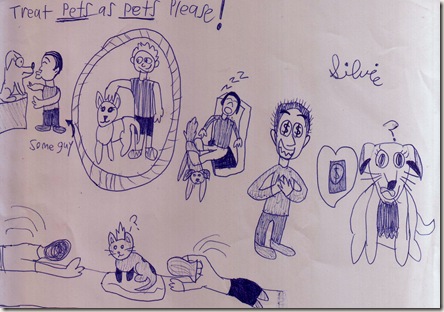
Silvie’s picture about not treating your dog better than your kid.


bildo0001

Silvie (John's daughter) speaking.

Updated title because:

1. I have always hated PETA. Don't know why dad chose that title...
2. Dad utterly missed the point of the drawing. It was drawn out of outrage after seeing someone treat their dog better than their kid. Sure, it was a cartoon. But some people probably actually do that in real life.
3. No mislead person would see fit to comment on a drawing that was misinterpreted to begin with.

Thank you and goodnight.

Silvie’s Impression of Her Father’s Problems

bildo

Dunnville's Commemoration of the Master's Visit to Montreal

Today's Badi' Blog Essay
Message from badijet@gmail.com:

We are having our annual commemoration of the Master's visit soon. Here is the letter to the editor sent to the local paper announcing this event by Betty Frost on behalf of the LSA of Haldimand.


To the Editor
 
This coming Wednesday, September 8th marks a very special time for the Baha'is of Canada as it is one of the days in the 11 day period which 'Abdu'l-Baha, Son of the Founder of the Baha'i Faith, spent in Canada in 1912.
 
From His early childhood he had suffered prison, being exiled on four occasions and undergoing innumerable trials and difficulties. It was not until the downfall of the Ottoman empire (Turkish) and the subsequent release of all religious and political prisoners that He was able, in His 69th year, to make the eagerly anticipated visit to the Americas. For many months He visited various parts of the United States often giving two or three talks in a day to people coming from all different backgrounds and religions eager to hear His voice.
 
Although only a short time could be spent in Canada, His visit to Montreal was a memorable one. He spoke in some large homes and in a number of Churches and other halls where people gathered to hear the "Apostle of Peace". Many newspaper articles appeared describing His talks, one of which said:
 
"'Abdu'l-Baha has preached Universal Peace for fifty years...In a word, 'Abdu'l-Baha is the great protagonist of Peace in the world today. To bring about its accomplishment is the practical corollary of the two tenets which are the foundation of his creed - the Fatherhood of God and the brotherhood of man. For forty years he was persecuted for preaching it...." The article goes on to say that although He preached peace, He was very much aware that Europe was a tinder box and that a war would certainly break out.
 
Despite the fact that He had never spoken from a public platform before, His talks in the various places He visited are remarkably diverse and form a large body of inspiring literature. In fact our community has been advised to concentrate this year on the specific concept of the need to regard all of humanity even as one family. 'Abdu'l-Baha said: "See ye no strangers, rather see all men as friends, for love and unity come hard when ye fix your gaze on otherness."
 
When He was leaving Chicago in May of that year He said to the believers: "Be in perfect unity. Never become angry with one another.... Love the creatures for the sake of God and not for themselves... Humanity is not perfect. There are imperfections in every human being and you will always become unhappy if you look towards the people themselves. But if you look toward God you will love them, and be kind to them....Therefore do not look at the shortcomings of anybody; see with the sight of forgiveness. The imperfect eye beholds imperfections...."
 
This, of course, is only part of what was said. When we meet together next Wednesday at 8:00 p.m. in the Garfield Disher Room of Dunnville's Library, we will no doubt hear many other inspirational words. We hope that you will join us. A social hour and refreshments will ensue.
 
Betty Frost
Haldimand Baha'i Community
AROUND TOWN
Wed. Sept.  8
 
You are warmly invited to enjoy the commemoration of the visit of the son of the Founder of the Baha'i Faith, 'Abdu'l Baha in 1912.  The meeting will take place in the Garfield Disher Room of Dunnville's Library at 8:00 p.m.  The talk and slides will focus on His teaching about the need to regard all of humanity as one family. 


::


Google Docs makes it easy to create, store and share online documents, spreadsheets and presentations.
Logo for Google Docs

Universal Consultancy


Pansophy


Pansophy and the Right to Counsel


By John Taylor; 2010 Aug 28, Asma 08, 167 BE
 

As an educator, John Amos Comenius believed that a world government could only persist if it is upheld by universal education. We all are born with brains, so school must be for all, young and old, rich and poor, throughout life. In developed nations this no longer sounds as radical as it did in the 17th Century; however, Comenius even asserted a kind of "right to counsellors," where even those who are not full time students are obliged to take full advantage of the best advice available.

We already recognize a limited version of the right to advice if a person is threatened by serious illness or a long prison sentence. Court systems in most developed nations today recognize a right to counsel if an individual is charged with a serious crime. Poor or disadvantaged persons get a court-appointed lawyer, paid for by the state, to defend their life. What Comenius suggested was that we broaden this right to counsel so as to make wisdom universal.

At first glance, paying for advisors for the poor seems like an extravagant expense. However, it could be justified for the same reasons that preventive medicine is known to be cheaper and more efficient in the long run. As the documentary film "Sicko" dramatizes, the American health care system is the most expensive in the world because it waits to intervene only when health is in rapid decline. Meanwhile, the much poorer Cubans are healthier overall because their doctors work to keep the people healthier in the first place.
 
Thus a wise society would retain advisors all the time, cradle to grave, in order to help the populace avoid choices that lead to disastrous decline. It is cheaper to teach people to avoid situations where crime can occur than to pay for trials, restitution and prisons. A universal right to advice would also put us in a position to completely avert other clear and present dangers to life and limb, such as accidents, illnesses, suicide and even unhappiness.

Of course, the roots of this imperative are found in Biblical wisdom literature, "Hear counsel, and receive instruction, that thou mayest be wise in thy latter end." (Prov 19:20-22, KJV) And, according to Plato, it is a basic aim of the rule of law to uphold wisdom.

"... it was ignorance, in its greatest form, which at that time destroyed the power we have described ... it follows that the lawgiver must try to implant in States as much wisdom as possible, and to root out folly to the utmost of his power." (R.G. Bury, tr., Laws, 688e)

Another translation puts this passage in the Laws more emphatically:

"A legislator's aim must be to create all the wisdom he can in a community, and with all his might to eradicate unwisdom." (Laws, 688, Collected Writings, p. 1283)

Comenius agreed with his predecessors that our chief aim must be to establish wisdom and to steer away from folly. The way to do this, he believed, would be to uphold what he called pansophy, or universal wisdom. Pansophy is an order of magnitude more powerful than just wisdom for a few. The services of experts and the wise are for everybody, not just a wealthy few; they must be available all the time, not just on special occasions. If each and all had the benefit of many advisors, everybody would become an active advocate of wisdom. We would know our own dignity, we would defend ourselves from error, and corruption would be completely eliminated. This, Comenius believed, would clear our perceptions, since folly corrupts both mind and soul.

"Since human nature has been blinded by its corruption, my Universal Education discussed how it should be safeguarded from downfall by wise guidance, and all its senses kept open to everything..." (Comenius, Panorthosia II, Ch. 9, para 11, pp. 146-147)

Nowadays science allows us to clarify and magnify our senses with great efficiency. We can set up an almost unlimited array of sensors, RFID devices, dials, readouts and other indicators to enhance our senses and memory. As electronics becomes more miniaturized and sophisticated, these sensory devices become cheaper and more common. I think Comenius would point out, though, that this is not the same as wisdom. Indeed, having a flood of sensory data at our fingertips only increases our need for wise intervention by human sages. Each of us needs a skilled teacher at every stage of our development to dispense the right advice at just the right time.

Establishing a universal right to good advice would empower each new generation to put a final end to dangers that now seem to be engrained in human nature. For example, the World Health Organization says that the two most common dangers to human health are tobacco and alcohol (including other substance abuse, legal and otherwise). What youth, properly guided, would voluntarily choose to sacrifice their own well being by becoming an addict in order to perpetuate a blight to human health? Indeed, even if tobacco, alcohol and other substances were only substantially reduced, the expense of paying for advisors for everybody would be more than justified.

What then would a broader right to counsel entail?

It is axiomatic that the more complex the task, the more one stands in need of wise consultants. Modern life is complicated, so whenever we take a step, we should keep at hand at least one advisor. Today we call them by various names, consultants, tutors, mentors, fitness trainers, life coaches and guidance counsellors, but the point is that the first thing we hear about any decision must be nothing less than the best advice available. What is more, that advisor needs to be there when a choice is taken. She needs to be standing nearby, as it were, as every future smoker considers lighting up his first cigarette.


The Right and Obligation to Tutelage


The right to counsel, Comenius further held, entails at least one generalist advisor for each of the three main tasks of life, to maintain a good relationship with oneself, with other people and with our God (or, for non-believers, with our future, with long term considerations). Each relation must be well maintained in order to live a balanced, creative life. Plato recognized that this internal three-fold responsibility extends out into our social relations,

"A legislator should have three aims in his enactments -- the society for which he makes them must have freedom, it must have amity with itself, must have understanding." (Laws, 701d)
 

A good consultant in one of the three areas needs to be a generalist, wise in dispensing advice but also trained to recognize when more specialized advice is required.
 
The Comenian right to advice makes a slight but crucial adjustment to the criteria by which we call upon an advisor.

Today we operate on the principle that the more important the job, the greater the need for advice. Those with the most responsible positions retain entire counsels of advisors. Meanwhile, the poor, whose jobs if they exist at all, tend to be manual and inconsequential, are deemed to be in the least need of advice. A Comenian system takes on a slightly different operating principle: the more difficult the job, the more we stand in need of advice.

That way, since poverty is by far the most difficult human condition, anyone in danger of poverty will be understood to be in greater need of the best advice. The rich, whose lives are easier than the poor, need fewer advisors. The indigent and those in danger of falling into poverty will get the best counselors first.

::