Conference and Tablet
By John Taylor; 2008 Oct 06, 09 Mashiyyat 165 BE
Sexuality and Homosexuality Conference
This weekend my daughter Silvie and I attended the spirituality and sexuality conference officially named "Spiritual Identity as a Path for Transcending Differences" at McMaster University. I blogged the announcement for this meeting on the Badi' Blog already at http://badiblog.blogspot.com/2008/09/sexuality-conference.html
Another Canadian blogger has provided more information on the upcoming annual meeting of BNASAA, one of the groups who sponsored this conference, which will take place in Louhelen at: http://bahailifecoach.blogspot.com/
All during the weekend I thought that BNASAA (Baha'i Network on AIDS, Sexuality, Addictions and Abuse) was an American group, but to my surprise I found out, on visiting their website http://www.bnasaa.org/ that they are a committee of the NSA of Canada. The website is new and very much, as they say, a work in progress. They can be contacted at: bnasaa@sympatico.ca.
The speaker for the entire time was a psychotherapist, Mary Kay Radpour, of Chattanooga, Tennessee. She made some impressive points about sex and homosexuality, much of which was new to me. Her anecdotes about the harrowing experiences of sexual abuse that some of her patients courageously suffered had us in tears. I especially liked her story about the fear of God, as explained by a Hand of the Cause -- I think it was Mr. Khadem -- who lived in her community when she was a Baha'i youth. Though she was shy, he encouraged her, saying that she would make an excellent teacher. Can you imagine anything better to put on a Baha'i teacher's resume? Of course it puts pressure on us, her listeners too. If you were to say, `No, the Hand of the Cause was wrong, I did not get anything out of what she told us,' immediately suspicion of denseness would fall on you, not on her or the Hand. Fortunately, I can say that I did get a great deal out of the meetings.
Dr. Radpour made use of a full blown shrink's vocabulary and I periodically had to lean over to explain to my daughter the meaning of words like "cleavage" and "pedophilia," usually followed by an embarrassingly loud "Eeeuww!" or "Yuck!" I wondered how much she got out of it until, on the evaluation form, she wrote: "It exceeded my expectations!"
Tablet of Baha'u'llah: "Preference and Distinction have laid waste the world..."
The conference distributed a handout from BNASAA (pronounced "bunasa"), most of which is to be found in the blog entries and websites that I linked to at the start of this post. One quote from the Writings of Baha'u'llah that they use as a headpiece is not there. I had come across it before, but in the context of homosexuality and abuse it seems particularly apt. It is from an "untranslated tablet," which was evidently not translated until 1979 -- very surprising in view of its force, universality and importance in understanding the Baha'i principle of equality. Here it is, in the earliest appearance I could find:
"And amongst the realms of unity is the unity of rank and station. It redoundeth to the exaltation of the Cause, glorifying it among all peoples. Ever since the seeking of preference and distinction came into play, the world hath been laid waste. It hath become desolate. Those who have quaffed from the ocean of divine utterance and fixed their gaze upon the Realm of Glory should regard themselves as being on the same level as the others and in the same station. Were this matter to be definitely established and conclusively demonstrated through the power and might of God, the world would become as the Abha Paradise.
"Indeed, man is noble, inasmuch as each one is a repository of the sign of God. Nevertheless, to regard oneself as superior in knowledge, learning or virtue, or to exalt oneself or seek preference, is a grievous transgression. Great is the blessedness of those who are adorned with the ornament of this unity and have been graciously confirmed by God." (Unpublished Tablet, cited in "Elucidation of Baha'i Teachings on Ranks and Stations," 27 March 1978, Universal House of Justice to all NSA's, Messages 1963 to 1986, 206.3a, 206.3b, pp. 376-377)
Monday, October 06, 2008


Incident from Baha'i history

I permit drawing pictures during our daily Baha'i class (just my two kids attend), which tends to be pretty heavy going at times for the little guy. This is 9 year old Tomaso's depiction drawn last night of Mirza Buzorg visiting the soothsayer in order to find out the meaning of his strange dream about his son, Husayn Ali, floating in the ocean his hair connected to many fishes. Tomaso's 14 year old sister objected that in the speech bubble is a depiction of the Manifestation of God as a baby, which is not permitted.
I personally think a little latitude has to be permitted in these things, don't you?
Sunday, October 05, 2008
Ask yourself: Am I Praying Enough? II
Ask yourself: Am I Praying Enough? II
2008 Oct 05, 08 Mashiyyat 165 BE
Last time I posted the question: "Ask yourself: Am I Praying Enough?" This issue has been nagging at me, especially in view of what the Bab said, "The prolongation of prayer has never been beloved of God," and the saying from the Aqdas, "Pride not yourselves on much reading of the verses or on a multitude of pious acts..." which is plastered over the back cover of one of our prayer books (Remembrance of God). These, it seems to me, are delimiting statements, saying that you are not doing yourself or anybody else any good by praying one minute longer than that elusive "state of prayer" lasts in the heart. Worship and pious deeds, unlike God Himself, are not goods in themselves, they have a purpose.
But before you consider limiting prayer you have to confront prior questions, like, "How do I know when I have reached the point of diminishing returns?" Or before that, "How do I know when I have reached the state of prayer in the first place?" It may take no time, or several hours just to wash away the myriad distractions and dullness of ordinary consciousness. Then you can start thinking about how long to continue the prayer. Just as with sex and lovemaking, it takes a long period of slow, building effort, of "seduction" or "foreplay" to get into the mood for prayer. The beauty of it is that very often getting into the mood is itself the answer to the prayer. Whatever the question or problem we hope to resolve with our prayer; we learn in this state to be conscious of what the Master said, that,
"With a glance He cures a hundred thousand ills..."
Prayer, then, is like when an actor stops rehearsal and talks his interpretation over with the director (the higher self), or if he gets really stuck or is very lucky, with the divine Playwright Himself. All your world is a stage, but to do well out on that stage it is best to take advantage of all the preparation and coaching available.
The question remains, though, how much is enough? Last time I noted that when Abdu'l-Baha was in London He got sick for a time and one of his secretaries reported on His daily routine, saying, "Every evening at midnight or after midnight (He) gets up and for at least two hours he prays and communes with the Infinite and when He gets up in the morning, he again prays for more than an hour."
This was what vexed me and set me thinking about this quandary, am I praying enough? The Master in face of that particular problem of falling ill in the London fog just before He was supposed to leave for Edinburgh (or was the secretary saying that He did it every day?) prayed alone in the night at least two hours, then woke and prayed one hour more. So, presumably if I am better, more perfect, more spiritual than Abdu'l-Baha, it might take me less time to get into the state of prayer and less time to have my consultation with my director and playwright before I go back out on stage to perform. Otherwise, if I am not yet at His level, I would think that it would take more time, not less. That means at least three hours of prayer every day and the lower my development the more time in prayer. I thought about that and decided to try increasing my time spent praying.
Later I will tell you about what happened with my little experiment.
2008 Oct 05, 08 Mashiyyat 165 BE
Last time I posted the question: "Ask yourself: Am I Praying Enough?" This issue has been nagging at me, especially in view of what the Bab said, "The prolongation of prayer has never been beloved of God," and the saying from the Aqdas, "Pride not yourselves on much reading of the verses or on a multitude of pious acts..." which is plastered over the back cover of one of our prayer books (Remembrance of God). These, it seems to me, are delimiting statements, saying that you are not doing yourself or anybody else any good by praying one minute longer than that elusive "state of prayer" lasts in the heart. Worship and pious deeds, unlike God Himself, are not goods in themselves, they have a purpose.
But before you consider limiting prayer you have to confront prior questions, like, "How do I know when I have reached the point of diminishing returns?" Or before that, "How do I know when I have reached the state of prayer in the first place?" It may take no time, or several hours just to wash away the myriad distractions and dullness of ordinary consciousness. Then you can start thinking about how long to continue the prayer. Just as with sex and lovemaking, it takes a long period of slow, building effort, of "seduction" or "foreplay" to get into the mood for prayer. The beauty of it is that very often getting into the mood is itself the answer to the prayer. Whatever the question or problem we hope to resolve with our prayer; we learn in this state to be conscious of what the Master said, that,
"With a glance He cures a hundred thousand ills..."
Prayer, then, is like when an actor stops rehearsal and talks his interpretation over with the director (the higher self), or if he gets really stuck or is very lucky, with the divine Playwright Himself. All your world is a stage, but to do well out on that stage it is best to take advantage of all the preparation and coaching available.
The question remains, though, how much is enough? Last time I noted that when Abdu'l-Baha was in London He got sick for a time and one of his secretaries reported on His daily routine, saying, "Every evening at midnight or after midnight (He) gets up and for at least two hours he prays and communes with the Infinite and when He gets up in the morning, he again prays for more than an hour."
This was what vexed me and set me thinking about this quandary, am I praying enough? The Master in face of that particular problem of falling ill in the London fog just before He was supposed to leave for Edinburgh (or was the secretary saying that He did it every day?) prayed alone in the night at least two hours, then woke and prayed one hour more. So, presumably if I am better, more perfect, more spiritual than Abdu'l-Baha, it might take me less time to get into the state of prayer and less time to have my consultation with my director and playwright before I go back out on stage to perform. Otherwise, if I am not yet at His level, I would think that it would take more time, not less. That means at least three hours of prayer every day and the lower my development the more time in prayer. I thought about that and decided to try increasing my time spent praying.
Later I will tell you about what happened with my little experiment.
Saturday, October 04, 2008
How much prayer is enough?
"Created half to rise and half to fall;
Great lord of all things, yet a prey to all;
Sole judge of truth, in endless error hurled:
The glory, jest, and riddle of the world!
(Alexander Pope, "Know Thyself," http://www.poetsgraves.co.uk/Classic%20Poems/Pope/know% 20thyself.htm)
Ask yourself: Am I Praying Enough?
When Abdu'l-Baha was in London, preparing to leave for Scotland, His secretary reported the following summary of His daily routine in a letter to a believer in New York.
"This morning when I entered in the Presence of Our Lord I found him indisposed. Last night, he said, he could not sleep he had fever, the climate not agreeing with Him. I was very sorry but he came out at about 9 o'clock the interviews started. Every evening at midnight or after midnight, Our Beloved gets up and for at least two hours he prays and communes with the Infinite and when He gets up in the morning, he again prays for more than an hour. Does not this teach us a lesson in prayer with God, Our Master who sustains us, provides for us and protects us?" (Abdu'l-Baha in Edinburgh - Sohrab's Diary Letters by Ahmad Sohrab Edited by David Merrick. http://bahai-library.com/file.php5?file=ahmadsohrab_diary_edinburgh_1913&language=All)
"Referring to the Tablet of Baha'u'llah which was revealed in Sulaymaniyyih and which began 'Create in me a pure heart, 0 my God, . . .', 'Abdu'l-Baha said: `When, for the first time, I read this Tablet, I wept openly.'" (Diya Baghdadi, unpublished memoir, cited in Stories of Baha'u'llah, Compiled and Edited by Ali-Akbar Furutan, tr. Katayoon and Robert Krerar, George Ronald, Oxford, 1986, #27, p. 20)
"Create in me a pure heart, O my God, and renew a tranquil conscience within me, O my Hope! Through the spirit of power confirm Thou me in Thy Cause, O my Best-Beloved, and by the light of Thy glory reveal unto me Thy path, O Thou the Goal of my desire! Through the power of Thy transcendent might lift me up unto the heaven of Thy holiness, O Source of my being, and by the breezes of Thine eternity gladden me, O Thou Who art my God! Let Thine everlasting melodies breathe tranquillity on me, O my Companion, and let the riches of Thine ancient countenance deliver me from all except Thee, O my Master, and let the tidings of the revelation of Thine incorruptible Essence bring me joy, O Thou Who art the most manifest of the manifest and the most hidden of the hidden!" (Baha'u'llah, Prayers and Meditations, CLV, p. 248)
Great lord of all things, yet a prey to all;
Sole judge of truth, in endless error hurled:
The glory, jest, and riddle of the world!
(Alexander Pope, "Know Thyself," http://www.poetsgraves.co.uk/Classic%20Poems/Pope/know% 20thyself.htm)
Ask yourself: Am I Praying Enough?
When Abdu'l-Baha was in London, preparing to leave for Scotland, His secretary reported the following summary of His daily routine in a letter to a believer in New York.
"This morning when I entered in the Presence of Our Lord I found him indisposed. Last night, he said, he could not sleep he had fever, the climate not agreeing with Him. I was very sorry but he came out at about 9 o'clock the interviews started. Every evening at midnight or after midnight, Our Beloved gets up and for at least two hours he prays and communes with the Infinite and when He gets up in the morning, he again prays for more than an hour. Does not this teach us a lesson in prayer with God, Our Master who sustains us, provides for us and protects us?" (Abdu'l-Baha in Edinburgh - Sohrab's Diary Letters by Ahmad Sohrab Edited by David Merrick. http://bahai-library.com/file.php5?file=ahmadsohrab_diary_edinburgh_1913&language=All)
"Referring to the Tablet of Baha'u'llah which was revealed in Sulaymaniyyih and which began 'Create in me a pure heart, 0 my God, . . .', 'Abdu'l-Baha said: `When, for the first time, I read this Tablet, I wept openly.'" (Diya Baghdadi, unpublished memoir, cited in Stories of Baha'u'llah, Compiled and Edited by Ali-Akbar Furutan, tr. Katayoon and Robert Krerar, George Ronald, Oxford, 1986, #27, p. 20)
"Create in me a pure heart, O my God, and renew a tranquil conscience within me, O my Hope! Through the spirit of power confirm Thou me in Thy Cause, O my Best-Beloved, and by the light of Thy glory reveal unto me Thy path, O Thou the Goal of my desire! Through the power of Thy transcendent might lift me up unto the heaven of Thy holiness, O Source of my being, and by the breezes of Thine eternity gladden me, O Thou Who art my God! Let Thine everlasting melodies breathe tranquillity on me, O my Companion, and let the riches of Thine ancient countenance deliver me from all except Thee, O my Master, and let the tidings of the revelation of Thine incorruptible Essence bring me joy, O Thou Who art the most manifest of the manifest and the most hidden of the hidden!" (Baha'u'llah, Prayers and Meditations, CLV, p. 248)
Friday, October 03, 2008
Monthly Public Meeting in Dunnville
Baha'i Principles Series
Physicians Cure the World
Worldwide ills require universal cures
prescribed by a wise physician.
The human race has not been left alone at any time
in history in its search for such doctors.
Presenter: Joseph Woods
Tuesday, Oct 14, 2008
8 PM
Garfield Disher Room,
Dunnville Public Library
Physicians Cure the World
Worldwide ills require universal cures
prescribed by a wise physician.
The human race has not been left alone at any time
in history in its search for such doctors.
Presenter: Joseph Woods
Tuesday, Oct 14, 2008
8 PM
Garfield Disher Room,
Dunnville Public Library
Eradicating Indigence
NSA's Poverty Eradication Suggestions; Tablet of Master on Economics
By John Taylor; 2008 Oct 03
October 17th is the International Day for the Eradication of Poverty, a day established by the United Nations General Assembly. The Baha'i National Spiritual Assembly of Canada has asked communities to think about this special day and report to them any activities we may sponsor. In a letter written on the NSA's behalf back in August, their director of external affairs wrote,
"This day presents an opportunity to acknowledge the struggles of people living in poverty, and a chance for the Baha'i community to raise awareness of the worldwide efforts to eradicate poverty and to share some of what the Baha'i community is learning as we strive to apply Baha'i principles to current social issues. The United Nations Office of the Baha'i International Community, in drawing attention to this international day, points out that October 16th is World Food Day, suggesting these two days be commemorated together."
Here in Dunnville we do this a little earlier. This weekend the Salvation Army holds its annual sleepover in the park (that is, Central Park, just across from the Taylor family mansion) in order to raise money for and awareness of homelessness. Our family is sponsoring one of the Baha'i youth in our community as she (and many other participants do too) sleeps over one night in a cardboard box, just like the indigent do every night. It is getting cold enough that this will not be an easy sleepover.
The Badi' Blog featured not long ago a biting bit of satire from a book called "What White Folks Like" that pointed out that this generation uses "raising awareness" as an excuse for doing things we like in the name of a good cause, thus removing all guilt. For example, if we like bicycling, we will hold a bike rally for charity. In that case, our attempt at consciousness-raising is nothing better than an empty gesture, a way of avoiding sacrifice, struggle, or doing anything substantive or even strenuous for the common good. But in this cause, the cause of raising awareness for the less fortunate, we Baha'is have divine sanction in the form of the following Hidden Word of Baha'u'llah,
"O Children of Dust! Tell the rich of the midnight sighing of the poor, lest heedlessness lead them into the path of destruction, and deprive them of the Tree of Wealth."
The NSA suggests that we could have some sort of educational activity to do the consciousness raising that the Hidden Word suggests, or perhaps hold a meeting to "evaluate the level of community interest" in the elimination of poverty. They also offer the following ideas for activities on this day,
-- Share the Baha'i International Community's perspective on poverty with the public, with municipal governmental contacts or non-governmental organizations (see the document "Eradicating Poverty: Moving Forward as One" at: www.bic.org).
-- Participate in events to commemorate the International Day for the Eradication of Poverty should any be held in your area
-- Provide this information to Baha'is in your community through your website or newsletter. (Which is what I am doing right here on the Badi' Blog)
-- Organize an event, such as a panel, workshop or conference to convey and discuss the Baha'i perspective on eradicating poverty
-- Organize a deepening on the Poverty Statement for the members of your Baha'i community.
Let me close with the full text of a Tablet the Master wrote when the young Shoghi Effendi, just graduated from a Beirut university with a master's degree in arts and sciences, was working as His secretary. This letter was written to a believer who was giving talks on economics. In it, Abdu'l-Baha briefly discusses two important aspects of the Baha'i view of how to eradicate poverty. In the first He makes the point, rarely mentioned even today, that the rich, even the super-rich, stand to benefit from economic equity as much as the poor.
His second point just blew me away when I read it lately: the Master gives details about how profit sharing would work that I never noticed before. There are many forms of profit sharing in companies around the world, but I highly doubt that they work anything like what the Master suggests here. This plan truly looks like it would offer a heavy incentive to workers to perform their very best. Amazing!
==========
from: Star of the West, v. 10, p. 329-330
Headline: "Recent Tablet from Abdul Baha to Alfred E. Lunt"
To his honor, imr. Alfred Lunt, Boston, Massachusetts Upon him be BAHA'O'LLAH El Abha!
O thou who art firm in the Covenant!
Rest thou assured in the bounty of the Merciful, and be hopeful for the blessings of the Abha Kingdom, for thou dost exert the utmost effort in service for Truth and this magnet attracts assistance and confirmation. The addresses thou hast delivered with reference to economic problems are highly suitable.
The essence of the Baha'i economic teachings is this, that immense riches far beyond what is necessary should not be accumulated. For instance, the well known Morgan, who possessed a sum of three hundred millions, and was day and night restless and agitated, did not partake of the divine bestowals save a little broth. This wealth was for him a vicissitude and not the cause of comfort. He invited me to his library and to his home, that I might visit the former and have dinner at his house. I went to the library in order to look at the Oriental books, but did not go to his house, and did not accept his invitation.
In short, he eagerly desired that I should visit him in the library but meanwhile important financial problems arose which prevented him from being present, and thus he was deprived of this bounty. Now, had he not such an excessive amount of wealth, he might have been able to present himself.
As to the events that had been predicted -- Praise be to God! all of them have come to pass, and all that had been the explicit and irrefutable declarations of His Holiness BAHAOLLAH, and had been incorporated in the addresses of Abdul Baha in America and Europe, all of them, word by word, have been fulfilled. These explicit declarations of His Holiness BAHAOLLAH were revealed fifty years ago by the Supreme Pen, and at present they have been made evident and manifest.
At present, thou hast a lofty aspiration, and hast the desire to engage in every service. My hope is, that through a heavenly power, and a Lordly influence, and by the assistance of the Holy Spirit thou mayst be confirmed in distinguished services a service which thou dost think advisable and its success assured.
Thou hadst inquired that if a person owned a piece of land and is not able to develop it, and his revenues are less than his expenditures, is it permissible that he sell a portion of that land and mortgage it? Undoubtedly, it is permissible.
Concerning the case of profit sharing by the employers among the workers, which thou hadst written about, undoubtedly the workers must secure their daily salary, and in addition, must have shares with the employers so that they may engage with the utmost effort in that work. For example, a capitalist has a thousand employees, he must give them a moderate salary every day, that they may not remain hungry and naked, and also assign a definite share of the profit to the workers so that at the beginning of each year it may be distributed among them, that this may cause the workers to exert the utmost care and effort in their job.
Embrace on my behalf thy sweet children, and name the son Hossein, for it is a portion of the name of the Blessed Beauty, and call the daughter Zahrah.
The letter thou hast written to the Boston paper is highly pleasing and favorable.
Upon thee be Baha El Abha!
(SIGNED) ABDUL BAHA ABBAS.
(Translated by Shoghi Rabbani, Bahjeh, Acca, Palestine, July 22, 1919)
By John Taylor; 2008 Oct 03
October 17th is the International Day for the Eradication of Poverty, a day established by the United Nations General Assembly. The Baha'i National Spiritual Assembly of Canada has asked communities to think about this special day and report to them any activities we may sponsor. In a letter written on the NSA's behalf back in August, their director of external affairs wrote,
"This day presents an opportunity to acknowledge the struggles of people living in poverty, and a chance for the Baha'i community to raise awareness of the worldwide efforts to eradicate poverty and to share some of what the Baha'i community is learning as we strive to apply Baha'i principles to current social issues. The United Nations Office of the Baha'i International Community, in drawing attention to this international day, points out that October 16th is World Food Day, suggesting these two days be commemorated together."
Here in Dunnville we do this a little earlier. This weekend the Salvation Army holds its annual sleepover in the park (that is, Central Park, just across from the Taylor family mansion) in order to raise money for and awareness of homelessness. Our family is sponsoring one of the Baha'i youth in our community as she (and many other participants do too) sleeps over one night in a cardboard box, just like the indigent do every night. It is getting cold enough that this will not be an easy sleepover.
The Badi' Blog featured not long ago a biting bit of satire from a book called "What White Folks Like" that pointed out that this generation uses "raising awareness" as an excuse for doing things we like in the name of a good cause, thus removing all guilt. For example, if we like bicycling, we will hold a bike rally for charity. In that case, our attempt at consciousness-raising is nothing better than an empty gesture, a way of avoiding sacrifice, struggle, or doing anything substantive or even strenuous for the common good. But in this cause, the cause of raising awareness for the less fortunate, we Baha'is have divine sanction in the form of the following Hidden Word of Baha'u'llah,
"O Children of Dust! Tell the rich of the midnight sighing of the poor, lest heedlessness lead them into the path of destruction, and deprive them of the Tree of Wealth."
The NSA suggests that we could have some sort of educational activity to do the consciousness raising that the Hidden Word suggests, or perhaps hold a meeting to "evaluate the level of community interest" in the elimination of poverty. They also offer the following ideas for activities on this day,
-- Share the Baha'i International Community's perspective on poverty with the public, with municipal governmental contacts or non-governmental organizations (see the document "Eradicating Poverty: Moving Forward as One" at: www.bic.org).
-- Participate in events to commemorate the International Day for the Eradication of Poverty should any be held in your area
-- Provide this information to Baha'is in your community through your website or newsletter. (Which is what I am doing right here on the Badi' Blog)
-- Organize an event, such as a panel, workshop or conference to convey and discuss the Baha'i perspective on eradicating poverty
-- Organize a deepening on the Poverty Statement for the members of your Baha'i community.
Let me close with the full text of a Tablet the Master wrote when the young Shoghi Effendi, just graduated from a Beirut university with a master's degree in arts and sciences, was working as His secretary. This letter was written to a believer who was giving talks on economics. In it, Abdu'l-Baha briefly discusses two important aspects of the Baha'i view of how to eradicate poverty. In the first He makes the point, rarely mentioned even today, that the rich, even the super-rich, stand to benefit from economic equity as much as the poor.
His second point just blew me away when I read it lately: the Master gives details about how profit sharing would work that I never noticed before. There are many forms of profit sharing in companies around the world, but I highly doubt that they work anything like what the Master suggests here. This plan truly looks like it would offer a heavy incentive to workers to perform their very best. Amazing!
==========
from: Star of the West, v. 10, p. 329-330
Headline: "Recent Tablet from Abdul Baha to Alfred E. Lunt"
To his honor, imr. Alfred Lunt, Boston, Massachusetts Upon him be BAHA'O'LLAH El Abha!
O thou who art firm in the Covenant!
Rest thou assured in the bounty of the Merciful, and be hopeful for the blessings of the Abha Kingdom, for thou dost exert the utmost effort in service for Truth and this magnet attracts assistance and confirmation. The addresses thou hast delivered with reference to economic problems are highly suitable.
The essence of the Baha'i economic teachings is this, that immense riches far beyond what is necessary should not be accumulated. For instance, the well known Morgan, who possessed a sum of three hundred millions, and was day and night restless and agitated, did not partake of the divine bestowals save a little broth. This wealth was for him a vicissitude and not the cause of comfort. He invited me to his library and to his home, that I might visit the former and have dinner at his house. I went to the library in order to look at the Oriental books, but did not go to his house, and did not accept his invitation.
In short, he eagerly desired that I should visit him in the library but meanwhile important financial problems arose which prevented him from being present, and thus he was deprived of this bounty. Now, had he not such an excessive amount of wealth, he might have been able to present himself.
As to the events that had been predicted -- Praise be to God! all of them have come to pass, and all that had been the explicit and irrefutable declarations of His Holiness BAHAOLLAH, and had been incorporated in the addresses of Abdul Baha in America and Europe, all of them, word by word, have been fulfilled. These explicit declarations of His Holiness BAHAOLLAH were revealed fifty years ago by the Supreme Pen, and at present they have been made evident and manifest.
At present, thou hast a lofty aspiration, and hast the desire to engage in every service. My hope is, that through a heavenly power, and a Lordly influence, and by the assistance of the Holy Spirit thou mayst be confirmed in distinguished services a service which thou dost think advisable and its success assured.
Thou hadst inquired that if a person owned a piece of land and is not able to develop it, and his revenues are less than his expenditures, is it permissible that he sell a portion of that land and mortgage it? Undoubtedly, it is permissible.
Concerning the case of profit sharing by the employers among the workers, which thou hadst written about, undoubtedly the workers must secure their daily salary, and in addition, must have shares with the employers so that they may engage with the utmost effort in that work. For example, a capitalist has a thousand employees, he must give them a moderate salary every day, that they may not remain hungry and naked, and also assign a definite share of the profit to the workers so that at the beginning of each year it may be distributed among them, that this may cause the workers to exert the utmost care and effort in their job.
Embrace on my behalf thy sweet children, and name the son Hossein, for it is a portion of the name of the Blessed Beauty, and call the daughter Zahrah.
The letter thou hast written to the Boston paper is highly pleasing and favorable.
Upon thee be Baha El Abha!
(SIGNED) ABDUL BAHA ABBAS.
(Translated by Shoghi Rabbani, Bahjeh, Acca, Palestine, July 22, 1919)
Thursday, October 02, 2008
Sheltering Ourselves from the Crash
Thoughts about the Stock Market Crash
By John Taylor; 2008 Oct 01
To make the Badi' blog topical I will address the big headline of the past couple of days, the stock market crash that threatens to turn an economic downturn into another Great Depression. This head over heels tumble over the brink started, as often happens, with a small stumble, a housing bubble followed by a mortgage insurance scam gone wrong. Throughout the financial system, bankers and other lenders are afraid to offer credit.
As always, what seems at first blush to be an outer, material concern is really a faith issue. The human spirit depends upon belief in the future, faith that our efforts will have meaning under a benevolent providence and that in the long run we will attain happiness. In the same way the economy depends upon an invisible belief in one another. This faith, the foundation of credit, is under grave threat. A crash comes when enough lenders cease to believe in other peoples' creditworthiness.
In order to avoid a meltdown a bailout scheme was devised, modified, rejected and may soon be modified again by an American government sadly weakened by partisan squabbling, corruption and blind ideology. My favourite columnist, George Monbiot, points out the base hypocrisy of these legislators on whom the world depends to save the financial system, the banking and insurance industries, as well as the pension funds upon which workers depend for their retirement income. In his latest column he summarizes the huge amounts of corporate welfare these politicians hand out, all the while hypocritically claiming to be advocates of capitalism, discipline and free enterprise.
"... the Congressmen and women now railing against financial socialism depend for their re-election on the companies they subsidise. The legal bribes paid by these businesses deliver two short-term benefits. The first is that they prevent proper regulation, which allows them to make spectacular profits and to generate disasters of the kind that Congress is now confronting. The second is that public money which should be used to help the poorest and weakest is instead diverted into the pockets of the rich." (
Just as it was when Baha'u'llah wrote the kings of Europe, the world's wealth is being skimmed off not only into the pockets of the rich, but also into means to protect them, that is, arms research, weapons manufacture and oversize defence expenditures. At the same time those areas of the economy that affect us most, our homes, neighbourhoods and the infrastructure that maintains them, remain primitive, underfunded and neglected.
How can we reverse this flow of funds so that it goes into what is ultimately most productive, human beings, starting with the poorest and most in need? The basic moral lesson of this crisis is that materialism is a virus that needs vigorous measures to defeat. Like any disease, it is invisible. It attacks from where the eye cannot see; its fever permeates our thinking.
Another Monbiot essay called "Property Paranoia" discusses a "hedonic treadmill" that lulls the elites and the wannabe wealthy into giving their all for slight enrichment compared with their peers, ignoring the fact that any number of other sacrifices and investments would better conduce to what they are really after: happiness. Instead, the materialists forget ethics and the general good and even their own freedom and they scrape, cheat and scrimp for the almighty dollar.
"Comparison is not the only reason the professors of happiness cite for our failure to feel better as we become richer. They point to the fact that we become habituated to wealth: Layard calls this `the hedonic treadmill'. They blame the longer hours we work and our deteriorating relationships. But there is something I think they have missed: that wealth itself can become a source of deprivation. Having money enhances your freedom. You can travel further and you can do more when you get there. But other people's money restricts your freedom. Where you once felt free, now you find fences. In fact, you MUST travel further to find somewhere in which you can be free.
"As people become richer, and as they can extract more wealth from their property, other people become more threatening to them. We know that the fear of crime is a cause of unhappiness, but so is the sense of being seen as a potential criminal. The spikes and lights and cameras proclaim that society is not to be trusted, that we live in a world of Hobbesian relations. The story they tell becomes true, as property paranoia makes us hate each other. The harmless wanderer in the woods becomes a mortal enemy." (George Monbiot, "Property Paranoia", January 31, 2006)
Monbiot is absolutely right here, a spiritual poverty drains us of the ability to create real wealth -- which is love for our fellow man -- and exclusive, absolute ownership denies everybody of the right to enjoy goods by roaming through them. Sole land and home ownership are great evils, greater I think than even he realizes.
Materialism reflects from the heart out into the outer, built environment. It created this insidious, outmoded system of real estate. Housing for both rich and poor is badly designed, overpriced and underplanned. We unthinkingly use land and buildings as investments and collateral and do not worry if they do not perform their function. Housing infrastructure routinely sinks homeowners heavily into debt just to put a roof over their heads. We are addicted to precarious mortgages, easy credit, complex regulations and mortgage insurance, a complex arrangement that became a precarious house of cards that nobody understands. Earlier this year economist Paul Krugman fingered housing as the main precondition of this crisis,
"In effect, U.S. policy is based on the premise that everyone should be a homeowner. But here is the thing: There are some real disadvantages to homeownership. First of all, there is the financial risk. Although its rarely put this way, borrowing to buy a home is like buying stocks on margin: if the market value of the house falls, the buyer can easily lose his or her entire stake. This is not a hypothetical worry. From 2005 through 2007 alone -- that is, at the peak of the housing bubble more than 22 million Americans bought either new or existing houses. Now that the bubble has burst, many of those homebuyers have lost heavily on their investment. At this point there are probably around 10 million households with negative home equity that is, with mortgages that exceed the value of their houses." (Home Not-So-Sweet Home, by Paul Krugman, New York Times, June 23, 2008, http://www.nytimes.com/2008/06/23/opinion/23krugman.html?_r=1&th&emc=th&oref=slogin
Bad housing is both cause and symptom of our gravest ill, materialism. Krugman in the same article points out another ill effect of owning a freehold dwelling: it ties workers down so that they cannot readily go where they are most needed. This binds the entire economy and prevents the people and their leaders from reacting quickly to changing conditions.
"Owning a home also ties workers down. Even in the best of times, the costs and hassle of selling one home and buying another -- one estimate put the average cost of a house move at more than $60,000 -- tend to make workers reluctant to go where the jobs are. And these are not the best of times. Right now, economic distress is concentrated in the states with the biggest housing busts: Florida and California have experienced much steeper rises in unemployment than the nation as a whole. Yet homeowners in these states are constrained from seeking opportunities elsewhere, because it is very hard to sell their houses."
We should rethink everything. We need to change the whole housing system, and indeed the institution of exclusive ownership itself. If public corporations can have multiple shareholders, why not other possessions? Why, in an age of computers, do we still allow large items like land, houses, planes, trains and automobiles to rest solely in the hands of one owner, be it individual or corporation, exclusive of everybody else?
Many tries have been made to reform housing from the ground up, but they always fail. I recently toured one of the most interesting attempts, Buckminster Fuller's Dymaxion house, which is on display at the Henry Ford Museum near Detroit. I videotaped the entire experience and will make it available on YouTube sometime soon. Fuller understood that housing should be more mobile and high tech. The Dymaxion house is specifically designed, among other things, to be easily cleaned, to circulate the air and offer dwellers the largest possible view of its surroundings. Most importantly, it is not only prefabricated, it is also collapsible. It can be taken apart and reassembled on another location quickly and easily by a couple of workers. Such mobility would free up the workforce to do an end run around regional economic reverses. Everybody would go where they are most needed.
Because our houses are so fixed and grounded in dead earth we forget that more mobile lifestyle in an efficient, flexible dwelling would be the optimum green solution. Present houses are very wasteful, and located in places that force us to travel more than necessary. The more mobility we have in housing the less carbon and time are burned up by commuting long distances to work, as Krugman points out.
"Finally, there is the cost of commuting. Buying a home usually though not always means buying a single-family house in the suburbs, often a long way out, where land is cheap. In an age of $4 gas and concerns about climate change, that is an increasingly problematic choice."
Most important, increased public space, the right to roam and mobile housing would make us happier. Whatever our political rights, if we live in cramped, ugly surroundings we will never be free or happy. We will be prisoners confined all our lives by four walls stuck in the same locale. Ironically, as things are even the rich tend to be glued to one location longer than is good for them. Even the most beautiful mansion becomes tedious if it sits unchanged. Only the super-rich can afford to own several mansions. Multiple homes, as well as suburban sprawl among the middle class, lead to gross waste of space and further destruction of natural habitats.
Inadequate houses in lifeless neighbourhoods cause not only economic depressions like this one, but they are at the root of personal depression as well. Gloomy, stodgy living conditions are the root of the world's most common mental illness, depression. Recent studies have shown how important a good night's sleep is to mental health. Yet we allow noise to permeate our days as well as our nights. Quiet, along with heat, should be a requirement of every bedroom. In well designed houses this would happen as a matter of course, thus curing -- according to these convincing studies -- almost all mental illness.
I dream of a more flexible, open, high density housing system that would, like the dymaxion house, be extremely moveable. It could even change our surroundings automatically according to physical and psychological needs that we tend not to be aware of ourselves. At times everybody needs to be around nature, so why not have our homes move us near a park or into the country? If we crave community, let it plunk us into a vibrant city neighbourhood.
By John Taylor; 2008 Oct 01
To make the Badi' blog topical I will address the big headline of the past couple of days, the stock market crash that threatens to turn an economic downturn into another Great Depression. This head over heels tumble over the brink started, as often happens, with a small stumble, a housing bubble followed by a mortgage insurance scam gone wrong. Throughout the financial system, bankers and other lenders are afraid to offer credit.
As always, what seems at first blush to be an outer, material concern is really a faith issue. The human spirit depends upon belief in the future, faith that our efforts will have meaning under a benevolent providence and that in the long run we will attain happiness. In the same way the economy depends upon an invisible belief in one another. This faith, the foundation of credit, is under grave threat. A crash comes when enough lenders cease to believe in other peoples' creditworthiness.
In order to avoid a meltdown a bailout scheme was devised, modified, rejected and may soon be modified again by an American government sadly weakened by partisan squabbling, corruption and blind ideology. My favourite columnist, George Monbiot, points out the base hypocrisy of these legislators on whom the world depends to save the financial system, the banking and insurance industries, as well as the pension funds upon which workers depend for their retirement income. In his latest column he summarizes the huge amounts of corporate welfare these politicians hand out, all the while hypocritically claiming to be advocates of capitalism, discipline and free enterprise.
"... the Congressmen and women now railing against financial socialism depend for their re-election on the companies they subsidise. The legal bribes paid by these businesses deliver two short-term benefits. The first is that they prevent proper regulation, which allows them to make spectacular profits and to generate disasters of the kind that Congress is now confronting. The second is that public money which should be used to help the poorest and weakest is instead diverted into the pockets of the rich." (
Just as it was when Baha'u'llah wrote the kings of Europe, the world's wealth is being skimmed off not only into the pockets of the rich, but also into means to protect them, that is, arms research, weapons manufacture and oversize defence expenditures. At the same time those areas of the economy that affect us most, our homes, neighbourhoods and the infrastructure that maintains them, remain primitive, underfunded and neglected.
How can we reverse this flow of funds so that it goes into what is ultimately most productive, human beings, starting with the poorest and most in need? The basic moral lesson of this crisis is that materialism is a virus that needs vigorous measures to defeat. Like any disease, it is invisible. It attacks from where the eye cannot see; its fever permeates our thinking.
Another Monbiot essay called "Property Paranoia" discusses a "hedonic treadmill" that lulls the elites and the wannabe wealthy into giving their all for slight enrichment compared with their peers, ignoring the fact that any number of other sacrifices and investments would better conduce to what they are really after: happiness. Instead, the materialists forget ethics and the general good and even their own freedom and they scrape, cheat and scrimp for the almighty dollar.
"Comparison is not the only reason the professors of happiness cite for our failure to feel better as we become richer. They point to the fact that we become habituated to wealth: Layard calls this `the hedonic treadmill'. They blame the longer hours we work and our deteriorating relationships. But there is something I think they have missed: that wealth itself can become a source of deprivation. Having money enhances your freedom. You can travel further and you can do more when you get there. But other people's money restricts your freedom. Where you once felt free, now you find fences. In fact, you MUST travel further to find somewhere in which you can be free.
"As people become richer, and as they can extract more wealth from their property, other people become more threatening to them. We know that the fear of crime is a cause of unhappiness, but so is the sense of being seen as a potential criminal. The spikes and lights and cameras proclaim that society is not to be trusted, that we live in a world of Hobbesian relations. The story they tell becomes true, as property paranoia makes us hate each other. The harmless wanderer in the woods becomes a mortal enemy." (George Monbiot, "Property Paranoia", January 31, 2006)
Monbiot is absolutely right here, a spiritual poverty drains us of the ability to create real wealth -- which is love for our fellow man -- and exclusive, absolute ownership denies everybody of the right to enjoy goods by roaming through them. Sole land and home ownership are great evils, greater I think than even he realizes.
Materialism reflects from the heart out into the outer, built environment. It created this insidious, outmoded system of real estate. Housing for both rich and poor is badly designed, overpriced and underplanned. We unthinkingly use land and buildings as investments and collateral and do not worry if they do not perform their function. Housing infrastructure routinely sinks homeowners heavily into debt just to put a roof over their heads. We are addicted to precarious mortgages, easy credit, complex regulations and mortgage insurance, a complex arrangement that became a precarious house of cards that nobody understands. Earlier this year economist Paul Krugman fingered housing as the main precondition of this crisis,
"In effect, U.S. policy is based on the premise that everyone should be a homeowner. But here is the thing: There are some real disadvantages to homeownership. First of all, there is the financial risk. Although its rarely put this way, borrowing to buy a home is like buying stocks on margin: if the market value of the house falls, the buyer can easily lose his or her entire stake. This is not a hypothetical worry. From 2005 through 2007 alone -- that is, at the peak of the housing bubble more than 22 million Americans bought either new or existing houses. Now that the bubble has burst, many of those homebuyers have lost heavily on their investment. At this point there are probably around 10 million households with negative home equity that is, with mortgages that exceed the value of their houses." (Home Not-So-Sweet Home, by Paul Krugman, New York Times, June 23, 2008, http://www.nytimes.com/2008/06/23/opinion/23krugman.html?_r=1&th&emc=th&oref=slogin
Bad housing is both cause and symptom of our gravest ill, materialism. Krugman in the same article points out another ill effect of owning a freehold dwelling: it ties workers down so that they cannot readily go where they are most needed. This binds the entire economy and prevents the people and their leaders from reacting quickly to changing conditions.
"Owning a home also ties workers down. Even in the best of times, the costs and hassle of selling one home and buying another -- one estimate put the average cost of a house move at more than $60,000 -- tend to make workers reluctant to go where the jobs are. And these are not the best of times. Right now, economic distress is concentrated in the states with the biggest housing busts: Florida and California have experienced much steeper rises in unemployment than the nation as a whole. Yet homeowners in these states are constrained from seeking opportunities elsewhere, because it is very hard to sell their houses."
We should rethink everything. We need to change the whole housing system, and indeed the institution of exclusive ownership itself. If public corporations can have multiple shareholders, why not other possessions? Why, in an age of computers, do we still allow large items like land, houses, planes, trains and automobiles to rest solely in the hands of one owner, be it individual or corporation, exclusive of everybody else?
Many tries have been made to reform housing from the ground up, but they always fail. I recently toured one of the most interesting attempts, Buckminster Fuller's Dymaxion house, which is on display at the Henry Ford Museum near Detroit. I videotaped the entire experience and will make it available on YouTube sometime soon. Fuller understood that housing should be more mobile and high tech. The Dymaxion house is specifically designed, among other things, to be easily cleaned, to circulate the air and offer dwellers the largest possible view of its surroundings. Most importantly, it is not only prefabricated, it is also collapsible. It can be taken apart and reassembled on another location quickly and easily by a couple of workers. Such mobility would free up the workforce to do an end run around regional economic reverses. Everybody would go where they are most needed.
Because our houses are so fixed and grounded in dead earth we forget that more mobile lifestyle in an efficient, flexible dwelling would be the optimum green solution. Present houses are very wasteful, and located in places that force us to travel more than necessary. The more mobility we have in housing the less carbon and time are burned up by commuting long distances to work, as Krugman points out.
"Finally, there is the cost of commuting. Buying a home usually though not always means buying a single-family house in the suburbs, often a long way out, where land is cheap. In an age of $4 gas and concerns about climate change, that is an increasingly problematic choice."
Most important, increased public space, the right to roam and mobile housing would make us happier. Whatever our political rights, if we live in cramped, ugly surroundings we will never be free or happy. We will be prisoners confined all our lives by four walls stuck in the same locale. Ironically, as things are even the rich tend to be glued to one location longer than is good for them. Even the most beautiful mansion becomes tedious if it sits unchanged. Only the super-rich can afford to own several mansions. Multiple homes, as well as suburban sprawl among the middle class, lead to gross waste of space and further destruction of natural habitats.
Inadequate houses in lifeless neighbourhoods cause not only economic depressions like this one, but they are at the root of personal depression as well. Gloomy, stodgy living conditions are the root of the world's most common mental illness, depression. Recent studies have shown how important a good night's sleep is to mental health. Yet we allow noise to permeate our days as well as our nights. Quiet, along with heat, should be a requirement of every bedroom. In well designed houses this would happen as a matter of course, thus curing -- according to these convincing studies -- almost all mental illness.
I dream of a more flexible, open, high density housing system that would, like the dymaxion house, be extremely moveable. It could even change our surroundings automatically according to physical and psychological needs that we tend not to be aware of ourselves. At times everybody needs to be around nature, so why not have our homes move us near a park or into the country? If we crave community, let it plunk us into a vibrant city neighbourhood.
Tuesday, September 30, 2008
What happens when you mention the cogito in a Baha'i Children's Class
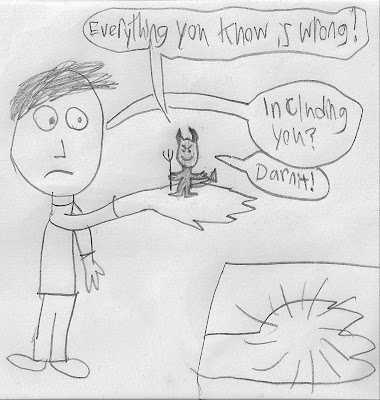
Silvie did this cartoon during our children's study session last night.
I offhandedly mentioned the Cogito, how Descartes posited a daemon who deceives him about the whole world, until Rene finally decides that "I think, therefore I am," and that cannot be doubted. Silvie asks here, what if Descartes had in turn instilled doubt into the daemon? End of daemon. He would just flare out.
I offhandedly mentioned the Cogito, how Descartes posited a daemon who deceives him about the whole world, until Rene finally decides that "I think, therefore I am," and that cannot be doubted. Silvie asks here, what if Descartes had in turn instilled doubt into the daemon? End of daemon. He would just flare out.
 |
| From The Badi Blog |
Hypothetical Buzzers
Two Buzzers as Leaders' Lifelines
By John Taylor; 2008 Sep 30
Normally I avoid watching American politicians. I literally cannot face them. When I try, my cringe reflex overworks itself. I twitch until my facial muscles become fatigued and my whole countenance aches. However, the hullaballoo over Alaskan vice presidential candidate Sarah Palin's recent interview intrigued me.
I tracked the video down on the Web and watched the eight minute report, which is still featured on an American television network's website. Then, with what she had really said fresh in my mind, I viewed the Saturday Night Live version with Tina Fey playing Sarah Palin. What a tough job the poor comedian has trying to satirize the preposterous personalities in the modern political scene! My heart went out to Tina Fey. Her version of the interview was very close, at times almost word for word. Palin, faced with a question she could not answer requiring detailed knowledge of McCain's record, had famously replied,
"I will have to get back to you on that."
Tina Fey's Palin was more imaginative. Before saying this, she asked for a lifeline, just like on "Who wants to be a Millionaire?" This was pretty funny and I thought satire had done its work until I saw the man-in-the-street interview made soon after the skit had played where a reporter asked the real Palin whether she had seen the Saturday Night Live skit. Palin's answer was, "Yes, I watched it with the volume turned down and it was hilarious." Just like the interviewer in the skit did throughout her interview with Tina Fey's Palin, all one can do is stare incredulously with one's mouth gaping. Satire decisively upstaged by inane reality. Truly, what can you say?
Of course for a Baha'i aspirant like myself the backbiting guilt reflex kicks in hard at this point. OMG. I am mocking a human soul. The fact that I am doing it with millions of others does not make it any better. God is not going to take that as an excuse. In fact, it makes it all the worse. The distain or mockery of many is surely far worse than anything that could happen in a one-on-one confrontation. Then you start to think, could I watch myself being pilloried on national television with the volume turned on? Probably not. Strike that. Definitely not. Then you start to admire the poor woman for saying pluckily that she had found it hilarious. I would not be surprised if there were not tears mixed in with her laughter at that silent screen. Then you think, no wonder there have been so few women aspiring to be leaders this level of American politics. They have to worry not about only knocking their heads on glass ceilings and the distain of men, but also cutting mockery from the likes of Tina Fey. Truly, in an election the one being chosen is not a handful of leaders but a mass of worthy voters, a people made capable by the act of voting of backing up these leaders in a way worthy of an upright citizen.
I like to laugh. Laughter is an effective medicine that alleviates the migraines that sit on my shoulders like malevolent monkeys half the time. I guess I allowed myself to be drawn into this satire by a need for relief from the depressing news of yesterday, the refusal of Congress to bail out their own golden nest egg, the de facto world currency, the dollar, and the subsequent stock market crash. By all accounts the man whom Palin was valiantly defending, Senator John McCain, was partly responsible for the failure of legislators to reach a consensus on the bailout proposal. McCain prides himself in being a maverick, an independent. But for a leader to go his own way in the present delicate climate amounts to flip-flopping and floundering. I was reminded of what John Keats wrote,
"The only means of strengthening one's intellect is to make up one's mind about nothing -- to let the mind be a thoroughfare for all thoughts. Not a select party."
Yet everything on the scene pushes leaders to align themselves with a "select party," ready or not. Whether the leader comes over well, whether he shines brilliantly in the glare of the lights of publicity, or whether she is burned, as Palin is burning -- in the end none of it matters, because in any case as long as personalities are in question the spotlights are turned away from the truth. As Heraclitus put it, nature loves to hide. The truth, the whole truth, cannot be exposed before it is good and ready, any more than you can tear open a seed and hope to find the fully grown plant inside.
One thing that Prince Philip, husband of Queen Elizabeth, long ago answered to an interviewer who asked him "What would you do if..." has stuck in my mind all these years as eminently wise. He responded, "I do not answer hypothetical questions." Clearly, that is not something that could come out of the mouth of a democratically elected leader. Why? Because everything they say has to be some sort of hypothetical. "If I am elected I will...", "If this happens I would..." But really, if a person of integrity is confronted with any changed situation there is only one thing to do. That is, consult with the parties involved, talk it over with the best advisors available, and then come to a conclusion based on what you learn. All you can say now is that you intend to to do the right thing. Therefore it is impossible before that happens to truthfully say anything about it. It lies in the dim mists of the future. The future is hypothetical by definition.
No, as I say, the really tough questions before an election are not directed at the poor servants we voted for, they should rather be asked of ourselves, by ourselves, in total honesty. In order for that to happen, we will require not the clamour of the hustings but the reverse, silent contemplation. Speech, like the seed in the ground, grows out of the dark deeps of truth, and therefore it must be buried in silent contemplation until it is mature. As Keats put it,
"Silence is deep as Eternity, speech is shallow as Time," and "As the Swiss inscription says: Sprechen ist silbern, Schweigen ist golden, 'Speech is silvern, Silence is golden;' or, as I might rather express it, Speech is of Time, Silence is of Eternity."
A silent election campaign would direct our attention to the eternal. The tough questions we ask of ourselves in private reflection would prepare us to voluntarily undergo what sacrifices are needed to respond to the challenge of the present hour. Unless we do that, it does not matter a hill of beans how competent or incompetent our elected leaders may be, they will be able to do nothing with us, any more than a potter, skilled or not, can mould dry sand into a firm vase. Elections have a serious purpose and we must be clear about how to attain that purpose.
I would therefore like to propose a hypothetical question buzzer. As soon as a candidate can point out that a question is hypothetical he can hit the buzzer and that reporter is bumped to the end of the line. For that matter, why not have a backbiting buzzer? This anybody, leader or reporter, could push at any time (I suppose I pushed it myself earlier on in this essay) and the discussion would then have to turn away from personalities. The only personality that can legitimately be skewered before voting is myself by myself. Let us keep it that way, and elections will turn out a firm clay of a citizenry ready to be shaped into great things.
By John Taylor; 2008 Sep 30
Normally I avoid watching American politicians. I literally cannot face them. When I try, my cringe reflex overworks itself. I twitch until my facial muscles become fatigued and my whole countenance aches. However, the hullaballoo over Alaskan vice presidential candidate Sarah Palin's recent interview intrigued me.
I tracked the video down on the Web and watched the eight minute report, which is still featured on an American television network's website. Then, with what she had really said fresh in my mind, I viewed the Saturday Night Live version with Tina Fey playing Sarah Palin. What a tough job the poor comedian has trying to satirize the preposterous personalities in the modern political scene! My heart went out to Tina Fey. Her version of the interview was very close, at times almost word for word. Palin, faced with a question she could not answer requiring detailed knowledge of McCain's record, had famously replied,
"I will have to get back to you on that."
Tina Fey's Palin was more imaginative. Before saying this, she asked for a lifeline, just like on "Who wants to be a Millionaire?" This was pretty funny and I thought satire had done its work until I saw the man-in-the-street interview made soon after the skit had played where a reporter asked the real Palin whether she had seen the Saturday Night Live skit. Palin's answer was, "Yes, I watched it with the volume turned down and it was hilarious." Just like the interviewer in the skit did throughout her interview with Tina Fey's Palin, all one can do is stare incredulously with one's mouth gaping. Satire decisively upstaged by inane reality. Truly, what can you say?
Of course for a Baha'i aspirant like myself the backbiting guilt reflex kicks in hard at this point. OMG. I am mocking a human soul. The fact that I am doing it with millions of others does not make it any better. God is not going to take that as an excuse. In fact, it makes it all the worse. The distain or mockery of many is surely far worse than anything that could happen in a one-on-one confrontation. Then you start to think, could I watch myself being pilloried on national television with the volume turned on? Probably not. Strike that. Definitely not. Then you start to admire the poor woman for saying pluckily that she had found it hilarious. I would not be surprised if there were not tears mixed in with her laughter at that silent screen. Then you think, no wonder there have been so few women aspiring to be leaders this level of American politics. They have to worry not about only knocking their heads on glass ceilings and the distain of men, but also cutting mockery from the likes of Tina Fey. Truly, in an election the one being chosen is not a handful of leaders but a mass of worthy voters, a people made capable by the act of voting of backing up these leaders in a way worthy of an upright citizen.
I like to laugh. Laughter is an effective medicine that alleviates the migraines that sit on my shoulders like malevolent monkeys half the time. I guess I allowed myself to be drawn into this satire by a need for relief from the depressing news of yesterday, the refusal of Congress to bail out their own golden nest egg, the de facto world currency, the dollar, and the subsequent stock market crash. By all accounts the man whom Palin was valiantly defending, Senator John McCain, was partly responsible for the failure of legislators to reach a consensus on the bailout proposal. McCain prides himself in being a maverick, an independent. But for a leader to go his own way in the present delicate climate amounts to flip-flopping and floundering. I was reminded of what John Keats wrote,
"The only means of strengthening one's intellect is to make up one's mind about nothing -- to let the mind be a thoroughfare for all thoughts. Not a select party."
Yet everything on the scene pushes leaders to align themselves with a "select party," ready or not. Whether the leader comes over well, whether he shines brilliantly in the glare of the lights of publicity, or whether she is burned, as Palin is burning -- in the end none of it matters, because in any case as long as personalities are in question the spotlights are turned away from the truth. As Heraclitus put it, nature loves to hide. The truth, the whole truth, cannot be exposed before it is good and ready, any more than you can tear open a seed and hope to find the fully grown plant inside.
One thing that Prince Philip, husband of Queen Elizabeth, long ago answered to an interviewer who asked him "What would you do if..." has stuck in my mind all these years as eminently wise. He responded, "I do not answer hypothetical questions." Clearly, that is not something that could come out of the mouth of a democratically elected leader. Why? Because everything they say has to be some sort of hypothetical. "If I am elected I will...", "If this happens I would..." But really, if a person of integrity is confronted with any changed situation there is only one thing to do. That is, consult with the parties involved, talk it over with the best advisors available, and then come to a conclusion based on what you learn. All you can say now is that you intend to to do the right thing. Therefore it is impossible before that happens to truthfully say anything about it. It lies in the dim mists of the future. The future is hypothetical by definition.
No, as I say, the really tough questions before an election are not directed at the poor servants we voted for, they should rather be asked of ourselves, by ourselves, in total honesty. In order for that to happen, we will require not the clamour of the hustings but the reverse, silent contemplation. Speech, like the seed in the ground, grows out of the dark deeps of truth, and therefore it must be buried in silent contemplation until it is mature. As Keats put it,
"Silence is deep as Eternity, speech is shallow as Time," and "As the Swiss inscription says: Sprechen ist silbern, Schweigen ist golden, 'Speech is silvern, Silence is golden;' or, as I might rather express it, Speech is of Time, Silence is of Eternity."
A silent election campaign would direct our attention to the eternal. The tough questions we ask of ourselves in private reflection would prepare us to voluntarily undergo what sacrifices are needed to respond to the challenge of the present hour. Unless we do that, it does not matter a hill of beans how competent or incompetent our elected leaders may be, they will be able to do nothing with us, any more than a potter, skilled or not, can mould dry sand into a firm vase. Elections have a serious purpose and we must be clear about how to attain that purpose.
I would therefore like to propose a hypothetical question buzzer. As soon as a candidate can point out that a question is hypothetical he can hit the buzzer and that reporter is bumped to the end of the line. For that matter, why not have a backbiting buzzer? This anybody, leader or reporter, could push at any time (I suppose I pushed it myself earlier on in this essay) and the discussion would then have to turn away from personalities. The only personality that can legitimately be skewered before voting is myself by myself. Let us keep it that way, and elections will turn out a firm clay of a citizenry ready to be shaped into great things.
Monday, September 29, 2008
The Simple Solution to the Troubles in the Middle East
JET: This originally was the lead article of Star of the West, v. 10, p. 196-197, reprinted directly from a New York Newspaper that I have never heard of.
I read this amazing statement, reportedly from the Master, in my salad days, many years ago when I had leisure to read through all the volumes of the Star of the West. Unfortunately, when I looked for it it was nowhere to be found. So it remained as one of the most precious chapters of my vast collection of Kitab-i-Hearsay, usually coming out as something like: Yes, the Master had suggestions for how the troubles in the Middle East could have been averted before they arose, if only He had been listened to by the founders of the present nations of the region.
Then the other day, looking for something else entirely, there it was, the Master's solution in all its glory. I copy it here for your perusal. Think of the lives and funds that would have been saved if only his peace proposal had been enacted meticulously as when Palestine grew into present day Israel! Also, note that the "well trained secretary may have been Shoghi Effendi, since his photo of the Master -- lately reproduced here -- graces the facing page of this edition of Star of the West.
As always, we have to be cautious historians; this was the unconfirmed report of a non-Baha'i journalist on a visit to the Master, and as such it is not the same as authoritative scripture. Nonetheless, this is an amazing article, written, judging by her name, by an American Jewess, addressing the question of Zionism directly, frankly and decisively.
Eizzat (sic 'Izzat) 1, 75 (September 8, 1919)
Declares Zionists Must Work with Other Races
Leader of Bahaism believes Neutral Government Like British Is Best for Palestine at Present Says His Father Advocated League Half Century Ago.
BY MARION WEINSTEIN.
(From the Globe and Commercial Advertiser, New York, July 17, 1919)
WHILE the league of nations is hailed or attacked here as a Wilsonian project, out in Palestine is a religious leader who claims it first saw the light in the writings of his father, fifty years ago. He is Abdul Baha, the son and successor of BAHAOLLAH, founder of the modern cult, Bahaism.
(The editors of Star of the West added this footnote: Bahais understand the Word of God again was "made flesh and dwelt among us" in the appearance of BAHAOLLAH. Miss Weinstein, not being acquainted with this fact, looks upon the Bahai Movement as a cult or "ism." The Editors.)
Abdul Baha, or Abbas Effendi, as he is widely known in the Near East, counts hundreds of followers in America.
He made a tour here in 1912, preaching his doctrine of universal love in churches and halls from coast to coast.
Born in Persia in 1844, he went to Acca as a young man. He was imprisoned by the Turks for his teachings, but was released in 1908, the year of the new Ottoman constitution.
Interested in World League.
I met Abdul Baha lately in his home in Haifa. He has many friends among the British, including General Ronald military governor of Jerusalem, and it was a British officer who took me to him. His influence is considerable in the Holy Land, but it is almost impossible to reduce it to actual numbers. I went to him curious as to his views of the future of Palestine, but he seemed more eager to talk of a matter of world importance -- the league of nations.
He spoke in Persian, a well trained secretary interpreting his low, soft words in good English. Through the open windows of the large sunny salon of his modern house came the trill of songbirds in the Effendi's lovely garden.
In white galabieh and turban, he fitted into the summery scene, his voice falling on the silence like a woodland echo. An ancient, venerable patriarch he seemed, with his snowy beard, a kindly patriarch, but with little of the Biblical fire.
Tells of Father's Plan.
"Fifty years ago," he began, "BAHAOLLAH wrote that there must be a league of nations to establish universal peace. He worked his idea out on practical lines, too. He said every nation must choose representatives, approved by the senate, the cabinet and the ruler of the country. They were to meet to found a universal peace congress to be forever a world court of arbitration.
"BAHAOLLAH saw even then, half a century ago, that unless universal peace is established, the world of humanity will continue in a state of barbarism. For it is a world of struggle for existence, of sensualism, a world of nature. Only when universal peace comes to stay will it become a world of spirit.
"I went to America myself on a mission of universal peace. I proclaimed seven years ago that Europe was an arsenal that needed but a spark to turn it into a volcano. The world leaders, I urged, must prevent this catastrophe. But they did not heed me. Now that they themselves are working for universal peace and we are soon to have a league of nations, there is no need for me to go to America again.
Message to His Followers.
"Tell my followers," Abdul Baha continued, "that I am always asking heavenly help for them, and that my deepest desire is that they shall be the source of the enlightenment of humanity and the unity of all the races of mankind. The point of distinction among men, let them remember, is their deeds, not their beliefs or words. I charge my disciples, too, at this time to show love even toward their 'enemies.'
They have no 'enemies.' The enemy of man is himself."
His religion, this leader explained, includes the highest principles of its forerunners, with this addition it fuses them all in the pursuit of one goal, the unity of mankind in universal love. Unlike its Mohammedan neighbor, it teaches the equality of man and woman.
"The world of humanity has two wings," is Abdul Baha's view, "man and woman. If one wing is weak then the bird cannot fly."
He looks to the rebirth of religion as a result of the war. The Bolshevist movement, he believes, will prove an admonition to the religious world and send mankind back to the fold, convinced that religion is the sole source of order and peace. Bolshevism was inevitable, because religion was on the daily decline in Europe, particularly in Russia.
Has Hope for Palestine.
For Palestine Abdul Baha has the brightest hopes. "It will develop day by day now," he declared, "in industry, in commerce, in agriculture, under an enlightened government. Up to the present the people of this country were like lost sheep. Now they have found their shepherd.
"If the Zionists will mingle with the other races and live in unity with them, they will succeed. If not, they will meet certain resistance. For the present I think a neutral government like the British administration would be best. A Jewish government might come later.
"There is too much talk today of what the Zionists are going to do here. There is no need of it. Let them come and do more and say less.
"The Zionists should make it clear that their principle is to elevate all the people here and to develop the country for all its inhabitants. This land must be developed, according to the promises of the prophets Isaiah, Jeremiah and Zechariah. If they come in such a spirit they will not fail.
Must Be Open to All.
"They must not work to separate the Jews from the other Palestinians. Schools should be open to all nationalities here, business companies, etc. The Turks went down because they attempted to rule over foreign races. The British are always in power because they keep fair and promote harmony.
"This is the path to universal peace here as elsewhere -- unity. We must prevent strife by all means. For 6,000 years man has been at war. It is time to try peace a little while. If it fails, we can always go back to war."
I read this amazing statement, reportedly from the Master, in my salad days, many years ago when I had leisure to read through all the volumes of the Star of the West. Unfortunately, when I looked for it it was nowhere to be found. So it remained as one of the most precious chapters of my vast collection of Kitab-i-Hearsay, usually coming out as something like: Yes, the Master had suggestions for how the troubles in the Middle East could have been averted before they arose, if only He had been listened to by the founders of the present nations of the region.
Then the other day, looking for something else entirely, there it was, the Master's solution in all its glory. I copy it here for your perusal. Think of the lives and funds that would have been saved if only his peace proposal had been enacted meticulously as when Palestine grew into present day Israel! Also, note that the "well trained secretary may have been Shoghi Effendi, since his photo of the Master -- lately reproduced here -- graces the facing page of this edition of Star of the West.
As always, we have to be cautious historians; this was the unconfirmed report of a non-Baha'i journalist on a visit to the Master, and as such it is not the same as authoritative scripture. Nonetheless, this is an amazing article, written, judging by her name, by an American Jewess, addressing the question of Zionism directly, frankly and decisively.
Eizzat (sic 'Izzat) 1, 75 (September 8, 1919)
Declares Zionists Must Work with Other Races
Leader of Bahaism believes Neutral Government Like British Is Best for Palestine at Present Says His Father Advocated League Half Century Ago.
BY MARION WEINSTEIN.
(From the Globe and Commercial Advertiser, New York, July 17, 1919)
WHILE the league of nations is hailed or attacked here as a Wilsonian project, out in Palestine is a religious leader who claims it first saw the light in the writings of his father, fifty years ago. He is Abdul Baha, the son and successor of BAHAOLLAH, founder of the modern cult, Bahaism.
(The editors of Star of the West added this footnote: Bahais understand the Word of God again was "made flesh and dwelt among us" in the appearance of BAHAOLLAH. Miss Weinstein, not being acquainted with this fact, looks upon the Bahai Movement as a cult or "ism." The Editors.)
Abdul Baha, or Abbas Effendi, as he is widely known in the Near East, counts hundreds of followers in America.
He made a tour here in 1912, preaching his doctrine of universal love in churches and halls from coast to coast.
Born in Persia in 1844, he went to Acca as a young man. He was imprisoned by the Turks for his teachings, but was released in 1908, the year of the new Ottoman constitution.
Interested in World League.
I met Abdul Baha lately in his home in Haifa. He has many friends among the British, including General Ronald military governor of Jerusalem, and it was a British officer who took me to him. His influence is considerable in the Holy Land, but it is almost impossible to reduce it to actual numbers. I went to him curious as to his views of the future of Palestine, but he seemed more eager to talk of a matter of world importance -- the league of nations.
He spoke in Persian, a well trained secretary interpreting his low, soft words in good English. Through the open windows of the large sunny salon of his modern house came the trill of songbirds in the Effendi's lovely garden.
In white galabieh and turban, he fitted into the summery scene, his voice falling on the silence like a woodland echo. An ancient, venerable patriarch he seemed, with his snowy beard, a kindly patriarch, but with little of the Biblical fire.
Tells of Father's Plan.
"Fifty years ago," he began, "BAHAOLLAH wrote that there must be a league of nations to establish universal peace. He worked his idea out on practical lines, too. He said every nation must choose representatives, approved by the senate, the cabinet and the ruler of the country. They were to meet to found a universal peace congress to be forever a world court of arbitration.
"BAHAOLLAH saw even then, half a century ago, that unless universal peace is established, the world of humanity will continue in a state of barbarism. For it is a world of struggle for existence, of sensualism, a world of nature. Only when universal peace comes to stay will it become a world of spirit.
"I went to America myself on a mission of universal peace. I proclaimed seven years ago that Europe was an arsenal that needed but a spark to turn it into a volcano. The world leaders, I urged, must prevent this catastrophe. But they did not heed me. Now that they themselves are working for universal peace and we are soon to have a league of nations, there is no need for me to go to America again.
Message to His Followers.
"Tell my followers," Abdul Baha continued, "that I am always asking heavenly help for them, and that my deepest desire is that they shall be the source of the enlightenment of humanity and the unity of all the races of mankind. The point of distinction among men, let them remember, is their deeds, not their beliefs or words. I charge my disciples, too, at this time to show love even toward their 'enemies.'
They have no 'enemies.' The enemy of man is himself."
His religion, this leader explained, includes the highest principles of its forerunners, with this addition it fuses them all in the pursuit of one goal, the unity of mankind in universal love. Unlike its Mohammedan neighbor, it teaches the equality of man and woman.
"The world of humanity has two wings," is Abdul Baha's view, "man and woman. If one wing is weak then the bird cannot fly."
He looks to the rebirth of religion as a result of the war. The Bolshevist movement, he believes, will prove an admonition to the religious world and send mankind back to the fold, convinced that religion is the sole source of order and peace. Bolshevism was inevitable, because religion was on the daily decline in Europe, particularly in Russia.
Has Hope for Palestine.
For Palestine Abdul Baha has the brightest hopes. "It will develop day by day now," he declared, "in industry, in commerce, in agriculture, under an enlightened government. Up to the present the people of this country were like lost sheep. Now they have found their shepherd.
"If the Zionists will mingle with the other races and live in unity with them, they will succeed. If not, they will meet certain resistance. For the present I think a neutral government like the British administration would be best. A Jewish government might come later.
"There is too much talk today of what the Zionists are going to do here. There is no need of it. Let them come and do more and say less.
"The Zionists should make it clear that their principle is to elevate all the people here and to develop the country for all its inhabitants. This land must be developed, according to the promises of the prophets Isaiah, Jeremiah and Zechariah. If they come in such a spirit they will not fail.
Must Be Open to All.
"They must not work to separate the Jews from the other Palestinians. Schools should be open to all nationalities here, business companies, etc. The Turks went down because they attempted to rule over foreign races. The British are always in power because they keep fair and promote harmony.
"This is the path to universal peace here as elsewhere -- unity. We must prevent strife by all means. For 6,000 years man has been at war. It is time to try peace a little while. If it fails, we can always go back to war."
Jelabiahs
Examples of a Jelabieh, Jelabiah, or, if you prefer, a Djellaba, defined as a long hooded garment from Egypt; versions of it appear to be worn by both sexes. A reporter described the dress of Abdu'l-Baha as a Jelabiah in 1919.
http://farm3.static.flickr.com/2142/1741066553_287bd31caf.jpg
http://flickr.com/photos/99014076@N00/376429286/
http://farm3.static.flickr.com/2142/1741066553_287bd31caf.jpg
http://flickr.com/photos/99014076@N00/376429286/




Saturday, September 27, 2008
About several things
Baha'i Columnist
Ottawa Baha'i scholar Jack McLean occasionally writes as a guest for a regular religious column by faith leaders answering a general question about faith. The latest question is:
"Do religious studies sometimes make students question their faith?"
Published: Saturday, September 13, 2008
Jack McLean, Ottawa Citizen Special
Baha'i Celebs
Every once in a while another article about or interview with Baha'i actor Rainn Wilson turns up. Here are a couple:
http://www.chicagotribune.com/features/arts/chi-rainn-wilson-0817aug17,0,7582857.story
It is the hundredth anniversary of the birth of Carol Lombard, a Baha'i star of the first order in Hollywood. An article is in one of the Baha'i Worlds about her, and this just appeared in her hometown newspaper.
Fort Wayne's brightest star: Carole Lombard
News Sentinel - Fort Wayne,IN,USA
Her mother, Bess Peters, was a member of the Baha’i faith, and Lombard formally declared in 1938.
http://www.news-sentinel.com/apps/pbcs.dll/article?AID=/20080926/LIVING/809260298
My Comments on Children's Classes
I wrote this a month or so ago about our almost daily children's study session,
"I must say, I had no idea teaching a Baha'i class would be such an intense intellectual challenge. I feel like I am on a game show firing line every minute of every class; these two whippersnappers shoot out the most difficult and imaginative questions one after the other, non-stop, and I barely have one handled before another, tougher one comes at me. I liberally use answers like, "I do not know," and "What can I say? I had never thought of that." I have been studying the Faith and the principles with all my might for over thirty five years, and I had no idea how little I really knew about it. I respect, and pity, all these new Baha'is who are so bold as to teach Baha'i children's classes. How they handle more than two at a time is beyond me."
Since then they have gone back to school and things have settled down a little. We started a few new Baha'i books written for children; this batch did not turn out as interesting as I had hoped. I was starting to lose them, not to mention boring myself, so I turned to the talks of the Master, specifically Paris Talks and sometimes some of the talks in Promulgation. We have been doing a talk a day for a few weeks and it has been reasonably successful.
One thing that really got them enthusiastic was a Christian book of skits from which we read together, dividing up the reading parts among each of us. Each play is written for a youth group and combines humor with a moral lesson. Over the summer they began fighting with one another over everything. For a while the question of who got which role was a bone of contention. Finally I settled on this compromise: one picks the skit to read while the other kid gets to choose the first role. Now we have read through these skits so often that I am getting bored and have been desperately searching the net for Baha'i skits. I found two, one the "drama of the Kingdom," written by the Master Himself in London, and the other a play about Sherlock Holmes written by a Baha'i youth. If you are a Baha'i writer looking for something to write a book about, please, please write a book of skits...
Baha'i Prayers In Many Languages
The following site is an aggregator for Baha'i Prayers in many languages, as compiled by believers around the globe. These devotional sites feature a selection of Baha'i Prayers in the indicated language.
http://www.bahaiprayers.org/languages.htm
Ottawa Baha'i scholar Jack McLean occasionally writes as a guest for a regular religious column by faith leaders answering a general question about faith. The latest question is:
"Do religious studies sometimes make students question their faith?"
Published: Saturday, September 13, 2008
Jack McLean, Ottawa Citizen Special
Baha'i Celebs
Every once in a while another article about or interview with Baha'i actor Rainn Wilson turns up. Here are a couple:
http://www.chicagotribune.com/features/arts/chi-rainn-wilson-0817aug17,0,7582857.story
It is the hundredth anniversary of the birth of Carol Lombard, a Baha'i star of the first order in Hollywood. An article is in one of the Baha'i Worlds about her, and this just appeared in her hometown newspaper.
Fort Wayne's brightest star: Carole Lombard
News Sentinel - Fort Wayne,IN,USA
Her mother, Bess Peters, was a member of the Baha’i faith, and Lombard formally declared in 1938.
http://www.news-sentinel.com/apps/pbcs.dll/article?AID=/20080926/LIVING/809260298
My Comments on Children's Classes
I wrote this a month or so ago about our almost daily children's study session,
"I must say, I had no idea teaching a Baha'i class would be such an intense intellectual challenge. I feel like I am on a game show firing line every minute of every class; these two whippersnappers shoot out the most difficult and imaginative questions one after the other, non-stop, and I barely have one handled before another, tougher one comes at me. I liberally use answers like, "I do not know," and "What can I say? I had never thought of that." I have been studying the Faith and the principles with all my might for over thirty five years, and I had no idea how little I really knew about it. I respect, and pity, all these new Baha'is who are so bold as to teach Baha'i children's classes. How they handle more than two at a time is beyond me."
Since then they have gone back to school and things have settled down a little. We started a few new Baha'i books written for children; this batch did not turn out as interesting as I had hoped. I was starting to lose them, not to mention boring myself, so I turned to the talks of the Master, specifically Paris Talks and sometimes some of the talks in Promulgation. We have been doing a talk a day for a few weeks and it has been reasonably successful.
One thing that really got them enthusiastic was a Christian book of skits from which we read together, dividing up the reading parts among each of us. Each play is written for a youth group and combines humor with a moral lesson. Over the summer they began fighting with one another over everything. For a while the question of who got which role was a bone of contention. Finally I settled on this compromise: one picks the skit to read while the other kid gets to choose the first role. Now we have read through these skits so often that I am getting bored and have been desperately searching the net for Baha'i skits. I found two, one the "drama of the Kingdom," written by the Master Himself in London, and the other a play about Sherlock Holmes written by a Baha'i youth. If you are a Baha'i writer looking for something to write a book about, please, please write a book of skits...
Baha'i Prayers In Many Languages
The following site is an aggregator for Baha'i Prayers in many languages, as compiled by believers around the globe. These devotional sites feature a selection of Baha'i Prayers in the indicated language.
http://www.bahaiprayers.org/languages.htm
Friday, September 26, 2008
Karlberg, III of III, Baha'is Demo Democracy
Competitive democracy III
By John Taylor; 2008 Sep 26, 18 Izzat, 165 BE
Today, let us get on with the last in our three part review of a highly topical article from the latest Baha'i World Volume.
Michael Karlberg, "Western Liberal Democracy as New World Order?" in The Baha'i World 2005-2006 (Haifa, World Centre Publications, 2007), 133-156. (http://bahai.haifa.ac.il/pdf/mk-cv.pdf)
A reader wrote, "Hi John, I would imagine you are coming to this, but what kind of solutions does Karlberg offer the public? I really find his ideas very helpful." I'm glad you asked that, Ed, because that is just what I want to talk about today. I will quote at length the section where Karlberg offers the Baha'i solution with the eloquence of the top-notch lawyer that he no doubt is. He does this in a section called "An alternative to political competition." He does the job so well that I will not presume to add to what he says afterwards; instead, I want to glance at the philosophical causes and implications of his thesis that we do not have democracy but rather "competitive democracy."
from: The Baha'i World, 2005-2006, pp. 147-149
"Winston Churchill once stated that `democracy is the worst form of government -- except for all the other forms that have been tried.' More accurately, this statement describes competitive democracy because this is the only form of democracy that has been tried, to date, as a model of state governance. In keeping with Churchill's sentiment, apologists defend the prevailing system with the argument that it is the most rational alternative to political tyranny or anarchy. The problems inherent in the system of political competition are simply accepted as `necessary evils.' All systems of government are imperfect, the argument goes, and competitive democracy is the best we can do.
"This argument is premised, however, on the faulty assumption that processes of social innovation have come to an end. According to this `end of history' thesis, the social experiments that have characterized so much of human history have finally played themselves out and Western liberal models have emerged as the only viable models of social organization. Yet this is an entirely unsupportable thesis. Indeed, it would be more plausible to say that the history of humankind as a single, interdependent species, inhabiting a common homeland, is just beginning. Under conditions of increasing global interdependence, brought on by our reproductive and technological success as a species, we have barely begun to experiment with just and sustainable models of social organization.
"Processes of social innovation have clearly not come to an end. The example of the international Baha'i community suffices to illustrate this point. The Baha'i community is a vast social laboratory within which a new model of social organization is emerging. With a current membership of over five million people, drawn from over 2,000 ethnic backgrounds and residing in virtually every nation on the planet, the community is a microcosm of the entire human race. This diverse community has constructed a unique system of democratically elected assemblies that govern Baha'i affairs internationally, nationally, and locally in thousands of communities throughout the planet. Significantly, in many parts of the world, the first exercises in democratic activity have occurred within these Baha'i communities.
"The Baha'i electoral system is entirely nonpartisan and non-competitive. In brief, all adult community members are eligible for election and every member has the reciprocal duty to serve if elected. At the same time, nominations, campaigning, and all forms of solicitation are prohibited. Voters are guided only by their own conscience as they exercise real freedom of choice in voting for those they believe best embody the qualities of recognized ability, mature experience, and selfless service to others. Through a plurality count, the nine individuals who receive the most votes are called to serve as members of the governing assembly.
"Unlike competitive systems in which decision makers must continually negotiate the demands of constituents, campaign contributors, lobbyists, and activists, the Baha'i system is shielded from external lobbying and other pressures to influence decisions. This is accomplished in two ways. First, as discussed above, those who are elected to assemblies do not seek election and they have no interest in re-election. Elected members are not political entrepreneurs seeking to build or retain political capital, and campaign financing opportunities do not exist because there are no campaigns. Second, elected members decide matters through the application of principle, according to the promptings of their own conscience (one of the primary qualities for which they were elected), and not according to the dictates or pressures of competing interest groups. In this regard, elected members are expected to weigh all of their decisions in a principled manner, even if this means forgoing immediate local or short-term benefits out of consideration for the welfare of distant peoples or future generations."
I would only add that the ideal of a leader with no interest in politicking is not new. It was Plato's Philosopher King, a leader who not only led reluctantly, but who was first of all a philosopher, not a career politician. Such souls long to wander off outside the "cave" of worldly affairs into the sunlit uplands of spiritual knowledge. They enter the realm of human affairs as a sacrifice on behalf of enlightenment.
Plato's is not necessary a hopelessly unrealistic ideal that has never been lived up to. Philosopher kings have graced the throne on more than one occasion. Indeed, Plato's model may have been the Biblical hero-managers, David and his son, Solomon. David, the father, was what we call a "musician songwriter" whose lyrics move us even today, and his son, Solomon, was a literary genius of the first order in addition to being a resourceful problem solver and just king. Since then quite a few great ancient heroes, generals and other leaders started out as farmers who, after leading their country to victory in battle, gladly returned to ploughing their fields. It is not such a ridiculous thing to hope that present and future leaders of a united world should take on the burden of office in a similar detached spirit. The Baha'i electoral system is such a perfect model for such an improved democracy because it expects service, nobility, maturity and self-sacrifice as the norm not only from prominent leaders but from all believers. As a result the brilliant leadership of a Solomon will not be a rare gift of fortune but, we can hope, the norm for every level of society.
The question remains, why do we not at least try to get a Solomon onto our ballots in democratic elections? Indeed we seem to be doing everything possible to get the reverse of a Solomon up there, and then, should a wise leader somehow make it into a position of influence, the entire weight of the system works to obstruct him at every turn. I used to think of it as the old "one for forty" ratio, the system is designed so that the wealthy one percent of the population can hold on to their precious forty percent of world resources; but I think the value of Karlberg is that he points to a broader, more philosophical reason that we are being divided and conquered. We are perverted and destroyed by our own materialist, competitive obsession. It is not in our stars but in our minds and hearts. Here is how Karlberg answers such big questions:
"The uncivil nature of much partisan discourse, alluded to at the beginning of this essay, is an inevitable outgrowth of this inversion of material and spiritual priorities. When the pursuit of self-interest comes to be understood as a virtue, and selflessness is dismissed as naive idealism, it is not surprising that politics becomes an uncivil arena. In this regard, the reality of partisan politics is better captured by war metaphors than by the market metaphors discussed earlier.
"A campaign, after all, is a military term, not a market term. Like military campaigns, political campaigns are expensive. Candidates amass `campaign war chests' as they prepare to `fight' election "b`ttles." 'n an age of mass-media spectacle and sound-bite politics, this translates into an escalating cycle of negative advertising, insults, and mudslinging, as political campaigns and debates become a `war of words' conducted from `entrenched positions.'
"In the abstract, debate is about ideas rather than people. In practice, however, the competitive structure of the system erases the line between ideas and people, because if your ideas do not prevail, neither does your political career. Hence, political debate slides easily into the quagmire of egoism and incivility. On the sidelines, meanwhile, the public grows increasingly cynical and disaffected -- yet another spiritual cost of this system.
"The result is that diverse people, who do not naturally fall into simple oppositional camps, come over time to separate themselves into such camps -- a process that can be accelerated by astute politicians who make emotionally charged `wedge issues' the centerpieces of their campaigns in an effort to create and enforce partisan loyalties. The social divisions that result are further spiritual costs of competitive democracy." (145-146)
Wedge issues... what was that called again? Oh yes, divide and conquer. Except divide and conquer of the democratic kind. It is significant that Karlberg quoted Winston Churchill, because he was in many ways the epitome of what we are talking about with competitive democracy. Competition breeds the sort of person who can survive constant clashes and furious struggle. These tend to be men. Churchill was a scrapper, a natural fighter, and this did a lot of harm in his earlier career, both to labour relations and the Irish question. His finest hour came only with the rise of Hitler. At that point the flaccid democracies of the age needed a prod, a vigorous military response to the challenge of tyranny. In other words, a very rare, extraordinary moment in history. We need scrappy males, but not most of the time.
What we must do now is to reset the default. We need peacemakers. We need more women. We should raise the percentage of women to men in leadership to at least 60-40, or higher, for quite a while. Norway is the closest in the world, and it has barely fifty percent women legislators. Also, we need to raise principle above expediency, stage campaign-free elections and seek the One behind the many in order to eradicate the causes of tyranny before they catch hold. We must learn to see competitiveness in all institutions as something to be avoided like a highly infectious disease.
If all nations had taken such a course after WWI there would have been no perceived need for a Hitler. Churchill then might have moderated his scrappiness and lived out a quiet retirement.
By John Taylor; 2008 Sep 26, 18 Izzat, 165 BE
Today, let us get on with the last in our three part review of a highly topical article from the latest Baha'i World Volume.
Michael Karlberg, "Western Liberal Democracy as New World Order?" in The Baha'i World 2005-2006 (Haifa, World Centre Publications, 2007), 133-156. (http://bahai.haifa.ac.il/pdf/mk-cv.pdf)
A reader wrote, "Hi John, I would imagine you are coming to this, but what kind of solutions does Karlberg offer the public? I really find his ideas very helpful." I'm glad you asked that, Ed, because that is just what I want to talk about today. I will quote at length the section where Karlberg offers the Baha'i solution with the eloquence of the top-notch lawyer that he no doubt is. He does this in a section called "An alternative to political competition." He does the job so well that I will not presume to add to what he says afterwards; instead, I want to glance at the philosophical causes and implications of his thesis that we do not have democracy but rather "competitive democracy."
from: The Baha'i World, 2005-2006, pp. 147-149
"Winston Churchill once stated that `democracy is the worst form of government -- except for all the other forms that have been tried.' More accurately, this statement describes competitive democracy because this is the only form of democracy that has been tried, to date, as a model of state governance. In keeping with Churchill's sentiment, apologists defend the prevailing system with the argument that it is the most rational alternative to political tyranny or anarchy. The problems inherent in the system of political competition are simply accepted as `necessary evils.' All systems of government are imperfect, the argument goes, and competitive democracy is the best we can do.
"This argument is premised, however, on the faulty assumption that processes of social innovation have come to an end. According to this `end of history' thesis, the social experiments that have characterized so much of human history have finally played themselves out and Western liberal models have emerged as the only viable models of social organization. Yet this is an entirely unsupportable thesis. Indeed, it would be more plausible to say that the history of humankind as a single, interdependent species, inhabiting a common homeland, is just beginning. Under conditions of increasing global interdependence, brought on by our reproductive and technological success as a species, we have barely begun to experiment with just and sustainable models of social organization.
"Processes of social innovation have clearly not come to an end. The example of the international Baha'i community suffices to illustrate this point. The Baha'i community is a vast social laboratory within which a new model of social organization is emerging. With a current membership of over five million people, drawn from over 2,000 ethnic backgrounds and residing in virtually every nation on the planet, the community is a microcosm of the entire human race. This diverse community has constructed a unique system of democratically elected assemblies that govern Baha'i affairs internationally, nationally, and locally in thousands of communities throughout the planet. Significantly, in many parts of the world, the first exercises in democratic activity have occurred within these Baha'i communities.
"The Baha'i electoral system is entirely nonpartisan and non-competitive. In brief, all adult community members are eligible for election and every member has the reciprocal duty to serve if elected. At the same time, nominations, campaigning, and all forms of solicitation are prohibited. Voters are guided only by their own conscience as they exercise real freedom of choice in voting for those they believe best embody the qualities of recognized ability, mature experience, and selfless service to others. Through a plurality count, the nine individuals who receive the most votes are called to serve as members of the governing assembly.
"Unlike competitive systems in which decision makers must continually negotiate the demands of constituents, campaign contributors, lobbyists, and activists, the Baha'i system is shielded from external lobbying and other pressures to influence decisions. This is accomplished in two ways. First, as discussed above, those who are elected to assemblies do not seek election and they have no interest in re-election. Elected members are not political entrepreneurs seeking to build or retain political capital, and campaign financing opportunities do not exist because there are no campaigns. Second, elected members decide matters through the application of principle, according to the promptings of their own conscience (one of the primary qualities for which they were elected), and not according to the dictates or pressures of competing interest groups. In this regard, elected members are expected to weigh all of their decisions in a principled manner, even if this means forgoing immediate local or short-term benefits out of consideration for the welfare of distant peoples or future generations."
I would only add that the ideal of a leader with no interest in politicking is not new. It was Plato's Philosopher King, a leader who not only led reluctantly, but who was first of all a philosopher, not a career politician. Such souls long to wander off outside the "cave" of worldly affairs into the sunlit uplands of spiritual knowledge. They enter the realm of human affairs as a sacrifice on behalf of enlightenment.
Plato's is not necessary a hopelessly unrealistic ideal that has never been lived up to. Philosopher kings have graced the throne on more than one occasion. Indeed, Plato's model may have been the Biblical hero-managers, David and his son, Solomon. David, the father, was what we call a "musician songwriter" whose lyrics move us even today, and his son, Solomon, was a literary genius of the first order in addition to being a resourceful problem solver and just king. Since then quite a few great ancient heroes, generals and other leaders started out as farmers who, after leading their country to victory in battle, gladly returned to ploughing their fields. It is not such a ridiculous thing to hope that present and future leaders of a united world should take on the burden of office in a similar detached spirit. The Baha'i electoral system is such a perfect model for such an improved democracy because it expects service, nobility, maturity and self-sacrifice as the norm not only from prominent leaders but from all believers. As a result the brilliant leadership of a Solomon will not be a rare gift of fortune but, we can hope, the norm for every level of society.
The question remains, why do we not at least try to get a Solomon onto our ballots in democratic elections? Indeed we seem to be doing everything possible to get the reverse of a Solomon up there, and then, should a wise leader somehow make it into a position of influence, the entire weight of the system works to obstruct him at every turn. I used to think of it as the old "one for forty" ratio, the system is designed so that the wealthy one percent of the population can hold on to their precious forty percent of world resources; but I think the value of Karlberg is that he points to a broader, more philosophical reason that we are being divided and conquered. We are perverted and destroyed by our own materialist, competitive obsession. It is not in our stars but in our minds and hearts. Here is how Karlberg answers such big questions:
"The uncivil nature of much partisan discourse, alluded to at the beginning of this essay, is an inevitable outgrowth of this inversion of material and spiritual priorities. When the pursuit of self-interest comes to be understood as a virtue, and selflessness is dismissed as naive idealism, it is not surprising that politics becomes an uncivil arena. In this regard, the reality of partisan politics is better captured by war metaphors than by the market metaphors discussed earlier.
"A campaign, after all, is a military term, not a market term. Like military campaigns, political campaigns are expensive. Candidates amass `campaign war chests' as they prepare to `fight' election "b`ttles." 'n an age of mass-media spectacle and sound-bite politics, this translates into an escalating cycle of negative advertising, insults, and mudslinging, as political campaigns and debates become a `war of words' conducted from `entrenched positions.'
"In the abstract, debate is about ideas rather than people. In practice, however, the competitive structure of the system erases the line between ideas and people, because if your ideas do not prevail, neither does your political career. Hence, political debate slides easily into the quagmire of egoism and incivility. On the sidelines, meanwhile, the public grows increasingly cynical and disaffected -- yet another spiritual cost of this system.
"The result is that diverse people, who do not naturally fall into simple oppositional camps, come over time to separate themselves into such camps -- a process that can be accelerated by astute politicians who make emotionally charged `wedge issues' the centerpieces of their campaigns in an effort to create and enforce partisan loyalties. The social divisions that result are further spiritual costs of competitive democracy." (145-146)
Wedge issues... what was that called again? Oh yes, divide and conquer. Except divide and conquer of the democratic kind. It is significant that Karlberg quoted Winston Churchill, because he was in many ways the epitome of what we are talking about with competitive democracy. Competition breeds the sort of person who can survive constant clashes and furious struggle. These tend to be men. Churchill was a scrapper, a natural fighter, and this did a lot of harm in his earlier career, both to labour relations and the Irish question. His finest hour came only with the rise of Hitler. At that point the flaccid democracies of the age needed a prod, a vigorous military response to the challenge of tyranny. In other words, a very rare, extraordinary moment in history. We need scrappy males, but not most of the time.
What we must do now is to reset the default. We need peacemakers. We need more women. We should raise the percentage of women to men in leadership to at least 60-40, or higher, for quite a while. Norway is the closest in the world, and it has barely fifty percent women legislators. Also, we need to raise principle above expediency, stage campaign-free elections and seek the One behind the many in order to eradicate the causes of tyranny before they catch hold. We must learn to see competitiveness in all institutions as something to be avoided like a highly infectious disease.
If all nations had taken such a course after WWI there would have been no perceived need for a Hitler. Churchill then might have moderated his scrappiness and lived out a quiet retirement.
Thursday, September 25, 2008
China-ward III
China as Country of the Future
By John Taylor; 2008 Sep 25, 17 Izzat, 165 BE
Let us continue with our quotes from the Writings on China, mixed with my own comments. First, here is an interesting incident Ahmad Sohrab reports taking place on Jan 5, 1913, while the Master was in London, just before He left for Scotland,
"After a few more people coming and receiving divine Blessings, an English minister who has been in China for 40 yrs is ushered into the Presence of Our Beloved. He is interested in the education and uplift of the Chinese women. He has done everything possible to help them. He has heard that the Baha'is are doing a wonderful educational work in Persia and he likes to get the facts so that he may write them for the Chinese people to show them how their Asiatic brothers are advancing in education. The Chinese are great imitators and if you show them how their Persian sisters are progressing they will walk in the same footstep[s]. The Master was patient enough to give him enough data and material so that he may go and write his articles. `This is indeed a marvellous man' he says as he goes out of the room, his face beaming with happiness." (Abdu'l-Baha in Edinburgh - Sohrab's Diary Letters by Ahmad Sohrab Edited by David Merrick, http://bahai-library.com/file.php5?file=ahmadsohrab_diary_edinburgh_1913&language=All)
From the Baha'i point of view, China is truly the place to watch; as the guy in Futurama dramatically announces, "Welcome to the land of the future." China was part of the birth of planning in the Faith, when it was mentioned a couple of years after the above incident in the foundational document of all Baha'i teaching plans, the Tablets of the Divine Plan,
"How good would it be were there any possibility of a commission composed of men and women, to travel together through China and Japan -- so that this bond of love may become strengthened, and through this going and coming they may establish the oneness of the world of humanity, summon the people to the Kingdom of God and spread the teachings." (Abdu'l-Baha, Tablets of the Divine Plan, p. 42)
Back in the 1980's I knew a physics student at McMaster from Hong Kong, who was an enthusiastic Baha'i and active member of the Baha'i Club on campus. I remember being with him while he was teaching the Faith to some other Chinese students; there was some confusion about the name of the Faith. Apparently instead of "Baha'i", at the time in pamphlets they were calling the Faith in the Chinese language something about "Unity Group." As far as I can guess, again gleaned from old Star of the West volumes, this word for Baha'i was probably "ta-tung," which means "great unity" in Chinese. This term is borrowed from the Chinese classical work, Li chi, or the Book of Rites. Because of its historical resonance, they probably chose that over the foreign sounding word "Baha'i." More recently I asked one of my Chinese pilot friends to translate the title of the current standard Baha'i pamphlet, and he sounded it out for me, "Baha'i." So now they are definitely calling "Baha'i" Baha'i.
Once the Revolution hit China, the Baha'is had to move very carefully in China. When the barrier of Communism was still in full force, the House of Justice wrote:
"The population of Asia and Australasia is well over half the world population. The area includes Asiatic USSR and mainland China, accounting for more than one thousand million souls who are, for the most part, untouched by the Revelation of Baha'u'llah. Obviously present conditions in these areas call for the exercise of the utmost wisdom and circumspection. Yet this vast segment of humanity cannot be ignored." (The Universal House of Justice, Messages 1963 to 1986, 341.5, p. 564)
In 1971 the House wrote the following in a message to the Oceanic Conference of the South China Seas in Singapore
"South East Asia, whose gifted and industrious peoples have embraced four of the world's major religions, have produced in all ages civilizations and cultures representative of the highest accomplishments of the human race, now experiencing with the rest of the world the disruptive, revolutionizing, `vibrating influence of this Most Great, this New World Order, the like of which mortal eyes have never witnessed,' lies open and receptive to the Word of God, ready once more to nourish in its fertile soil that potent seed and to bring forth, in its own characteristic manner and as an integral part of the world civilization, the institutions, the fabric, the brilliant edifice of Baha'u'llah's World Order." (The Universal House of Justice, Messages from the Universal House of Justice 1968-1973, p. 63)
As soon as Communism began to fall, in 1989, the House made public a goal that they had kept under wraps for decades,
"As Baha'is, we have been entrusted with the responsibility of taking the message of Baha'u'llah to all of mankind, but only a comparatively small beginning has yet been made to take the teachings to the vast population of China. The Universal House of Justice feels that this task must be regarded as one of the highest priorities for the entire Baha'i world." (April 19, 1989, written on behalf of the Universal House of Justice, Universal House of Justice, A Wider Horizon, Selected Letters 1983-1992, p. 208-209)
Abdu'l-Baha made several very similar statements, one of which I just blogged onto the Badi' Blog, where the Master in the early, dark days of His ministry apparently came within an ace of pioneering to the town in China known as Kashi. Here is a very similar statement about China that appeared at another time in Star of the West.
...And such is the prophecy of Abdu'l Baha, who bespeaks for China a destiny most great. "China," he says, "is the country of the future.
"China-ward the Cause of Baha'u'llah must march. China has most great capability. The Chinese people are most simple hearted and truth seeking. In China one can teach many souls and train and educate such divine personages, each one of whom may become the bright candle of the world of humanity.
"Truly, I say they are free from any deceit and hypocrisies and are prompted with ideal motives. I hope the right kind of a teacher will be inspired to go to that vast Empire to lay the foundation of the Kingdom of God, to promote the principles of Divine Civilization, to unfurl the banner of the Cause of Baha'u'llah and to invite the people to the Banquet of the Lord." (SW, Vol. 15, p. 45)
"China is the Country of the Future"
Words of Abdu'l-Baha from Diary of Mirza Ahmad Sohrab, April 3, 1917.
CHINA, China, China, China-ward the Cause of Baha'u'llah must march! Where is that holy, sanctified Baha'i to become the teacher of China!
China has most great capability. The Chinese people are most simplehearted and truth seeking. The Baha'i teacher of the Chinese people must first be imbued with their spirit, know their sacred literature, study their national customs and speak to them from their own stand point, and their own terminologies. He must entertain no thought of his own, but ever think of their spiritual welfare. In China one can teach many souls and train and educate divine personages, each one of whom may become a bright candle of the world of humanity. Truly, I say they are free from any deceit and hypocrisies, and are prompted with ideal motives.
Had I been feeling well, I would have taken a journey to China myself! China is the country of the future. I hope the right kind of teacher will be inspired to go to that vast empire to lay the foundation of the Kingdom of God, to promote the principles of divine civilization, to unfurl the banner of the Cause of Baha'u'llah and to invite the people to the banquet of the Lord!
For the last twenty years I have repeatedly emphasized the matter of spreading the Cause of God. In every city there must be organized assemblies of teaching classes to teach the young how to teach the Cause and prepare them for this most important service. Every Baha'i must acquire the lessons of teaching. This will yield results. No other service is as important as this. This service of the promotion of the revelation of Baha'u'llah is the most confirmed service. Every time one service holds the most supreme importance.
There is one season to harrow the ground, another season to scatter the seeds, still another season to irrigate the fields and still another to harvest the crop. We must attend to these various kinds of activities in their proper seasons in order to become successful. Now is the time of seed sowing, but it seems to me some of the believers are thinking about crop getting. This will give them no results. Whosoever is thinking of any other thing, is wasting his time. The promotion of the principles of Baha'u'llah is the most dominant issue before the believers of God." (SW, Vol. 8, p. 37)
By John Taylor; 2008 Sep 25, 17 Izzat, 165 BE
Let us continue with our quotes from the Writings on China, mixed with my own comments. First, here is an interesting incident Ahmad Sohrab reports taking place on Jan 5, 1913, while the Master was in London, just before He left for Scotland,
"After a few more people coming and receiving divine Blessings, an English minister who has been in China for 40 yrs is ushered into the Presence of Our Beloved. He is interested in the education and uplift of the Chinese women. He has done everything possible to help them. He has heard that the Baha'is are doing a wonderful educational
From the Baha'i point of view, China is truly the place to watch; as the guy in Futurama dramatically announces, "Welcome to the land of the future." China was part of the birth of planning in the Faith, when it was mentioned a couple of years after the above incident in the foundational document of all Baha'i teaching plans, the Tablets of the Divine Plan,
"How good would it be were there any possibility of a commission composed of men and women, to travel together through China and Japan -- so that this bond of love may become strengthened, and through this going and coming they may establish the oneness of the world of humanity, summon the people to the Kingdom of God and spread the teachings." (Abdu'l-Baha, Tablets of the Divine Plan, p. 42)
Back in the 1980's I knew a physics student at McMaster from Hong Kong, who was an enthusiastic Baha'i and active member of the Baha'i Club on campus. I remember being with him while he was teaching the Faith to some other Chinese students; there was some confusion about the name of the Faith. Apparently instead of "Baha'i", at the time in pamphlets they were calling the Faith in the Chinese language something about "Unity Group." As far as I can guess, again gleaned from old Star of the West volumes, this word for Baha'i was probably "ta-tung," which means "great unity" in Chinese. This term is borrowed from the Chinese classical work, Li chi, or the Book of Rites. Because of its historical resonance, they probably chose that over the foreign sounding word "Baha'i." More recently I asked one of my Chinese pilot friends to translate the title of the current standard Baha'i pamphlet, and he sounded it out for me, "Baha'i." So now they are definitely calling "Baha'i" Baha'i.
Once the Revolution hit China, the Baha'is had to move very carefully in China. When the barrier of Communism was still in full force, the House of Justice wrote:
"The population of Asia and Australasia is well over half the world population. The area includes Asiatic USSR and mainland China, accounting for more than one thousand million souls who are, for the most part, untouched by the Revelation of Baha'u'llah. Obviously present conditions in these areas call for the exercise of the utmost wisdom and circumspection. Yet this vast segment of humanity cannot be ignored." (The Universal House of Justice, Messages 1963 to 1986, 341.5, p. 564)
In 1971 the House wrote the following in a message to the Oceanic Conference of the South China Seas in Singapore
"South East Asia, whose gifted and industrious peoples have embraced four of the world's major religions, have produced in all ages civilizations and cultures representative of the highest accomplishments of the human race, now experiencing with the rest of the world the disruptive, revolutionizing, `vibrating influence of this Most Great, this New World Order, the like of which mortal eyes have never witnessed,' lies open and receptive to the Word of God, ready once more to nourish in its fertile soil that potent seed and to bring forth, in its own characteristic manner and as an integral part of the world civilization, the institutions, the fabric, the brilliant edifice of Baha'u'llah's World Order." (The Universal House of Justice, Messages from the Universal House of Justice 1968-1973, p. 63)
As soon as Communism began to fall, in 1989, the House made public a goal that they had kept under wraps for decades,
"As Baha'is, we have been entrusted with the responsibility of taking the message of Baha'u'llah to all of mankind, but only a comparatively small beginning has yet been made to take the teachings to the vast population of China. The Universal House of Justice feels that this task must be regarded as one of the highest priorities for the entire Baha'i world." (April 19, 1989, written on behalf of the Universal House of Justice, Universal House of Justice, A Wider Horizon, Selected Letters 1983-1992, p. 208-209)
Abdu'l-Baha made several very similar statements, one of which I just blogged onto the Badi' Blog, where the Master in the early, dark days of His ministry apparently came within an ace of pioneering to the town in China known as Kashi. Here is a very similar statement about China that appeared at another time in Star of the West.
...And such is the prophecy of Abdu'l Baha, who bespeaks for China a destiny most great. "China," he says, "is the country of the future.
"China-ward the Cause of Baha'u'llah must march. China has most great capability. The Chinese people are most simple hearted and truth seeking. In China one can teach many souls and train and educate such divine personages, each one of whom may become the bright candle of the world of humanity.
"Truly, I say they are free from any deceit and hypocrisies and are prompted with ideal motives. I hope the right kind of a teacher will be inspired to go to that vast Empire to lay the foundation of the Kingdom of God, to promote the principles of Divine Civilization, to unfurl the banner of the Cause of Baha'u'llah and to invite the people to the Banquet of the Lord." (SW, Vol. 15, p. 45)
"China is the Country of the Future"
Words of Abdu'l-Baha from Diary of Mirza Ahmad Sohrab, April 3, 1917.
CHINA, China, China, China-ward the Cause of Baha'u'llah must march! Where is that holy, sanctified Baha'i to become the teacher of China!
China has most great capability. The Chinese people are most simplehearted and truth seeking. The Baha'i teacher of the Chinese people must first be imbued with their spirit, know their sacred literature, study their national customs and speak to them from their own stand point, and their own terminologies. He must entertain no thought of his own, but ever think of their spiritual welfare. In China one can teach many souls and train and educate divine personages, each one of whom may become a bright candle of the world of humanity. Truly, I say they are free from any deceit and hypocrisies, and are prompted with ideal motives.
Had I been feeling well, I would have taken a journey to China myself! China is the country of the future. I hope the right kind of teacher will be inspired to go to that vast empire to lay the foundation of the Kingdom of God, to promote the principles of divine civilization, to unfurl the banner of the Cause of Baha'u'llah and to invite the people to the banquet of the Lord!
For the last twenty years I have repeatedly emphasized the matter of spreading the Cause of God. In every city there must be organized assemblies of teaching classes to teach the young how to teach the Cause and prepare them for this most important service. Every Baha'i must acquire the lessons of teaching. This will yield results. No other service is as important as this. This service of the promotion of the revelation of Baha'u'llah is the most confirmed service. Every time one service holds the most supreme importance.
There is one season to harrow the ground, another season to scatter the seeds, still another season to irrigate the fields and still another to harvest the crop. We must attend to these various kinds of activities in their proper seasons in order to become successful. Now is the time of seed sowing, but it seems to me some of the believers are thinking about crop getting. This will give them no results. Whosoever is thinking of any other thing, is wasting his time. The promotion of the principles of Baha'u'llah is the most dominant issue before the believers of God." (SW, Vol. 8, p. 37)
Kashgar
http://www.chinahighlights.com/image/xinjiang/kashgar/map/kashgar-location-xinjiang.gif
Kashgar
Here is where the Master almost pioneered during the early years of His ministry.
There seems to be a city by that name nearby, in Kazakhstan; the Chinese place seems to be a province. Here is an article about the Chinese Kashgar, from China Review:
http://www.chinareview.com/provinces/xinjiang/kashgar/index.html
Here is the Wiki article on Kashgar:
http://en.wikipedia.org/wiki/Kashgar
The Baha'i Cause and the Chinese People
(Words of Abdu'l-Baha recorded and translated by Mirza Ahmad Sohrab, Star of the West, Vol. 13, 184-186)
A Chinese student connected with the Peace Conference in Washington, D. C. last February attended a Baha'i meeting and asked questions with intense interest. At the close of the session he said: "This is the best religion of which I have heard." Another Chinese student, whose family are leaders in the new China, read the Baha'i literature with great enthusiasm. "This is just what the new China needs," he said. "Confucius taught duties to princes. But how are we to teach the ethics of Confucius to the people in a Republic where there are no princes? Today we need a universal ethics in China, something modern and something to unite the religions."
"When I was a little boy," continued this student, "my dear old grandmother in China used to take me on her knee and say, `Some day, in the golden age, the good and wise Confucius will comeback to earth.' I do believe if my grandmother were living now she would say, 'Abdu'l-Baha is Confucius come back to earth!'"
This same Chinese student read Abdu'l-Baha's "Paris Talks" with enthusiasm. He read them in the morning and their radiant sentences filled his heart with the joy of loving kindness. But about four in the afternoon, after a hard day's study, he became irritable, ready, he said, to strike anyone who disagreed with him. Then he would sit down and read again the "Paris Talks." They filled his heart with such love that he could be kind and gentle to his associates until he went to bed at ten in the evening.
A Chinese students' club in one of our great universities listened not long ago to a Baha'i address and asked eager questions. Some of them had been caught by the materialism and agnosticism of current western thought but most of them were eager for a modern religion.
They were especially attracted to the Baha'i teaching of the oneness of the races, the need of a universal language, the fundamental truth in all religions, and to the picture of the universal Temple to he built at Wilmette, north of Chicago, with its nine gardens, nine doors open to all sects and religions. "How wonderful," they said, "to find a religion which teaches that all the world religions are fundamentally true and divine!"
The Chinese are just waiting for the universal light of the Baha'i Glad Tidings. "China, China, China-ward the Cause of Baha'u'llah must march," says Abdu'l-Baha. "Where is that holy, sanctified Baha'i to become the teacher of China! China has most great capability. The Chinese people are most simple-hearted and truth seeking. The Baha'i teacher of the Chinese people must first be imbued with their spirit, know their sacred literature, study their national customs and speak to them from their own standpoint and their own terminologies. He must entertain no thought of his own but ever think of their spiritual welfare. In China one can teach many souls and train and educate such divine personages that each one of them may become the bright candle of the world of humanity. Truly, I say, the Chinese are free from any deceit and hypocrisies and are prompted with ideal motives. Had I been feeling well I would have taken a journey to China myself!"
One day on Mount Carmel Abdu'l-Baha told of his plans to go to China in the days of his imprisonment and exile, of how he longed to travel to all nations in the service of the Kingdom. But for forty years he was a prisoner. He prefaces his story with these words about how Baha Ollah loved to describe the glory of teaching:
"Whenever during his lifetime the Blessed Perfection (Baha'u'llah) desired to signalize anyone with his special favor he encouraged him to go forth and teach the Cause of God. When he spoke to one of the pilgrims or wrote to a far off Baha'i concerning the promotion of the Cause, inciting the former and the latter to arise and deliver the message of the Kingdom, everyone felt instinctively that these souls were elected, the chosen ones and that the glances of mercifulness had encircled them. It is noteworthy to remark that most of the general epistles of Baha'u'llah, embracing comprehensive teachings and principles are revealed in the names of the teachers of the Cause. A number of rare spiritual souls having consecrated themselves to the promulgation of the glad tidings of the Kingdom were peculiarly favored by him. Whenever their names were mentioned in his presence his countenance became all wreathed in smiles. This was the most notable proof and clear evidence of the favor and bestowal of the Blessed Perfection. When he happened to discourse on teaching and teachers he waxed most eloquent, his words inspired the hearts, his face became radiant with the anticipated joy of a humanity instructed in the laws of God and the application of the laws of nature, and his unquestioned, divine authority filled the listeners with such fiery enthusiasm for the promotion of the Cause that they were ready to give up their lives to execute his command. He used to say that the teachers were the Israfels of God who, with the sound of their trumpets blow the spirit of life into the dead bodies of mankind.
"One day, in the course of his talk, he praised so much the lives and services of the teachers of the Cause and expressed such high appreciation of their unselfish lives that, although I was a prisoner said to myself: 'O! That I might be confirmed in this!' Then I thought I might go to Kashgar, one of the provinces of China and a place not visited up to that time by any Baha'i teacher. I was going to travel alone and with no baggage only a handbag containing a number of tablets and books and papers and pens.
"I secured even my passport; the old Mufti stood as my guarantor. When the crafty Motosarraf, Ibrahim Pasha, heard about this he sent his secretary to me with the message: I have heard that your Excellency contemplates taking a long journey. I will not be so disrespectful or discourteous as to thwart your plan or in any way hinder your departure but, as I am the Governor of this province, I am responsible to the central government for everything that happens here. Therefore, it will be but my official duty to send a cable concerning your departure as soon as you set your feet on the steamer.' I was familiar with the fortuitous ways of oriental expression. So I saw that this was a polite way of saying: 'We will not let you go.' Hence I deferred my departure to a more opportune time."
"China is the country of the future. I hope the right kind of teacher will be inspired to go to that vast empire to lay the foundation of the Kingdom of God, to promote the principles of divine civilization, to unfurl the banner of the Cause of Baha'u'llah and to invite the people to the banquet of the Lord!"
Kashgar
Here is where the Master almost pioneered during the early years of His ministry.
There seems to be a city by that name nearby, in Kazakhstan; the Chinese place seems to be a province. Here is an article about the Chinese Kashgar, from China Review:
http://www.chinareview.com/provinces/xinjiang/kashgar/index.html
Here is the Wiki article on Kashgar:
http://en.wikipedia.org/wiki/Kashgar
The Baha'i Cause and the Chinese People
(Words of Abdu'l-Baha recorded and translated by Mirza Ahmad Sohrab, Star of the West, Vol. 13, 184-186)
A Chinese student connected with the Peace Conference in Washington, D. C. last February attended a Baha'i meeting and asked questions with intense interest. At the close of the session he said: "This is the best religion of which I have heard." Another Chinese student, whose family are leaders in the new China, read the Baha'i literature with great enthusiasm. "This is just what the new China needs," he said. "Confucius taught duties to princes. But how are we to teach the ethics of Confucius to the people in a Republic where there are no princes? Today we need a universal ethics in China, something modern and something to unite the religions."
"When I was a little boy," continued this student, "my dear old grandmother in China used to take me on her knee and say, `Some day, in the golden age, the good and wise Confucius will comeback to earth.' I do believe if my grandmother were living now she would say, 'Abdu'l-Baha is Confucius come back to earth!'"
This same Chinese student read Abdu'l-Baha's "Paris Talks" with enthusiasm. He read them in the morning and their radiant sentences filled his heart with the joy of loving kindness. But about four in the afternoon, after a hard day's study, he became irritable, ready, he said, to strike anyone who disagreed with him. Then he would sit down and read again the "Paris Talks." They filled his heart with such love that he could be kind and gentle to his associates until he went to bed at ten in the evening.
A Chinese students' club in one of our great universities listened not long ago to a Baha'i address and asked eager questions. Some of them had been caught by the materialism and agnosticism of current western thought but most of them were eager for a modern religion.
They were especially attracted to the Baha'i teaching of the oneness of the races, the need of a universal language, the fundamental truth in all religions, and to the picture of the universal Temple to he built at Wilmette, north of Chicago, with its nine gardens, nine doors open to all sects and religions. "How wonderful," they said, "to find a religion which teaches that all the world religions are fundamentally true and divine!"
The Chinese are just waiting for the universal light of the Baha'i Glad Tidings. "China, China, China-ward the Cause of Baha'u'llah must march," says Abdu'l-Baha. "Where is that holy, sanctified Baha'i to become the teacher of China! China has most great capability. The Chinese people are most simple-hearted and truth seeking. The Baha'i teacher of the Chinese people must first be imbued with their spirit, know their sacred literature, study their national customs and speak to them from their own standpoint and their own terminologies. He must entertain no thought of his own but ever think of their spiritual welfare. In China one can teach many souls and train and educate such divine personages that each one of them may become the bright candle of the world of humanity. Truly, I say, the Chinese are free from any deceit and hypocrisies and are prompted with ideal motives. Had I been feeling well I would have taken a journey to China myself!"
One day on Mount Carmel Abdu'l-Baha told of his plans to go to China in the days of his imprisonment and exile, of how he longed to travel to all nations in the service of the Kingdom. But for forty years he was a prisoner. He prefaces his story with these words about how Baha Ollah loved to describe the glory of teaching:
"Whenever during his lifetime the Blessed Perfection (Baha'u'llah) desired to signalize anyone with his special favor he encouraged him to go forth and teach the Cause of God. When he spoke to one of the pilgrims or wrote to a far off Baha'i concerning the promotion of the Cause, inciting the former and the latter to arise and deliver the message of the Kingdom, everyone felt instinctively that these souls were elected, the chosen ones and that the glances of mercifulness had encircled them. It is noteworthy to remark that most of the general epistles of Baha'u'llah, embracing comprehensive teachings and principles are revealed in the names of the teachers of the Cause. A number of rare spiritual souls having consecrated themselves to the promulgation of the glad tidings of the Kingdom were peculiarly favored by him. Whenever their names were mentioned in his presence his countenance became all wreathed in smiles. This was the most notable proof and clear evidence of the favor and bestowal of the Blessed Perfection. When he happened to discourse on teaching and teachers he waxed most eloquent, his words inspired the hearts, his face became radiant with the anticipated joy of a humanity instructed in the laws of God and the application of the laws of nature, and his unquestioned, divine authority filled the listeners with such fiery enthusiasm for the promotion of the Cause that they were ready to give up their lives to execute his command. He used to say that the teachers were the Israfels of God who, with the sound of their trumpets blow the spirit of life into the dead bodies of mankind.
"One day, in the course of his talk, he praised so much the lives and services of the teachers of the Cause and expressed such high appreciation of their unselfish lives that, although I was a prisoner said to myself: 'O! That I might be confirmed in this!' Then I thought I might go to Kashgar, one of the provinces of China and a place not visited up to that time by any Baha'i teacher. I was going to travel alone and with no baggage only a handbag containing a number of tablets and books and papers and pens.
"I secured even my passport; the old Mufti stood as my guarantor. When the crafty Motosarraf, Ibrahim Pasha, heard about this he sent his secretary to me with the message: I have heard that your Excellency contemplates taking a long journey. I will not be so disrespectful or discourteous as to thwart your plan or in any way hinder your departure but, as I am the Governor of this province, I am responsible to the central government for everything that happens here. Therefore, it will be but my official duty to send a cable concerning your departure as soon as you set your feet on the steamer.' I was familiar with the fortuitous ways of oriental expression. So I saw that this was a polite way of saying: 'We will not let you go.' Hence I deferred my departure to a more opportune time."
"China is the country of the future. I hope the right kind of teacher will be inspired to go to that vast empire to lay the foundation of the Kingdom of God, to promote the principles of divine civilization, to unfurl the banner of the Cause of Baha'u'llah and to invite the people to the banquet of the Lord!"
Wednesday, September 24, 2008
Revisiting Fundamentalism
Fundamentalism True and False
By John Taylor; 2008 Sep 24, 16 Izzat, 165 BE
I have been fascinated over the past several months by the question of fanaticism and fundamentalism. Are false fundamentalists, simmering tensions among faiths and rioting fanatics mere symptoms of the disease of prejudice as it shows up in the realm of religion? Or is there more to it than that?
There is a big difference, it seems to me, in one major respect.
In religion fanatics tend to be systematically nurtured by professionals. For instance, the recent bombings in India may not have been directly coached by religious leaders, but their age-old rivalries, hatred and inability to unite for the common interest of humankind certainly laid the groundwork for such violence. Too often clergy see it as a central professional duty to instil ideology rather than understanding into their adherents.
It was noticed as early as Voltaire that this is not true of other experts in other specialties. Doubts and clashes of ideology are largely confined to discussions among scientists and professionals themselves. Theorists may fight like cats and dogs with one another but as a rule they are responsible enough not to bring their disputations into the classroom. The recent meltdown of stock markets, for instance, was not fomented by disputes among economists but rather by widespread lawlessness, irresponsibility and disavowal of principles that the experts generally agree upon.
Abdu'l-Baha, perhaps commenting upon Jesus saying that "if thine eye offend thee, pluck it out," and at the same time a point made in the Writings of Baha'u'llah that pure hearted, spiritual religious leaders are and always have been the "eyes" of humanity, said:
"Each power is localized. Reason has its seat in the brain, sight in the eye, hearing in the ears, speech in the tongue. The force of gravity is localized in the center of the earth. Everything on the surface of the earth is attracted toward the center. Our light is localized in the sun. The heat of the sun transforms minerals, vegetables, animals, and man. In the world of beings, some have specialized in statesmanship, some in morals, others in commerce, agriculture, art, politics, laboratory work, or industrial activities, for these are the outer expression of spiritual, philosophical and scientific faculties. In brief, each individual expresses himself through some special occupation; but one does not hold the others in condemnation."
"Certain religious teachers, however, think only of their creeds. They believe a holy war can conquer the world. They reason thus: `All the other religious teachers are in error and I am obliged to chastise them and show them their mistakes for their own salvation.' The belief of the friends of God is quite different. They believe that one must affiliate with all, love all humanity and seek ever to better its condition. God is one, the true shepherd of all creation. Let us be kind to every one in order to unify the world and spread affection abroad." (Abdu'l-Baha, Divine Philosophy, p. 97)
Whether holy war is openly declared or not, the oppositional mind set is the same. It is a serious thing when among faith leaders there is an agreement not only to disagree but to do battle with one another and with the world. This is especially so if that profession plays the crucial role "eye" to the body politic. If spiritual leaders see the world in one-dimensional terms as right or wrong, either/or without gray areas; if they see competition and struggle as the only practical way to resolve differences, then what hope is there that the rest of society will stay un-beguiled by this false but seductive set of suppositions about human nature?
An academic who has studied fundamentalism points out that in America,
"Generic fundamentalism takes its cues from a sacred text that stands above criticism. (And) ... sees the secular state as the primary enemy, for the latter is more interested in education, democratic reforms, and economic progress than in preserving the spiritual dimension of life." (The Rise of Fundamentalism Grant Wacker, Duke University Divinity School, National Humanities Center, http://nationalhumanitiescenter.org/tserve/twenty/tkeyinfo/fundam.htm)
Thus while trying to put it onto a pedestal a fanatic devalues his own Holy Writ by putting it above social transformation, by expecting that it cannot act as a progressive force in reforming and spiritualizing secular society. Thus enthusiasts become fundamentalists by taking a fundamentally self-contradictory position. On one hand, fundamentalism "sees time-honored social distinctions and cultural patterns as rooted in the very nature of things, in the order of creation itself. That means clear-cut and stratified roles for men and women, parents and children, clergy and laity." On the other hand, it,
"seeks to minimize the distinction between the state and the church. To hold that the state should operate according to one set of publicly shared principles, while individuals should operate according to multiple sets of privately shared principles, is morally pernicious and ends up harming everyone, believers and nonbelievers alike. Religious truths are no different from the truths of medical science or aeronautical engineering: if they hold for anyone they hold for everyone." (Id.)
Undoubtedly, in this last sense the fundamentalists are on to something. Religious truths, insofar as they are true, do hold for one and all. But the only way to prove they are true is for all believers of all religious traditions to hold to the true fundamentals, love, forgiveness and kindness to all, believers and non-believers alike. This is why I think we need to make a hard distinction between true and false fundamentals. False fundamentals only divide us further and deeper than we already are. True fundamentals, by their very nature, unite and promote peace. Leaders enlightened by truth encourage followers to look upon everyone they meet as suggested by Ali, Son-in-Law of Muhammad, "either as a brother in religion or a brother in humanity." Peter expressed the same sentiment when, addressing a crowd, he said,
"I truly understand that God shows no partiality, but in every nation anyone who fears him and does what is right is acceptable to him." (Acts 10:34-45)
By John Taylor; 2008 Sep 24, 16 Izzat, 165 BE
I have been fascinated over the past several months by the question of fanaticism and fundamentalism. Are false fundamentalists, simmering tensions among faiths and rioting fanatics mere symptoms of the disease of prejudice as it shows up in the realm of religion? Or is there more to it than that?
There is a big difference, it seems to me, in one major respect.
In religion fanatics tend to be systematically nurtured by professionals. For instance, the recent bombings in India may not have been directly coached by religious leaders, but their age-old rivalries, hatred and inability to unite for the common interest of humankind certainly laid the groundwork for such violence. Too often clergy see it as a central professional duty to instil ideology rather than understanding into their adherents.
It was noticed as early as Voltaire that this is not true of other experts in other specialties. Doubts and clashes of ideology are largely confined to discussions among scientists and professionals themselves. Theorists may fight like cats and dogs with one another but as a rule they are responsible enough not to bring their disputations into the classroom. The recent meltdown of stock markets, for instance, was not fomented by disputes among economists but rather by widespread lawlessness, irresponsibility and disavowal of principles that the experts generally agree upon.
Abdu'l-Baha, perhaps commenting upon Jesus saying that "if thine eye offend thee, pluck it out," and at the same time a point made in the Writings of Baha'u'llah that pure hearted, spiritual religious leaders are and always have been the "eyes" of humanity, said:
"Each power is localized. Reason has its seat in the brain, sight in the eye, hearing in the ears, speech in the tongue. The force of gravity is localized in the center of the earth. Everything on the surface of the earth is attracted toward the center. Our light is localized in the sun. The heat of the sun transforms minerals, vegetables, animals, and man. In the world of beings, some have specialized in statesmanship, some in morals, others in commerce, agriculture, art, politics, laboratory work, or industrial activities, for these are the outer expression of spiritual, philosophical and scientific faculties. In brief, each individual expresses himself through some special occupation; but one does not hold the others in condemnation."
"Certain religious teachers, however, think only of their creeds. They believe a holy war can conquer the world. They reason thus: `All the other religious teachers are in error and I am obliged to chastise them and show them their mistakes for their own salvation.' The belief of the friends of God is quite different. They believe that one must affiliate with all, love all humanity and seek ever to better its condition. God is one, the true shepherd of all creation. Let us be kind to every one in order to unify the world and spread affection abroad." (Abdu'l-Baha, Divine Philosophy, p. 97)
Whether holy war is openly declared or not, the oppositional mind set is the same. It is a serious thing when among faith leaders there is an agreement not only to disagree but to do battle with one another and with the world. This is especially so if that profession plays the crucial role "eye" to the body politic. If spiritual leaders see the world in one-dimensional terms as right or wrong, either/or without gray areas; if they see competition and struggle as the only practical way to resolve differences, then what hope is there that the rest of society will stay un-beguiled by this false but seductive set of suppositions about human nature?
An academic who has studied fundamentalism points out that in America,
"Generic fundamentalism takes its cues from a sacred text that stands above criticism. (And) ... sees the secular state as the primary enemy, for the latter is more interested in education, democratic reforms, and economic progress than in preserving the spiritual dimension of life." (The Rise of Fundamentalism Grant Wacker, Duke University Divinity School, National Humanities Center, http://nationalhumanitiescenter.org/tserve/twenty/tkeyinfo/fundam.htm)
Thus while trying to put it onto a pedestal a fanatic devalues his own Holy Writ by putting it above social transformation, by expecting that it cannot act as a progressive force in reforming and spiritualizing secular society. Thus enthusiasts become fundamentalists by taking a fundamentally self-contradictory position. On one hand, fundamentalism "sees time-honored social distinctions and cultural patterns as rooted in the very nature of things, in the order of creation itself. That means clear-cut and stratified roles for men and women, parents and children, clergy and laity." On the other hand, it,
"seeks to minimize the distinction between the state and the church. To hold that the state should operate according to one set of publicly shared principles, while individuals should operate according to multiple sets of privately shared principles, is morally pernicious and ends up harming everyone, believers and nonbelievers alike. Religious truths are no different from the truths of medical science or aeronautical engineering: if they hold for anyone they hold for everyone." (Id.)
Undoubtedly, in this last sense the fundamentalists are on to something. Religious truths, insofar as they are true, do hold for one and all. But the only way to prove they are true is for all believers of all religious traditions to hold to the true fundamentals, love, forgiveness and kindness to all, believers and non-believers alike. This is why I think we need to make a hard distinction between true and false fundamentals. False fundamentals only divide us further and deeper than we already are. True fundamentals, by their very nature, unite and promote peace. Leaders enlightened by truth encourage followers to look upon everyone they meet as suggested by Ali, Son-in-Law of Muhammad, "either as a brother in religion or a brother in humanity." Peter expressed the same sentiment when, addressing a crowd, he said,
"I truly understand that God shows no partiality, but in every nation anyone who fears him and does what is right is acceptable to him." (Acts 10:34-45)
Tuesday, September 23, 2008
p24 bps qua Baha'i
The Baha'i Principles qua Baha'i
By John Taylor; 2008 Sep 23, 15 Izzat, 165 BE
Part I, The Spiritual Principles
I am about to plunge into a heavy reworking of my life-long study of the Baha'i principles in the light of the signal contribution of Jan Amos Comenius. Before I do so, however, I will briefly go over the principles in the light of their distinctive role as pillars of the Baha'i Faith. I am also preparing a website on the principles and a series of short YouTube videos on this theme.
About the Principles generally
The Baha'i principles, qua Baha'i, started when Baha'u'llah wrote the Kings, according to Abdu'l-Baha,
"Fifty years ago Baha'u'llah wrote epistles to the kings and rulers of the world, in which the teachings and principles revealed by him were embodied and set forth. These epistles were printed in India forty years ago and spread broadcast." (Promulgation, 295)
This does not mean that the principles were not discernable in earlier Writings of Baha'u'llah. Many, as the Master Himself pointed out, were laid out in the Hidden Words, perhaps for the first time. The concepts of the oneness and relativity of religion are worked out in detail in the Kitab-i-Iqan, which came just before the Ridvan announcement in 1863. Abdu'l-Baha appears to mean only that the principles were announced virtually at the same time that the word "Baha'i" was introduced to the world, and that they cannot be separated from the single organic unity we know of as the Baha'i Faith.
The Master, in His Secret of Divine Civilization, commissioned a year or two after the revelation of the Aqdas, stated that,
"The primary purpose, the basic objective, in laying down powerful laws and setting up great principles and institutions dealing with every aspect of civilisation, is human happiness..." (SDC 60)
This explains why the Guardian, in God Passes By, calls the principles the "comity of Baha'u'llah." A comity is an arrangement where science, religion and government unite with a single aim: the good and happiness of all. Any exclusion at all, any division into parts, falls short of comity. That is why nationalist politics, dividing humanity into citizens and aliens, is obsessed with competitive division. Only a comity can apply principle, and only principle can sustain world order. Baha'u'llah was very emphatic on this point, that His goal was not self glorification but the good and unity of the entire human world.
"My object is none other than the betterment of the world and the tranquillity of its peoples. The well-being of mankind, its peace and security, are unattainable unless and until its unity is firmly established. This unity can never be achieved so long as the counsels which the Pen of the Most High hath revealed are suffered to pass unheeded." (Gl 286)
Imagining Principle
My challenge, one that I hope my study of Comenius will help with, is to expound upon these central spiritual principles in a way that will include not only non-Baha'is, but even non-believers. Inclusivity is of the essence of principle. Somehow I believe that an image or model may help make the abstractions of principle universally comprehensible.
The principles have been pictured in many ways, as branches of a tree, in the Bible as twelve precious stones taken from surrounding mountains, as the variant colors of the spectrum of light, and so forth. The image I want to use throughout these videos on principle is a circular arrangement that returns to me persistently in recent years. I have rigged up a round tabletop with a Lazy Suzan turntable castor in the center in order to demonstrate it. On the spinning, slightly raised central level I will place the spiritual principles, of which I have discerned four (if you can think of other spiritual principles, do let me know). On the lower, fixed level I will place representations of the social principles, search, oneness, etc.
Spiritual Principle
Today, let us concentrate on an overview of the principles of the Spirit. Here are the four spiritual principles that vivify, inhabit and illumine the sunlit uplands of the human mind and spirit,
Oneness of God
Power of the Holy Spirit
Covenant
Love
In my little videos somehow I would like to convey the ineffable, transcendent, holographic quality of the spiritual principles, as opposed to the static, reified qualities of the social principles inhabiting the plane below.
So, on this upper, inner circle I would ideally place a black hole. I would do it, too -- if only such a thing were possible without destroying the earth and much of the solar system. Failing that, I will place a globe, or a beach ball, or one of those omni-reflecting silver balls that they used to place in Victorian gardens.
Alternatively, I could place there a model of a Mashriqu'l-Adhkar, or maybe several models of each of the continental temples. At Louhelen they have in their library a model of the Wilmette temple enclosed in a glass bottle. That would be perfect.
The temple, with its dome and nine sides symbolically represents many of the ethereal qualities of the spiritual principles. As the Master pointed out at the start of the second public talk He ever gave, this world is a reflection of the world of spirit. Since there are nine, more or less, major Baha'i social principles, having a nine sided temple on the inner, upper level would convey the overarching other-dimensionality of Spirit over mind.
Part One: Spiritual Principles
The spiritual principles are huge, completely impossible to hold or even touch with our tiny, finite minds. They are still but moving, everywhere but nowhere, complex beyond comprehension, yet at the same time almost too simple to realize deep down in our gut. They give life to the social principles, but it seems at times impossible to say which applies more or less to any given social principle. This is just why I have placed them on a spinning turntable jutting out into a third dimension, each principle equal to the other. The first spiritual principle is:
Oneness of God
The Oneness of God is the identification of God not with man but with what the atheist philosopher called Ubermensch, or Superman. As Baha'is grow in faith we in turn reflect this Mind in our self, our own loves and struggles. This principle was expounded in very personal terms by the Baha'i Superman, which we term the "Manifestation of God."
"The Great Being saith: The Tongue of Wisdom proclaimeth: He that hath Me not is bereft of all things. Turn ye away from all that is on earth and seek none else but Me. I am the Sun of Wisdom and the Ocean of Knowledge. I cheer the faint and revive the dead. I am the guiding Light that illumineth the way. I am the royal Falcon on the arm of the Almighty. I unfold the drooping wings of every broken bird and start it on its flight." (Tablets, 169)
This personal relationship at the core of principle distinguishes principle from ideology or the cold, necessary, inflexible abstractions of mathematical formulae. No, we hold to oneness out of a relationship with a Man who lived a life on earth, confronted history, suffering, weakness, ignorance and evil. His triumph inspires us and offers us strength to win our own spiritual victories.
This is an ethereal spiritual principle, but it becomes a religious principle as we unite with others in carrying out the social principles of oneness of religion, oneness of humanity, and so forth. Thus the personal becomes the social.
Power of the Holy Spirit
The Oneness of God, however intimately we may relate to it personally, is nothing but an idea, a vain feeling, an idle passion, if it is not carried out into action. To do that, we need power, what Baha'u'llah calls confirmations of the Holy Spirit. These confirmations come from constant relationship, as with a parent, sibling or friend. Hence the salutation in the following summary of this principle,
"O friend of mine! The Word of God is the king of words and its pervasive influence is incalculable. It hath ever dominated and will continue to dominate the realm of being. The Great Being saith: The Word is the master key for the whole world, inasmuch as through its potency the doors of the hearts of men, which in reality are the doors of heaven, are unlocked." (Tablets, 173)
The principle of divine power is the mother principle of all power because it deals with language. Old sayings like "the pen is mightier than the sword," and "a word to the wise is sufficient," teach that as long as we hold to the power of speech, there is no need for force or violence. This is a divine force. Conflicts can be worked out peacefully if we pray, consult and apply the result of consultation.
The Manifestation of God is the Word, the genetic code in every order we live by, personally and socially. As the Tablet of Ahmad puts it, He it is "through Whom ... the wisdom of every command shall be tested." Thus the chief way we know the Manifestation is through His Word, by constant study of the Writings. Hence language Baha'u'llah calls the "master key" to the power of spirit that informs all things.
Covenant
"The light of men is Justice. Quench it not with the contrary winds of oppression and tyranny. The purpose of justice is the appearance of unity among men." (Baha'u'llah, Tablets, 66-7, Kalimat-i-Firdousiyyih, 6th leaf)
Covenant is justice as expressed in our relationship with Almighty God. As with every relationship, for every action there is a reaction, implicit rules and obligations are set up by every interaction with God. When he and I become friends we agree to a contract of reciprocity, a covenant. Our creator sets it going by the very fact that we were created; the more we depend upon Him, the more we thrive, the greater our debt, the more actively we apply the contract. We pay our debt by participating to the extent of our ability in the principles of unity.
Love
Love is the first teaching of all the Divine Teachers. The great Teacher whose main message was love taught that "strait is the gate and narrow the way that leadeth unto life, and few there be that find it," (Matt 7:14) meaning that just as we enter and leave this life alone, so we must seek truth alone, and express it according to our own lights and that of none other. Baha'u'llah adds that the prime expression of this love is the primal love, love in, through and for God,
"For every one of you his paramount duty is to choose for himself that on which no other may infringe and none usurp from him. Such a thing -- and to this the Almighty is My witness -- is the love of God, could ye but perceive it." (Gleanings, p. 261)
The axial social principle of search for truth, along with that of justice, are rare in that they are spiritual as well as social principles. As such, they apply not only to a special area of expertise, but they make all the other principles into principles. For example, economics is mere selfishness, tinkering and money grubbing unless it is adjusted by the comity of individuals struggling towards God.
By John Taylor; 2008 Sep 23, 15 Izzat, 165 BE
Part I, The Spiritual Principles
I am about to plunge into a heavy reworking of my life-long study of the Baha'i principles in the light of the signal contribution of Jan Amos Comenius. Before I do so, however, I will briefly go over the principles in the light of their distinctive role as pillars of the Baha'i Faith. I am also preparing a website on the principles and a series of short YouTube videos on this theme.
About the Principles generally
The Baha'i principles, qua Baha'i, started when Baha'u'llah wrote the Kings, according to Abdu'l-Baha,
"Fifty years ago Baha'u'llah wrote epistles to the kings and rulers of the world, in which the teachings and principles revealed by him were embodied and set forth. These epistles were printed in India forty years ago and spread broadcast." (Promulgation, 295)
This does not mean that the principles were not discernable in earlier Writings of Baha'u'llah. Many, as the Master Himself pointed out, were laid out in the Hidden Words, perhaps for the first time. The concepts of the oneness and relativity of religion are worked out in detail in the Kitab-i-Iqan, which came just before the Ridvan announcement in 1863. Abdu'l-Baha appears to mean only that the principles were announced virtually at the same time that the word "Baha'i" was introduced to the world, and that they cannot be separated from the single organic unity we know of as the Baha'i Faith.
The Master, in His Secret of Divine Civilization, commissioned a year or two after the revelation of the Aqdas, stated that,
"The primary purpose, the basic objective, in laying down powerful laws and setting up great principles and institutions dealing with every aspect of civilisation, is human happiness..." (SDC 60)
This explains why the Guardian, in God Passes By, calls the principles the "comity of Baha'u'llah." A comity is an arrangement where science, religion and government unite with a single aim: the good and happiness of all. Any exclusion at all, any division into parts, falls short of comity. That is why nationalist politics, dividing humanity into citizens and aliens, is obsessed with competitive division. Only a comity can apply principle, and only principle can sustain world order. Baha'u'llah was very emphatic on this point, that His goal was not self glorification but the good and unity of the entire human world.
"My object is none other than the betterment of the world and the tranquillity of its peoples. The well-being of mankind, its peace and security, are unattainable unless and until its unity is firmly established. This unity can never be achieved so long as the counsels which the Pen of the Most High hath revealed are suffered to pass unheeded." (Gl 286)
Imagining Principle
My challenge, one that I hope my study of Comenius will help with, is to expound upon these central spiritual principles in a way that will include not only non-Baha'is, but even non-believers. Inclusivity is of the essence of principle. Somehow I believe that an image or model may help make the abstractions of principle universally comprehensible.
The principles have been pictured in many ways, as branches of a tree, in the Bible as twelve precious stones taken from surrounding mountains, as the variant colors of the spectrum of light, and so forth. The image I want to use throughout these videos on principle is a circular arrangement that returns to me persistently in recent years. I have rigged up a round tabletop with a Lazy Suzan turntable castor in the center in order to demonstrate it. On the spinning, slightly raised central level I will place the spiritual principles, of which I have discerned four (if you can think of other spiritual principles, do let me know). On the lower, fixed level I will place representations of the social principles, search, oneness, etc.
Spiritual Principle
Today, let us concentrate on an overview of the principles of the Spirit. Here are the four spiritual principles that vivify, inhabit and illumine the sunlit uplands of the human mind and spirit,
Oneness of God
Power of the Holy Spirit
Covenant
Love
In my little videos somehow I would like to convey the ineffable, transcendent, holographic quality of the spiritual principles, as opposed to the static, reified qualities of the social principles inhabiting the plane below.
So, on this upper, inner circle I would ideally place a black hole. I would do it, too -- if only such a thing were possible without destroying the earth and much of the solar system. Failing that, I will place a globe, or a beach ball, or one of those omni-reflecting silver balls that they used to place in Victorian gardens.
Alternatively, I could place there a model of a Mashriqu'l-Adhkar, or maybe several models of each of the continental temples. At Louhelen they have in their library a model of the Wilmette temple enclosed in a glass bottle. That would be perfect.
The temple, with its dome and nine sides symbolically represents many of the ethereal qualities of the spiritual principles. As the Master pointed out at the start of the second public talk He ever gave, this world is a reflection of the world of spirit. Since there are nine, more or less, major Baha'i social principles, having a nine sided temple on the inner, upper level would convey the overarching other-dimensionality of Spirit over mind.
Part One: Spiritual Principles
The spiritual principles are huge, completely impossible to hold or even touch with our tiny, finite minds. They are still but moving, everywhere but nowhere, complex beyond comprehension, yet at the same time almost too simple to realize deep down in our gut. They give life to the social principles, but it seems at times impossible to say which applies more or less to any given social principle. This is just why I have placed them on a spinning turntable jutting out into a third dimension, each principle equal to the other. The first spiritual principle is:
Oneness of God
The Oneness of God is the identification of God not with man but with what the atheist philosopher called Ubermensch, or Superman. As Baha'is grow in faith we in turn reflect this Mind in our self, our own loves and struggles. This principle was expounded in very personal terms by the Baha'i Superman, which we term the "Manifestation of God."
"The Great Being saith: The Tongue of Wisdom proclaimeth: He that hath Me not is bereft of all things. Turn ye away from all that is on earth and seek none else but Me. I am the Sun of Wisdom and the Ocean of Knowledge. I cheer the faint and revive the dead. I am the guiding Light that illumineth the way. I am the royal Falcon on the arm of the Almighty. I unfold the drooping wings of every broken bird and start it on its flight." (Tablets, 169)
This personal relationship at the core of principle distinguishes principle from ideology or the cold, necessary, inflexible abstractions of mathematical formulae. No, we hold to oneness out of a relationship with a Man who lived a life on earth, confronted history, suffering, weakness, ignorance and evil. His triumph inspires us and offers us strength to win our own spiritual victories.
This is an ethereal spiritual principle, but it becomes a religious principle as we unite with others in carrying out the social principles of oneness of religion, oneness of humanity, and so forth. Thus the personal becomes the social.
Power of the Holy Spirit
The Oneness of God, however intimately we may relate to it personally, is nothing but an idea, a vain feeling, an idle passion, if it is not carried out into action. To do that, we need power, what Baha'u'llah calls confirmations of the Holy Spirit. These confirmations come from constant relationship, as with a parent, sibling or friend. Hence the salutation in the following summary of this principle,
"O friend of mine! The Word of God is the king of words and its pervasive influence is incalculable. It hath ever dominated and will continue to dominate the realm of being. The Great Being saith: The Word is the master key for the whole world, inasmuch as through its potency the doors of the hearts of men, which in reality are the doors of heaven, are unlocked." (Tablets, 173)
The principle of divine power is the mother principle of all power because it deals with language. Old sayings like "the pen is mightier than the sword," and "a word to the wise is sufficient," teach that as long as we hold to the power of speech, there is no need for force or violence. This is a divine force. Conflicts can be worked out peacefully if we pray, consult and apply the result of consultation.
The Manifestation of God is the Word, the genetic code in every order we live by, personally and socially. As the Tablet of Ahmad puts it, He it is "through Whom ... the wisdom of every command shall be tested." Thus the chief way we know the Manifestation is through His Word, by constant study of the Writings. Hence language Baha'u'llah calls the "master key" to the power of spirit that informs all things.
Covenant
"The light of men is Justice. Quench it not with the contrary winds of oppression and tyranny. The purpose of justice is the appearance of unity among men." (Baha'u'llah, Tablets, 66-7, Kalimat-i-Firdousiyyih, 6th leaf)
Covenant is justice as expressed in our relationship with Almighty God. As with every relationship, for every action there is a reaction, implicit rules and obligations are set up by every interaction with God. When he and I become friends we agree to a contract of reciprocity, a covenant. Our creator sets it going by the very fact that we were created; the more we depend upon Him, the more we thrive, the greater our debt, the more actively we apply the contract. We pay our debt by participating to the extent of our ability in the principles of unity.
Love
Love is the first teaching of all the Divine Teachers. The great Teacher whose main message was love taught that "strait is the gate and narrow the way that leadeth unto life, and few there be that find it," (Matt 7:14) meaning that just as we enter and leave this life alone, so we must seek truth alone, and express it according to our own lights and that of none other. Baha'u'llah adds that the prime expression of this love is the primal love, love in, through and for God,
"For every one of you his paramount duty is to choose for himself that on which no other may infringe and none usurp from him. Such a thing -- and to this the Almighty is My witness -- is the love of God, could ye but perceive it." (Gleanings, p. 261)
The axial social principle of search for truth, along with that of justice, are rare in that they are spiritual as well as social principles. As such, they apply not only to a special area of expertise, but they make all the other principles into principles. For example, economics is mere selfishness, tinkering and money grubbing unless it is adjusted by the comity of individuals struggling towards God.
Some Baha'i Links
Badi' Blog reader Jimbo's website offers flowery prayer cards: http://members.shaw.ca/dawningplace/home.htm
Warning on Mount Carmel:
http://designblog.nzeldes.com/2008/09/watch-the-beauty/
Earth Graphic
http://psdtuts.s3.amazonaws.com/117_Earth/final_1920.jpg
Warning on Mount Carmel:
http://designblog.nzeldes.com/2008/09/watch-the-beauty/
Earth Graphic
http://psdtuts.s3.amazonaws.com/117_Earth/final_1920.jpg
Wednesday, September 17, 2008
Master by holy site

This picture appeared in Star of the West, Volume 10, Number 10, September 8, 1919
Captions below:
Abdu'l-Baha walking near the holy tomb
Photograph taken midsummer 1919 and sent to the Star of the West by Shoghi Rabbani

Subscribe to:
Posts (Atom)