Wednesday, October 15, 2008

Soul Chart

Lua Explains Her Soul Chart

By John Taylor; 2008 Oct 15, 18 Mashiyyat 165 BE


If you are like me, you have stumbled across the huge chart of the soul on the Baha'i Academics Library and wondered where it comes from. In the blog version of this post I will try to include a copy of the chart so you can see what it looks like. Otherwise, go to:


http://bahai-library.com/visuals/evolution.txt.html

It turns out that Lua Getsinger used a copy of this chart, drawn at the bidding of the Master, to explain the soul in one of the many talks she gave in California a few months before the Master came to America. She and Abdu'l-Baha's nephew-in-law, Amin Fareed, had been sent there by the Master himself as sort of shock troops preparing the way for His coming. Here is how her biographer describes the circumstances of the talk.

The Word of God -- A Talk by Lua Getsinger

On Sunday evening, December 17th, Lua gave a talk at the California Club Hall in San Francisco, on the subject "The Word of God". Introducing her, Dr. Fareed said:

"We thought of combining two talks tonight, but inasmuch as both these talks are rather lengthy, and inasmuch as the one Mrs. Getsinger is to give you is profound and requires your closest attention, we have decided to postpone the one on social considerations of the Baha'i Movement, or the Baha'i consideration of economics and sociology, to a later period, and tonight you are to listen to an exposition of the great Word of God as taught by 'Abdu'l-Baha. This talk which Mrs. Getsinger will present is, in substance, the fundamental teaching of the Baha'i Reform, the great Baha'i light on this most interesting and absorbing subject..."

Lua's talk was "stenographically reported" and is available us today, together with a few of the many talks she gave this time. Reading (Lua's talks) we can understand what 'Abdu'l-Baha meant when He wrote to her in 1900:

"Oh my Daughter - know that thou art a woman, whose words will have a great effect on the hearts of the people, and to whose words they will listen. Do not lose one single opportunity in this blessed time to talk to the people - be prepared on all occasions, and put forth all the efforts within thy power to deliver the message and do not look to thy comfort, or to what you shall eat or drink or wear - or to name, fame, renown, wealth, or even as to how you shall sleep, but look only to delivering the Truth with sincerity and true devotion sacrificing any and everything for the Cause! - And if you will do this - by God - you shall receive a confirmation - which you have never imagined - or conceived in your mind, and for this, I am the guarantee - and of it there is no doubt." (endnote: Quoted by Lua in a letter to Purley M. Blake, February 23, 1900. It is not known if these were Abdu'l-Baha's exact words, although Lua was usually careful to quote accurately.)

By late December, Fareed was summarily summoned by 'Abdu'l-Baha to return to the Holy Land. He was in Chicago on the 24th of that month on his way back. Lua remained in California and spoke on December 31, 1911 ...

from: Lua Getsinger, Herald of the Covenant, by Velda Piff Metelmann, George Ronald, Oxford, 1997, pp. 144-145

==========

Reading Piff Metelmann's biography, I realize that Lua was named "Herald of the Covenant" for good reason. Like a herald, she went before giving news of the Master's approach. Not only that, but she earned the "covenant" part too. She travelled around with a soon-to-be covenant breaker, Fareed, who all the time was -- unbeknownst to her -- soliciting funds for himself from Baha'is and friends of the Faith in the name of his Uncle. That is evidently why he was "summarily summoned" back home at the end of 1911. Introducing this talk about soul and spirit, the biographer says,

"However, the informed reader will find that much of the content of Lua's talks is still valid today; while her insight and perception is unlikely to be surpassed."

Lua was indeed uniquely qualified to talk about soul, since she had spent years in the Holy Land, had learned Persian there, and attended the same sort of table talks whose transcripts formed the newly published Some Answered Questions. She quotes at length from an early translation of a tablet of the Master that is to be found in Baha'i Scriptures, 404-407, as well as (I think) some passages from Baha'u'llah that she and Farid had evidently just translated. It is a long talk, so I will not talk more.


The Word of God


from Herald of the Covenant, pp. 357-373
Talk given by Mrs. Lua M. Getsinger, California Club Hall, San Francisco, California
Sunday evening, December 17, 1911
Stenographically reported by B.S. Straum


The Word of God


One time in Acca, when 'Abdu'l-Baha was trying to make us understand the possibility of man more clearly knowing God, he used this chart.
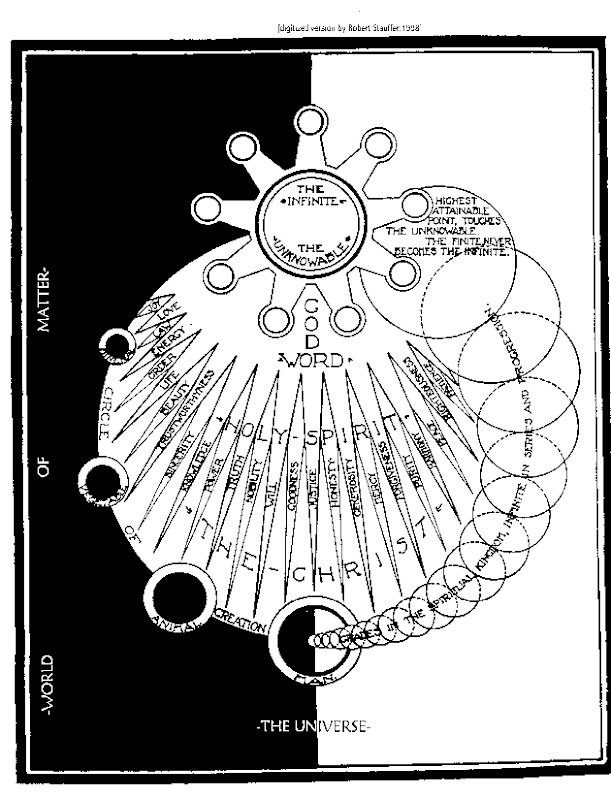


(note, this is a chart made up by Curtis Kelsey that may or may not be the one Lua is describing)

(The chart is dark on one side, light on the other and consists of circles. At the top a circle labeled INFINITE ESSENCE - GOD. Next circle to the right and on the light side written "Highest possible attainment by man - the Prophets". Circles descending to the bottom circle which is half in the dark and half in the light labeled "Human Kingdom." Three circles on the left labeled (ascending) "Animal Kingdom", "Vegetable Kingdom", "Mineral Kingdom". From the large circle at the top are rays going out labeled "Love, Life, Knowledge, Faith, Forgiveness, Justice, Mercy, Primal Will, Beauty, Power, Generosity, Munificence, Righteousness, Purity". The chart is circular in itself with words written upon the rays at the top "Word of God", along the side "Spirit", at the bottom "The Christ Holy Spirit", and to the left "Matter".)

Just a word of explanation regarding the chart itself. He likened the Infinite Essence, the Incomprehensible, unto the sun, the substance of which we do not know save through the analyzation (sic) of the waves of light emanating therefrom.

The first Effulgence emanating from the Infinite Essence, is the Word of God, the Creator.

The rays of light emanating from the First Effulgence constitute the Holy Spirit, or the Christ.

The darkened half of the chart represents the world of matter, and the other half the world of Spirit, or the Heavenly Kingdom. We have, then, the Illuminator, the Illumination, and that which is to be illuminated.

Taking it for granted that the statements made in mythic or God-given writings must be absolutely true, however anomalous are irreconcilable with the facts of modern science and the deductions of enlightened reason they may appear to the natural mind, we affirm that the sacred scriptures are true in their own domain -- the soul. By the sacred scriptures we mean the Word of God, the revealed Word of God, considered apart from its setting of Man's interpretation, or interpretations of that Word. And, further, that they are equally true in respect to physical science; that through them Deity speaks to men, who may thus learn, if their comprehension will allow them, the secret nature of things, whether pertaining to the life of earth or of the hereafter.

According to the sacred Scripture, we are told: "In the beginning was the Word, and the Word was with God, and the Word was God." But before this, there was no beginning, because that which existed before this beginning of the Word, and the manifestation thereof, always, was the Infinite Essence, the Unknowable, Incomprehensible, Almighty God, for we are told that all that is is as a result of the Word, that by the Word were all things made that are made.

Then the Word becomes the power through which creation takes place, and the process of this Word producing creation is the science of Divinity, which embraces the hidden and mysterious principles of every science, sacred and secular, for it is the science of Divine action in the works of creation, the science of universal existence, both active and passive, and its original foundation is not speculation, deduction or theory, but the revealed Word of God through Prophets and Speakers whom He has selected, anointed and sent into the world.

The Baha'i Reformation teaches that all things existing in the material world were originally spoken into existence through the power of this Word - God. As to how, or what was the process we do not pretend to say we know. That belongs to the realm of the divine alchemy of the Almighty Creator, which he forever secretes from the knowledge of His created beings. But through this Word were all things made that are made. All things - the mineral kingdom, the animal kingdom and the kingdom of man - were spoken into existence, after which the law of evolution was declared and established, and through this law they maintain their existence.

What called for this lesson on the part of 'Abdu'l-Baha was a question, and the question was, "What is soul?" In answer to this question, he instructed me how to draw this chart - not this one, but one from which this one was reproduced. And now I wish to use his words, to give you the lesson verbatim. He said:

"As to thy question concerning the soul, know thou, verily, soul is a term applied to numerous realities, according to the exigence of those realities in regard to development in the world of existence."

Let us take one attribute now emanating from the First Effulgence of the Sun of Truth, the Word, - the attribute of life - and let us evolve it through the different kingdoms, until we find it manifesting itself in the kingdom of man.

"In the mineral kingdom it is called latent force, silently working away for the disintegration of the substances of that kingdom."

This power of life, or soul, then, manifesting itself in the rocks, is latent force. That is the term applied to it in that kingdom.

"In the vegetable kingdom it is called virtue augmentative, or the power of growth, which attracts and absorbs the delicate materials of inorganic matter and transforms them to the condition of growth. Thus the inorganic substances found in the mineral kingdom become growing vegetable life through the act of the Word of God. This vegetable soul, or virtue augmentative, or power of growth, is a quality which is produced by the admixture of elements, and appears in accidental or contingent organisms of which contingency is an essential necessity or attribute.

"In the animal kingdom this same power, latent force, virtue augmentative, becomes sense perception or instinct. This term, as applied to the animal kingdom, is also a natural quality resulting from the mixture of the elements, and it appears from their mingling and combination, for it is a quality which results from the composition of bodies, organism, and is dispersed at their decomposition. From this we are to understand that the animal soul, or the sense perception, is not endowed with the capacity of attaining immortality, as the life force is dispersed at the decomposition of the animal tissues.

"All things, then, up to this point, or to the human kingdom, are contingent realities, and not divine realities. A contingent reality, which continues as it is, and is perpetuated by the fullness of existence, will suffer no corruption, and will thus become a divine reality, for the accidental reality is only distinguished from the pre-existent reality by its subjection to corruption, for transformation is an essential necessity to every contingent reality, and this is what the Mature Wisdom has deemed advisable. This is also proven by physical science.

"The term soul, which in its fourth application, or in the kingdom of man, is called rational being; soul, mind, has a potential existence before its appearance in human life. It is like unto the existence of a tree within the seed. The existence of a tree within the seed is potential, but, when the seed is sown and watered, the signs thereof - its roots and branches and all its different qualities - appear. Likewise, the rational soul has a potential existence before its appearance in the human body, and through the mixture of elements and a wonderful combination, according to the natural law of conception and birth, it appears in its identity and becomes an individuality."

Well, now, what is soul?

Life, manifesting in the mineral kingdom, is latent force; manifesting in the vegetable kingdom, it is the power of growth; the same life, in the animal kingdom, becomes sense perception; and then as a human soul, it is endowed with certain attributes which will enable it to attain for itself that something by which it can become perpetuated and become a divine reality.

All beings, to this point, have not the capacity to receive it, and we can liken existence unto a tree, and call it the tree of existence. In the mineral kingdom we find the roots of the tree of existence. The vegetable kingdom produces the trunk and branches. The animal kingdom brings forth its leaves and blossoms. But only in the kingdom of man do we find its fruit, the heart of which contains that which can reproduce the tree, for in the heart we find the seed from which the original tree was produced.

"Be it known that to know the reality or essence of the soul of man is impossible, for, in order to know a thing, one must comprehend it, and since a thing cannot comprehend itself, therefore man cannot comprehend himself. To know oneself in substance or essence is absolutely impossible. As the comprehender cannot be the comprehended, man cannot know himself' in reality or essence.

"In order to obtain any knowledge of the reality or soul of man, the student must study the manifestations, qualities, names and characteristics of man.

"This much can be stated, that the reality of man is a pure and unknown essence, a Divine depositary; that is, it is an emanation from the Light of the Ancient Entity - God. This Divine essence, or soul of man, because of its innate purity and its connection with the unseen and Ancient Entity, is old as regards time, but new as regards individuality. This connection is similar to that of the ray with the sun, or the effect to the Primal Cause. Otherwise, the thing that is generated, or the creature, has no connection with, or relation, individually, to the Generator and Creator.

"Therefore, since the reality or soul of man is a ray of light emanating from the Sun of the Word of God, it is capable of manifesting all the perfections of Being. It is then worthy to be the throne upon which may be established the manifestation of the Names, the Qualities and the Attributes of the Ancient Entity. Inasmuch as this entity is capable of expressing the great virtues of Being, and is the greatest and purest of all existing beings on earth, from its earliest rise in the human temple to its resurrection from the grave of the body, it can be likened to a mirror which reveals the seen and the unseen, which possesses the virtues of the world and of the Kingdom.

"The difference which exists between the mirror and the pure essence of the elements is the same which exists between the animal and man. The mirror reveals the image, but it is not conscious of the act, while the reality or soul of man, the pure mirror of God, is conscious of the reflection and the fact that it is revealing. (The animals are not conscious. They possess not the attribute of consciousness.)

"The human soul is an essence spiritual in entity and material or physical in function. It is defined as essence because it is independent in itself, while the body is accidental and dependent upon the soul.

"The personality and activity of the body are due to the individuality of the soul. Thus the soul is the cause of the life of the body, and the body, with all its organs, is but the vehicle of its expression.

"Since that pure essence (the human soul), whose identity is unknown, possesses the virtues of the worlds of matter and of the Kingdom, it has two sides: First, the material and physical; second, the mental and spiritual, attributes not found as qualities of matter. It is the same reality, which is given different names according to the conditions wherein it becomes manifest. Because of its attachment to matter and to the phenomenal world - that is, when it governs the physical functions of the body - it is called the human soul. When it manifests itself as the thinker and comprehender of things, it is called the mind. When it soars in the atmosphere of God and travels in the spiritual worlds, it is designated as Spirit." (The School of the Prophets)

The soul of man, the great substance which is a ray of this light, or which is life manifested in the most perfect organism which has been formed upon this earth, possesses nine great attributes or qualities which distinguish it as an identity, separate it from all other creatures upon this earth, and we can say of these qualities that they are to the soul what the organs are to the body. They are: perception, memory, imagination, abstraction, reason, judgment, consciousness, mental taste and will.

By perception we mean that faculty or organ of the soul which sees, hears, feels, tastes.

Memory is that which records.

Imagination forms.

Abstraction classifies, is that faculty or organ which enables us to know the difference between materials, and the proper use to which those materials ought to be put.

Reason argues.

Judgment decides.

Consciousness knows.

Mental taste detects.

Will acts.

Upon this tree of existence anything not possessing these nine attributes falls short of possessing the ability to become immortal. All the creatures below the kingdom of man are devoid of these nine faculties. The animals possess five, or less, of these faculties, but any being who does not possess them all has not the capacity to attain immortality or eternal life.

We have now reached the dividing line and the human soul.

"This rational or human soul, when quickened through the breath of the Holy Spirit, is eternal, everlasting, divine, heavenly, and shall continue with the continuation of its Lord. Otherwise, it returns to the contingent reality or potential existence in the sphere of its oblivion, concealment or extinction. This station is the lowest degree in the world of contingent life."

Hear that sentence well. "This station is the lowest degree in the world of contingent life." There is no death, then, for the human soul. When once the ray of light, life, has become developed through the different kingdoms of matter until it enters the human organism, it is forever established. It cannot be annihilated. It only can go back to the lowest degree in the world of contingent life, because for it there is no death.

Then, the line which divides the station of man into two parts, the material and the spiritual, becomes the point of man's extremity and God's opportunity.

How?

I had a dear brother who became greatly agitated over this question, and he studied and gave the matter a great deal of thought. He was a medical student at the time, or had just graduated from the Medical College, and after giving it a great deal of thought he wrote me a letter one day. I am going to read you a portion of his letter, because it very ably explains the point -- how man is to escape from the world of matter into the world of spirit.

"I read one day a definition of eternal life given by Mr. Herbert Spencer which appealed to me very strongly for some reason. I thought over it and tried to see if it would hold.

"'Perfect correspondence with environment would be eternal life.'

"That looked true enough in this life, for a man lives just as long as he can correspond with environment, and when he ceases to do so he dies. But would this hold true of the soul?

"Christ said: 'This is eternal life, to know Thee, the only true God, and Jesus Christ whom Thou hast sent.'

"That did not conflict with my friend's definition, for `to know God' is to correspond with Him. Life, then, is correspondence, or the union of the organism with environment. Life is not in the organism by itself, for, without environment, it is not. The organism is only half of being; environment is its complement.

"This is true in the natural life. Now I looked to see if it were equally true of the spiritual life.

"The natural man cannot, according to our definition, live eternally, even though he has perfect correspondence with the natural environment, for to last eternally the environment must be eternal, while we know nature is not eternal - that is, creation is not - but is temporary. Therefore, a man, to live eternally, must become a new creature, must acquire a correspondence with an environment which in its nature is eternal.

"Now, as I was trying to prove the spiritual from the natural, I began to look for something analogous to this new birth, this change from natural to spiritual. It is surely according to natural law or order - this new birth; in fact, must be another step higher than the one that led up to it, as from the mineral to the plant, the plant to the animal, and so on. How, then, are these steps brought about? Is it not also a new birth in each instance? Is there not a new creation?

"The mineral, be it ever so refined, can never become a plant, because plant life is a higher life. The life principle of the mineral cannot correspond to the environment of the plant life.

"The principle of plant life must bend down and touch the mineral ere it can enter the higher life. In other words, it is transformed, or has acquired greater correspondence with environment, but it must needs have another birth to become a bird, for the bird life is still higher, and the plant cannot correspond with the environment of the bird life.

"We can easily see, therefore, that the evolution is due to a higher principle bending down to the kingdom below it and elevating that kingdom to its standing, but it cannot carry it beyond the point of its own correspondence. Therefore, man cannot of himself go higher than natural man. His correspondence is only with the natural world, therefore he has no life beyond the natural world. A new and higher principle must enter into him and establish a higher correspondence, or he ceases to be when he dies the natural death.

"Now to return to Christ's definition: 'This is eternal life, to know Thee, the only true God, and Jesus Christ whom Thou has sent.' It is not in the power of man to know God, for naturally he has no correspondence beyond the natural world. How, then, is he to acquire this correspondence? Just as the mineral acquired its higher life, and that was when it was touched by the higher principle.

"Is this not Christ's teaching also? He said: 'The Father and I are one' - or the same principle. And again He said: 'I came that ye might have life.'

"From a spiritual standpoint, the natural man is dead, as the tree is dead from man's standpoint. But the God principle bends down, and touches man, and he acquires a new life, is a new creature, has a correspondence with a new environment, and, as this environment is eternal, the man born of the spirit is eternal, even according to science, as long as he maintains his correspondence.

"We have now the capacity for eternal life, but, as no organism can live out of environment, neither can the soul.

"The natural environment of the soul is God, and cut off from it the soul dies as surely as the body dies when cut off from its environment or food.

"Thus the only life of the soul is attained through communion with God by means of prayer."

You can readily see now how man as a human being, at this point, is indeed in grave extremity. He constitutes the highest organism in which and to which all life in kingdoms below him ascend and become involved. Through man, all things in this world rise and become manifest. But man is dependent for his evolution or ascension beyond the state of the human being upon the Word of God. This Word constitutes the natural environment of his soul, and without it he passes into the next state of existence dead - dead from the standpoint of the spiritually enlightened being. He lives - he exists.

When we reached this point with 'Abdu'l-Baha I remember a lady said: "But what becomes of such souls? Will they always exist in the outer state, in the state of outward darkness?" He had referred us to some of the descriptions found in Revelation, describing the conditions of those souls who depart from this world untouched by the Spirit of God, unregenerated by the Word of God, who had not acquired a correspondence with the environment of the Word of God.

He replied by asking this question; "When you become enlightened upon this earth a little with the knowledge of God, when you have felt the touch of His Spirit upon your soul, and you have become the recipient of His mercy and His love, what do you wish to do first?"

She answered, "Of course I wish to tell others about it."

Then he said: "If in this world of matter, of ignorance and spiritual darkness, your first impulse is to communicate to others what little light you have received from coming in contact with the knowledge of God, what you have received from feeling His mercy and knowing a little bit of His love, how do you think you will feel when you have left this world entirely, which for the soul constitutes the glass through which we see but darkly? When you have ascended into the station or grade which you have attained for yourself in the next world, how will you feel toward those creatures who are below you?"

She replied: "If I had received light, and if I knew more than I did here, certainly I would be more anxious there to teach them."

He said, "That is exactly what will happen."

Those souls who have left this world unregenerated and unborn spiritually can be compared to those souls in this world born deprived of sight and hearing. What have we done for those souls in that condition? Have we not, through love and a greater and higher understanding, invented ways and means by which and through which they have come in contact with knowledge? Have we not institutions for the blind and deaf and dumb? If we know enough to do that here, and if we are impelled by the spirit - the little amount of the spirit we possess - to do those good things to those who are deprived, shall we forget to be good when we get into the world of spirit?

So it resolves itself to this: that those who have received the spirit, who have felt its touch and have become regenerated by it, wholly or in part, ascend to the station in the next world which corresponds to their attainment. And, by the way, we shall have no more treasures than we lay up for ourselves while here. What constitute the treasures of the soul in the next world? That which enables the human creature to assume the title `man.'

Baha'u'llah says that the human soul is not called man because of wealth, adornment, education or environment. It ascends to that glorious station, the image of God, when as a soul it adorns itself with all the heavenly characteristics: love, life, knowledge, faith, forgiveness, justice, mercy, obedience to the Divine Will, beauty, power, generosity, munificence, peace, righteousness and purity.

If we have adorned ourselves in part, as souls, with these heavenly characteristics, we ascend only in part to the glorious stations prepared for the souls of God in the next or spiritual world.

If we have adorned ourselves completely and entirely, we ascend to the station of the highest possible attainment. The souls who have ascended to that station thus far are those who have descended from that station. Those souls are the Prophets and Messengers of God, who have come, through mercy on the part of God, to teach us how to adorn ourselves with those attributes and characteristics with which they are adorned.

Therefore, the station we shall occupy in the great hereafter depends upon ourselves.

Man, in his extremity, comes to the dividing line. There he meets or sees before him, the Primal Will of God. Just as the mineral had to sacrifice its own kingdom, the mineral, and become disintegrated before it could be taken into a higher environment, to form part of a higher life principle; just as the vegetable had to sacrifice its own kingdom, the vegetable, before it could become part of a higher life principle; and just as the animal must sacrifice itself and its kingdom before it can become part of the human kingdom of man; so must man sacrifice himself and the human kingdom. He must lay down on this altar of the Primal Will of God his human side, his human qualities, and adorn himself with the qualities of God, and must look up, in his extremity, and ask God to bestow upon him these attributes.

As a soul, and as souls, we are in need of food. We are in need of water and clothing. Here, at the altar of the Primal Will, we must ask first for the food which will sustain us as souls, for the water which will quench our thirst as souls, and for that garment which will screen us, protect us, from the inclement elements and forces all around us.

Therefore, first of all, we must ask for knowledge - that knowledge which constitutes food and makes us independent of all creatures, dependent only upon God. We must then ask and demand that faith in God which becomes the substance, the very essence, of all our hopes, and the evidence of this great unseen God - this great unseen Holy Spirit upon which our eternal existence depends.

Then we must ask for love, that love which will enable us to turn away from all else save God and be satisfied, that love which will enable us to go out and sacrifice even life itself for the Beloved - God - when we, as souls, have found Him.

Therefore, you can readily see from this chart that the Baha’i teaching does not teach the doctrine or philosophy of reincarnation. We do not believe in the reincarnation of the human soul, because the human soul, when it has become touched with the Divine Spirit, is no longer human. It has left the world of the human. It has come forth in the full image and likeness of God, and when it has once extricated itself, through the mercy and love of God, from this dark world, why should it, to gain spiritual knowledge, go down again and put itself in this place where it might lose all it had attained, as the doctrine of reincarnation does not teach the soul retaining its memory. Some think they have recurrent memory, but there is a question. Imagination, that wonderful attribute of the soul which forms, everything, plays us many false tricks. The reincarnation of the human soul is not a part of the Baha'i teaching.

We believe in the incarnation of the Holy Spirit, for there is One which has incarnated itself many times upon this earth, that man may come in contact with the higher life principle, and be forever taken from the dark confines of matter into the realms of spirit.

"There is a law of involution as well as evolution, and there must be some point where forces meet and balance or find equilibrium.

"Human beings evolve, or ascend, and unfold into spiritual beings.

"The Holy Spirit involves, or descends.

"Humanity ascends, which is evolution.

"Spirit descends, which is involution, and finds embodiment in humanity.

"The Dove, or Holy Spirit, descended from on high to build its nest in the heart of Jesus that He, being lifted up, should draw all men unto Him.

"The fifth aspect of the soul is the soul of faith born from the Spirit of God. This is an irradiation from the Divine Spirit and traces and fragrances from the Supreme Holy Spirit. This is what assures eternal life for the human rational soul. This is that of which Christ said, 'That which is born of spirit is spirit.'

"We have also another aspect of soul, and that is the Holy Soul, the Holy Spirit, the Word of God manifested in the human temple, shining forth like the Sun of Truth to all horizons, and from which the penetration appears, the lights spread, the fragrances waft, the mentioning is raised, and the commands of God prevail."

Regarding the soul, after it has ascended into the other world, I wish to read to you what Baha'u'llah has revealed on this subject, or a quotation of what He has revealed:

"Concerning that which you asked about the Spirit, or the soul born of the Spirit, and its everlastingness after its ascension, know that it will ascend at the time of its departure until it enters the Presence of God in a form which, throughout all centuries, times, and throughout all circumstances and events of the world will remain unchanged, but will be everlasting as the perpetuity of the Kingdom of God, His Sovereignty, His Power and His Might, and from it will appear the traces of God, His Qualities, Providences and Favors."

The providences and favors are those things which the soul receives through the mercy, bounty and munificence of God.

"The Pen cannot move at the mentioning of this Station as it is in its Supremeness and Exaltation. The hand of the Divine Bounty will cause it to enter into a station that cannot be comprehended by expression, nor be explained by all the creatures of existence."

'Abdu'l-Baha likened our condition in this material world, in comparison with what the condition will be in the spiritual world, to that of a child while it is still in the matrix. As a child ready for birth, it possesses feet, hands, eyes, ears, nose and mouth, but in that little space, in that little dark world of the matrix, if it were endowed with consciousness, with speech, it might say: "Of what use are these hands? Why have I these eyes? For what purpose are these ears? And to what use shall I put these feet?" But when the time comes for it to leave the dark confines, the world of the matrix, and it comes forth into this great spacious world, it soon learns the use and purpose of the hands and feet, the eyes, ears, nose and the mouth, and it soon becomes conscious of the fact that were any of them missing or imperfect it would indeed be in a state of deprivation.

And so we, while we cannot comprehend what is this form which is spoken of, or what will constitute our vision, our hearing, our senses in that next state, we know that the substance or essence of the soul exists, that it will exist because it is a ray emanating from the Sun of the Word of God, and that owing to the nature of His bounty it will receive all that it can possibly take according to its capacity.

"Blessing be upon the spirit who departed from the body purified from the doubts and superstitions of the nations. Verily, it moves in the atmosphere of God's desire, and enters into the Supreme Paradise.

"All the angels of the Supreme paradise attend and surround it, and it will have fellowship with all the Prophets of God and His saints, and speak with them, and tell them what happened to it in the cause of God, the Lord of the Universe.

"Prophets and Messengers came only to guide the creatures to the straight path of God, and in order that people may be trained.

"Then, at the time of their ascension, with a perfect holiness and separation, and having been cut from the things of this world, they will repair to the Supreme Station."

The Supreme Station is that station prepared for those who have clothed themselves as souls entirely with these attributes, and, not only that, but they become Speakers of the Word itself.

"By the Self of God the rays of those spirits are the cause of the development of the people and the station of the nations. These are the leaven of the existence and the greatest causes of the Appearances of Divinity, and the works of the Universe. By them the clouds will shower and the plants of earth spring up; not one thing, of all the things, is existing without cause, reason and beginning.

"The greatest cause is that the Spirits were and are forever above us equal, and the difference between this earthly kingdom and the other is like the difference between the embryonic world and this world - though after the ascension it will enter in the Presence of God in a form suited for eternity and for the Kingdom."

In closing, I wish to read a quotation from Persia's greatest poet, Jalalu'd-din Rumi, from his masterpiece, called the "Masnavi," and you will see that to all the wise souls this has not been a new thought.

The line on the chart called the arc of descent and ascent is as old as God. It is the way through which the soul is evolved and ascends. He said:


EXTRACT FROM "THE MASNAVI" BY JALALU'D-DIN RUMI
(Translation by Prof. E. G. Browne)


"I died from the mineral and became a plant;
I died from the plant and reappeared in an animal;
I died from the animal and became a man;
Wherefore then should I fear? When did I grow less by dying?

Next time I shall die from the man
That I may grow the wings of the angels.
From the angel, too, must I seek advance; 'All things shall perish save His Face.' (Qu'ran 28:88)

Once more shall I wing my way above the angels,
I shall become that which entereth not the imagination.

Then let me become naught, naught; for the harp-string
Crieth unto me 'Verily unto Him do we return! "'

Tuesday, October 14, 2008

Gabby and Bea Meet W

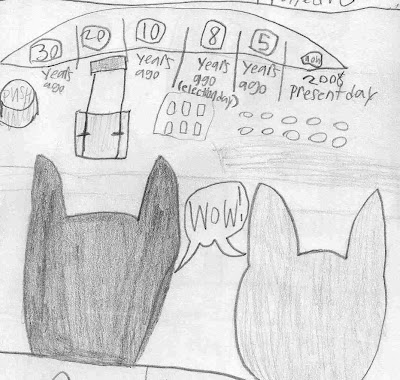
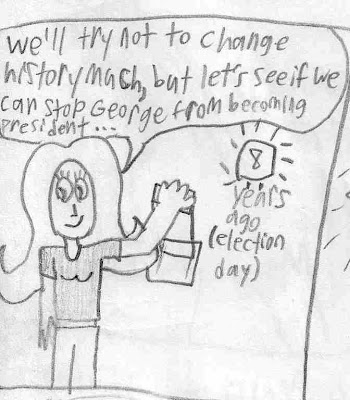
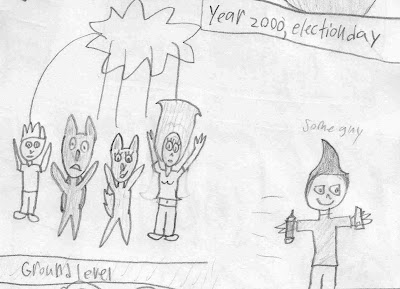
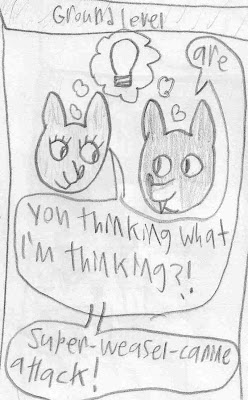
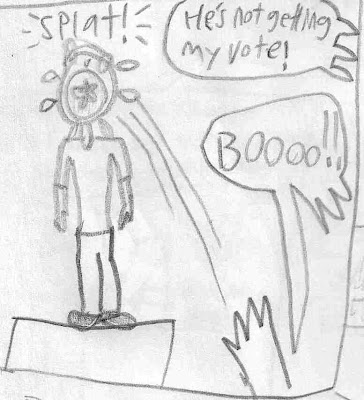
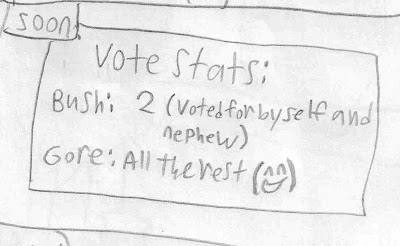
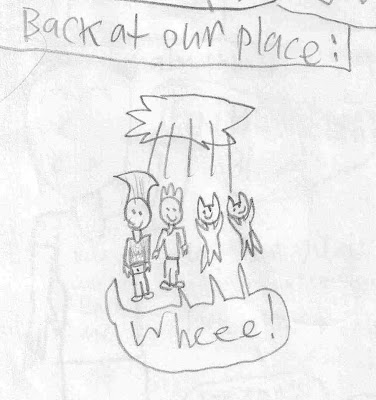
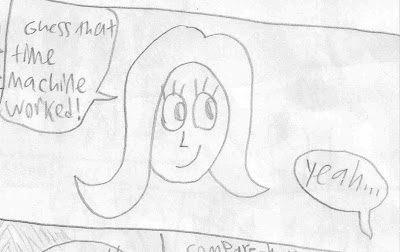
Today is election day in Canada. A few days ago I was explaining about voting and elections during our Baha'i class, and that inspired 14 year old Silvie to write the following comic about when Gabby and Bea go back in time to influence the outcome of a recent election that took place south of the border. The kids these days are heavily influenced by the view of recent history expounded in An Inconvenient Truth, which their teachers show to them often. Although I have no problem with that, it would be good if there were access to a variety of historical viewpoints beyond Al Gore's sour grapes. Anyway, here is the story, called:

Gabby and Bea and the Time Machine


Note the fox Bea, crazy like a fox, is purring, pretending to be a cat, which makes her even more cute...


Even the cars would have solar panels. Oh, what a better world it would be with so little intervention. If only ...

::

Perfecting families

Perfection in the Family


Panorthosia, Chapter 21, paragraphs 2 and 3
By John Taylor; 2008 Oct 14, 17 Mashiyyat 165 BE


In the second paragraph of this family chapter of the Panorthosia, Comenius points to some of the many precedents in scripture for putting family first. He singles out Psalm 101, which, he says, "shows how David on perceiving that he was destined by God to hold the reins of kingship, proposed first and foremost to purify his household again." Comenius did not need to go into the Psalm's details, but I for one could do with a refresher. The prayer starts off,

"I will sing of mercy and judgment: unto thee, O LORD, will I sing. I will behave myself wisely in a perfect way. O when wilt thou come unto me? I will walk within my house with a perfect heart." (KJV)

Family is a training ground for perfection. A perfect heart, the Psalm implies, comes about by combining compassion with justice. Mercy and judgment are normally thought of as mutually exclusive but the quality of wisdom can balance them out. Of course, this is especially difficult to do in the close confines of domestic life -- which is why David is determined to walk there with a "perfect heart." Whereas conflicts with outsiders are aerated and cooled by regular separations, conflicts under the same roof tend to act like greenhouse gases preventing the heat of ill will from being vented. As oppressive tensions rise, violence or divorce often result. Worse, any breaches in a household harm everyone, not just the parties who are in dispute.

A family whose members "walk with a perfect heart" are determined to serve God by acting as moral filters to one another, by turning attention away from faultfinding and wrongdoing and instead concentrating on the unity and example of God, whose "eyes shall be upon the faithful of the land, that they may dwell with me: he that walketh in a perfect way, he shall serve me." This is one reason, perhaps, why the perfect Baha'i chose to call Himself by the title "servant," Abdu'l-Baha.

Perfection, then, is the use of wisdom in applying two principles; tolerantly forgiving flaws while still maintaining a teaching relationship, judging when it is timely to change and improve one another. This is also confirmed by Baha'u'llah in the third Taraz, "This Wronged One exhorteth the peoples of the world to observe tolerance and righteousness, which are two lights amidst the darkness of the world and two educators for the edification of mankind." (Tablets, 36) He repeats this in the Lawh-i-Maqsud, "The heaven of true understanding shineth resplendent with the light of two luminaries: tolerance and righteousness." (Tablets, 169-170)

The family Psalm continues, going on to condemn obstructions to teaching, including pride, disobedience, insolence and estrangement. Note the special attention to backbiting.

"I will set no wicked thing before mine eyes: I hate the work of them that turn aside; it shall not cleave to me. A froward heart shall depart from me: I will not know a wicked person. Whoso privily slandereth his neighbour, him will I cut off: him that hath an high look and a proud heart will not I suffer."

The intimate confines of a home can turn it into a seedbed of wrongs and a shelter of oppression, especially if the natural human habits of rebellion and backstabbing are not strictly curtailed. The 101st Psalm thus also condemns lying and intrigue, evil habits which rapidly obliterate happiness and unity in a family.

"He that worketh deceit shall not dwell within my house: he that telleth lies shall not tarry in my sight..."

Not only is truthfulness the foundation of character, it is the basis of family happiness as well. It is a strict condition of membership in any family under God.

As mentioned, Comenius is aiming in this chapter at a family constitution, one that each family would devise itself. He plainly has in mind that a Christian family would use this Psalm as a preamble to their constitution and I see no reason why a Baha'i family should not use it as well.

The balance of the second paragraph of Comenius's discussion of family is concerned with other examples of Old Testament prophets, heads of families one and all, whose teaching about God started by transforming their own households.

"The patriarchs of old set a good example by beginning with their own families whenever they desired to reform human affairs in times of decadence. When Abraham was summoned to leave the company of idolaters, he did his best to instil into his children and his household the knowledge of God, and the observance of His ways, and the practice of justice and judgement, on the recommendation of God Himself (Genesis 18:19). Also, although Jacob had met with great blessing from God in the increase of his family and his wealth, and had engaged in conflict with God's help and received the title of Conqueror, yet when he knew of the hatred of his brother towards him and saw the stain of guilt upon his household (from the defilement of his daughter and the bloody crime of his sons), he set his mind to the reform of his entire household (Genesis 35: 2,3,4).

I would add that Job too was an example of this. His afflictions began with the violent death of most of his family and, after his passion and as part of his recompense, it ended with the gift of a new, even larger extended household. Baha'u'llah tells the Baha'i version of Job's story in the Surih-i-Sabr,

"We solaced his eyes by the joy of his family and we fulfilled what We had promised the patient ones in all the holy and preserved Tablets. We made good all his affairs and We confirmed him with (the) mighty arm of Our revelation."

Comenius continues in the third paragraph, comparing the virtue orientation of a pious family to the materialism of one that is not.

"So long as holy examples such as these are generally disregarded, the effect is to produce households which are mainly no better than pigsties or cattle-stalls where food for their bellies is the only thing they care about,' and further confusion is caused by the lack of agreement, faith, and virtue between husbands and wives, parents and children, masters and servants."

The obstacles to happy family life do not change over the centuries, do they? It is astonishing to read this so long before advertising learned to pipe materialist propaganda right into every living room. Now a "pigsty" philosophy of family is the norm.

We need, Comenius is telling us, to put a great deal more effort into holding up examples of successful families and keeping our attention on that.

I often think of an incident that happened in the late 1980's in Hamilton. The local paper, the Spectator, reported how a family volunteered to have its daily interactions videotaped for an early "reality show" on television. Only a few episodes were broadcast because as soon as child welfare authorities viewed it they shut it down, so perverse and abusive were the parent's methods of "discipline." Later at the child custody trial it was said in their defence that if they had had an inkling that their family was doing wrong or that they were in any way out of the bounds of normality, they would not have volunteered for the show.

To me this demonstrates what Comenius is warning against. Unless families are exposed to training and good examples to aim at, family leaders will work in a vacuum. They will assume that whatever they do is good, normal and adequate. In less crucial areas we routinely dole out rewards for excellence, why not the family?

As an example, Macleans Magazine produces an influential annual list of the best universities in Canada, as well as a list of the hundred best companies to work for. I know of no such journalistic work being done to rate and measure the best households. In their last survey of the best hundred employers, Macleans asked an interesting question of the bosses whose company had won: What was the worst job you have ever had? It transpires in the article that these executives had learned from their worst job what not to do. When they went on to better jobs and eventually became boss later on they were determined to improve upon what they had suffered. At least two of those interviewed had even come up with their own profit sharing plan. The conclusion of the article says,


"Top 100 executives Macleans talked to all have one thing in common: they recognize that their companies will never be better than the people who work there. That is why they are making sure that the suffering they endured at their bad workplaces was not in vain. They do not want the poor leadership, petty internal wars, deaf management and suffocating rules that drove them away from previous employers to drive away the best and brightest from the companies they work for now. It is not a bad way to check whether your workplace really is doing everything it should to keep workers happy and productive." ("How backstabbers, evil bosses and dumb rules taught our top firms what not to do", )


If a survey of the best hundred families were taken, would their members tell a similar story? It is impossible to say, since nobody in our corporate run, privately owned press is bothering to pay any attention at all to the health of families. Unfortunately, advertisers see profit in the breakup and multiplication of households and are unwilling to support what might help keep families together. In the rest of the third paragraph, Comenius points out the harm that weakened families, concerned only with sustenance and pleasure, those embroiled the "pig sty" philosophy promoted by advertising, do to the broader political institutions that are derived from the family foundation,


"... This evil infection has a very damaging effect on the life of the state and defeats any effort to put an end to the world's confusions either by the spiritual power of the Word and the Keys ("Behold -- I have the keys of hell and of death" (Revelation 1:18)) or the political weapon of execution. Consequently if there is desire for reform, it is necessary to seek out and overcome this plague of tares that is rooted in the grass itself."


Comenius makes an interesting point. Healthy families, among other things, would bring down crime rates. If so, why not tie funding of prisons and punitive measures to investment in family support, the ultimate crime prevention? Would it pay to put one dollar reform the family for every dollar that goes into policing and the military? That is a question that is not being seriously considered, since eliminating the influence of materialist philosophy on the family, the "tares sown among the wheat," would go for the jugular of the reigning ideology.

As things are, it would be very inexpensive to devise a family constitution based on Comenius's plan in this chapter, and then distribute it on the Web. This could then form an open template to adapt to particular family websites and other virtual locations. That way a tested family constitution would be available to all families, who could then design households based on that model.

Monday, October 13, 2008

TAILLESS MOUSE

From Badi Blog


The Coming of the Kingdom

This comic book we picked up in the bookstore at Louhelen at the insistence of 9 year old Tomaso. We read a couple of pages and it was clear that this was a complex argument about prophesy aimed at Christians investigating the Faith. Tomaso was undeterred and insisted we go through it during our Baha'i classes. 14 year old Silvie was not fooled and protested weakly that this was not a kid's comic. It took us over a month but we finally finished it. It has some nice prophetic references that I was not aware of. In some ways it is heavier than Thief in the Night, though much shorter. As well it has some good illustrations. This is the only place I have seen where the portraits of the kings and queen Baha'u'llah wrote to are in full color. Recommended for contacts, not children's classes.


From Badi Blog


The Golden Jungle
Carmel Publishing, New Delhi, 3rd Ed., 2002,


This series of four booklets from India Silvie insisted we read, though it is written for much younger children. It is highly didactic and moralizing in tone, and even Tomaso was protesting at the alternative spelling and diction. He was constantly asking, "Is not that a mistake?" No, they have their own ways of speaking English in India... The first few stories about forest animals were soppy and bland in the extreme. That seems to have lulled them into low expectations, because the following story hit them like like a brick. They were utterly shocked in the first reading, protesting, "You cannot put that in a children's story!" Tonight they insisted on reading it to their mother, and this time they were laughing all the way through. I insisted that Tomaso read it aloud, since, unlike most of what we read in these classes, it is at his reading skill level. A highly successful story, though probably for the wrong reasons. What do you think, is this appropriate?

from: Book One, Meera Saves Squirrel

THE TAILLESS MOUSE

This is the story of a little mouse who lived with his father, mother and eleven sisters and brothers. He was always obedient to his parents and he loved his, brothers and sisters.

His mother taught him to be honest and good to others. She also taught him to take her permission for going anywhere, so that he may not get into trouble. "Yes Mom," he would say. And they were all very happy.

But the little mouse got into a big trouble when he forgot his mother's advice. This is how it happened.

Diwali is one of the most important Indian Festivals. It is a very happy occasion. People decorate their houses and prepare, many sweets. They visit and greet each other saying, "Happy Diwali!" In the evenings the people fire many crackers and rockets and set off other types of fireworks.

The little mouse was very excited to see all this. "We have to get some of those crackers," the little mouse said to his friends. At first they hesitated -to join him in the mischief. However, they gave in when he insisted.

The three of them hid behind a bush near a pile of Fireworks the children had made. One by one these were fired by the children. Everyone enjoyed the sight of the rockets bursting high in the sky.
The mice waited patiently until the children were gone. When all was clear they dashed out and picked up one of the biggest and heaviest of the rockets.

"Be quick!" cried the little mouse as the three of them struggled to carry the rocket away.

Soon the mice were out of sight. They managed to place the rocket stick into the ground and aimed it towards the sky.

"We need matches to fire the rocket," said one of them.

"I will go and fetch one," replied the little mouse. Soon he was back with a big match box that he had stolen from the children.

"Wow, this is a great moment in my life. This event will be written in mouse history... the first mouse to fire a rocket into space!" the naughty mouse announced.

"I will hold the stick tightly while you light the wick," he said, not realizing that it was dangerous to hold onto the rocket stick. (The safe way to fire a rocket is to light the wick and then immediately move away a safe distance from it.)

"Five, four, three, two, one, fire!" screamed the naughty little mouse.

Within a moment the rocket zoomed up into the sky carrying the terrified little mouse with it. He did not know what to do as he flew up into the air along with the burning rocket. All he could think of was to hold fast to the stick.

He looked below once and got a big fright when he saw how high he was flying. Then he saw the kind face of his mother. She had always been telling him to stay out of mischief and not go anywhere without her permission.

As he flew higher through the clouds, he overcame his fears and began to enjoy the flight. "Rocket flying is fun, he decided."I have gone where no mouse has gone before!" He was full of such thoughts when the rocket burst with a big bang. This time the noise was terrific. The poor mouse somersaulted in the air and began falling towards the earth at a terrible speed. He began screaming and crying, but there was no one to help him. He shut his eyes so that he would not see his end. Again he began talking to his mother, promising to be good. But it seemed there was little chance of his survival.

"Oh Mommy," he sobbed, "if I stay alive this time, I will never touch anything that does not belong to me, and I will never go anywhere without your permission!"

Now the little, mouse was very lucky for he splashed noisily head first into a puddle of mud. From his head to his tummy, he was stuck in the mud. Only his two legs and long tail were left sticking out. He struggled to get out but to no avail. He only managed to swallow mud.

The other two mice saw the big crash from a distance. They rushed over to the puddle and were astonished to see his legs and tail sticking out of the mud.

"Let us pull his legs to get him out." They began pulling his legs in two opposite directions. They could not hear their friend screaming in pain. And as he screamed, he swallowed more mud.

"This is not working, let us pull on his tail," one of his friends suggested. They pulled and pulled with all their strength. The poor mouse's tail stretched and stretched and finally snapped right off! But the poor mouse was still stuck in the mud.

Again, the little mouse cried out in pain, swallowing even more mud. Not only did it hurt him, but it hurt his pride. His tail, as with all mice, was a sign of dignity and honour.

"Let us pull his legs in the same direction... I hope his legs do, not break off so easily," one of them said. They quickly pulled him out of the mud.

He was half dead, covered with mud, and without his jail. His friends forced the mud out of his stomach, revived him, and washed him with water from a clean pond nearby.

His friends tried to console him by telling him his mother would stitch his tail back on. Finally they gave him his tail and sent him home.

He told the whole story to his mother who was shocked to see her child in such a terrible condition. "Mommy! My tail!" sobbed the little mouse as he held it up to her."Oh, dear, what have you done to your beautiful tail?" said the mother. "My friends said you could stitch it back on for me."

"I will try, my dear." replied his mother, after hearing out his story. She got a thread and a big needle. As she stuck the needle into his back he shouted and screamed with pain. His mother did it again. But she soon realized; could not be fixed.

"I doubt if we could fix it. It is better to hang it on the wall in your room as a reminder to stay away from mischief." said the mother.
The little mouse grew up to be wise and well behaved and became known as the Tailless Mouse. He never forgot his lesson.


After we finished reading this story they protested to us: using body parts to teach a lesson, isn't that horrible?

Momka and I told them that they should try German fairy tales if they want shocking, what with their obsession with child cannibalism. Still, you cannot accuse the brothers Grimm of being patronizing, as this story no doubt is... Anyway, I really am interested in your opinion as to whether this story is appropriate or not. Is it possible to be funny without being politically incorrect? Is it appropriate to be unintentionally funny like this?

::

Sunday, October 12, 2008

Paragraph One: back to that old time family

The Particular Reform of Families.

By John Taylor; 2008 Oct 12, 15 Mashiyyat 165 BE


Jan Amos Comenius, Panorthosia, or Universal Reform, translated by A.M.O. Dobbie, Sheffield Academic Press, Sheffield, England, 1995 p. 29

Today let us launch into chapter Twenty-One of Jan Amos Comenius's Panorthosia. Previous chapters in this work have dealt at length with what Comenius rightly considers the first step to all reform, its Sine Qua Non, the reform of self. Now Comenius takes the next step, reformation of the first circle of unity outside the individual, the family.

By family Comenius intends a large (by our standards) working household run by an extended family, including everybody under one roof, relatives close and distant, live-in servants, children, pets, guests and lodgers. Such households more often than not ran a family business, including until about a century ago virtually all farms. As such, the family unit was by far the largest employer. Not only was a family expected to provide economic sustenance, it also made the clothing, managed the land, grew food, prepared and served meals, and handled many recycling, reusing, composting, and welfare provisions, including "pensions" for the aged, that long ago were offloaded to the state.

Such large households have been around far longer than our present nuclear family and for that reason are probably more natural to the human emotional makeup. Many mental and physical illnesses, drug dependencies and other afflictions would be cured or alleviated if a greater proportion of the population lived in the sort of active, well ordered household that Comenius is aiming for here. In addition, such high-density housing arrangements are easier on the environment (they eliminate urban sprawl and take advantage of economies of scale in infrastructure). For these and other reasons, planners should encourage such housing arrangements in both urban and rural settings.

As we shall see, the measures Comenius suggests in this chapter would enable larger homes not only to become an attractive choice for a larger proportion of the population but also they could help attain that Holy Grail of modern governance, full employment. He begins by saying,

"The next stage will be for each of us to proceed from his own individual reform according to God's pleasure and reform those who are in his immediate family circle, firstly because virtue begins by exerting its influence on its immediate neighbourhood, and secondly because this is a step towards the reform of the state and the church, which are composed of families."

As Comenius points out, both religion and politics are nothing more than aggregations and extensions of the family unit. To weaken the family is to banish faith to irrelevance and doom the state to over-centralization and eventually some form of tyranny. So long has the family been suppressed, divided and neutralized that this is often forgotten today.

Also overlooked is the fact that a well run household is the first training ground for leaders. An exceptionally efficient head of a family is in a perfect position to extend his or her management skills to service on a broader scale. As such, it is a winnower of democratic choice. A voter who knows the best heads of households in a community has no need of nomination or political parties to artificially narrow her choices, she need only pick from members of the most unified, efficient families.

Comenius goes on to make the point that managers ought to take advantage of family as a laboratory for their ideas and plans for change. If a change does not catch on in your own household, what are the chances of success in a wider arena?

"It is especially necessary for every one of those who have been honoured with a call to leading positions in politics or the church (regardless of their denomination) to look in the first instance at his own family which is a miniature form of state and church combined, and to think how to bring it up to an ideal standard, as he will find it easier and safer to advance from the smaller to the larger."

For Baha'is, the core of the family as "church" is the twice daily gathering together in order to pray and read from Holy Writ. Since the family is already together at these times, it is natural to consult about plans and divvy up service to the household, i.e., the "state" function of family. Since Baha'u'llah stipulated that this meeting occur at morning and evening, the every day is bracketed by attention to these two central functions of family, according to Comenius, church and state, spiritual and physical.

This morning I started this experiment suggested by Comenius with our family, which has been in the doldrums lately. It was painful at times but we made good progress. Tomorrow we will go on to the second paragraph of Panorthosia applied at the household level.

::

Saturday, October 11, 2008

God’s Dwelling Place

God’s Dwelling Place; A Family Constitution, I

By John Taylor; 2008 Oct 11, 14 Mashiyyat 165 BE

The Particular Reform of Families; Panorthosia, Chapter Twenty-One

This past spring and summer I went through Comenius's Panorthosia in detail. Looking back over the whole two volume opus, I am persuaded more than ever that this is one of the most important books ever written, little known as it may be. Its title in Latin means "universal reform," and its universal approach is unique and essential, not just from the perspective of the history of ideas but that of the futurist and reformer, anyone who asks, "Where do we go from here?" I have been working for decades on plans and proposals for world governance, and yet this book, written in the 16th Century, is in many ways far in advance of my boldest ideas, my most high tech proposals and imaginative prognostications.

When I came across the twenty-first chapter, The Particular Reform of Families, I knew immediately that this was where I had to begin writing, not because it is better than the rest of the Panorthosia but because we, as a society, are most in need of it. As the West sets into decline and fall, the family, the foundation of all corporate life, is under siege. Its walls are routinely breached for implacable enemies to rush impetuously in from all quarters.

But most of all I am starting here because Comenius offers in this chapter, for the first and only time in history that I know of, a constitution for the family. As the head of a large extended family household, the sort which is rare to non-existent in otherwise advanced nations today, Comenius was in a position to offer a clear set of criteria by which a large home's health can be measured and improved. Nor is he dogmatic about it, he offers his experience in applying a constitution only as a model for what we would now call an open Wiki document, revised in light of local experience and of professionals researching more universal factors. We will discuss his suggested constitution in detail in upcoming essays. Let me start, though, before going into detail, by taking a step back to take a more distant overview of Comenius's family constitution.

In the last sentence of this twenty first chapter Comenius offers an official reward and public face to the household's constitution. If it attains to the highest excellence in living up to its standards and goals, a family gains the right to post above their door the following inscription:

"THIS IS THE DWELLING PLACE OF VIRTUE, ORDER, AGREEMENT, AND GOD AMONGST MEN! Therefore let nothing that is evil ever enter it!"

This public notice, placed over the door of a successful, thriving household, ties that family to its laws, to a constitution that Comenius proposes be posted within the household, as well as a sheet listing clear tasks and duties for every member of the household. This public declaration is very similar to the badges of merit that I have been proposing be designed into standard personal and national websites. Such merit badges are commonplace in industry --a local pickle factory in Dunnville sports on its wall facing the road a large placard proclaiming that it has lived up to the standards of some ISO professional standards organization with a long alphabet soup acronym. However, there are no such systematized rules and standards for the foundational political entity, the family.

Nor is this declaration restricted to families. Comenius devised similar mottos for individuals, churches, research institutes, nations, and many other types of institutions, based on his overall plan for what the title of the book says, universal reform. In post-Internet language, these mottos would form a portal by which surfers could enter the various levels of society. For example, a tourist might wish to tour most advanced households in an area, or the most in need, or the most improved, and so forth. Thus the public face of a household is tied directly to universal standards, to real achievements of its members, individually and collectively. Merit rather than wealth or pride determines the beauty and impressiveness of its facade, both real and virtual.

Note that, characteristic of Comenius, this family "merit badge" ends with a protective statement: "let nothing evil enter here."

It is the clear duty of every political entity not only to grow but to protect what it has from attack. This is especially so when there are children involved, who do not have the defences that adults have, and whose wounds, psychic and physical, often last a lifetime. And the family household is the only political institution that has direct contact with children in their tenderest stages of development. That is why I love the fact that the second half of this declaration makes the family irreconcilably opposed to letting the slightest evil enter. The need for this generally was recognized by Heraclitus as well,

"The people should fight for their laws, as for their walls." (Frag. 44)

In earlier times the walls of a city were its only defence against the assault of wild beasts, human or animal. Heraclitus saw that in future the true wall of protection will not be physical walls but laws and constitutions, and that the lives and safety of everybody within a political grouping will depend upon its defence. Thus Comenius's succinct declaration above the doors of a home assures that all are aware, members and outsiders, that the true walls of protection of a family are its laws and constitution.

There are many enemies to the family, but nobody can doubt that its most dangerous foe are, as we detailed in yesterday's essay, commercial values and self-help ideas.

Advertising invades the mind from the tenderest age. International corporations spend vast sums brainwashing the young against the one institution designed primarily for them, the family. As we saw yesterday, materialistic values "maintain that the purpose of life is pleasure and happiness, while a spiritual view holds that the purpose of life is service to humanity and the development of virtues." (http://badiblog.blogspot.com/2008/10/shams-i-imrikai.html) It is the declared goal of advertisers to get around what they call the "gatekeepers" of the hearts and minds of children; in the case of the Internet, they have done this by removing all gates completely. Now, the most vulnerable members of society, the ones in whom our future rests, are entirely unprotected from the worst that animal passions can spew out to them.

How are we "gatekeepers" of society ever to erect protective legal walls for households in the face of constant assaults by siege-works made by wealthy, powerful enemies? Whatever the walls we erect look like, they would be improved by Comenius's suggestion for a universal plan.

Next time I will plunge into the details of his learned, theoretical argument for a family constitution.

Friday, October 10, 2008

Shams-i-Imrika'i

SHAM Addiction and Marriage

By John Taylor; 2008 Oct 10, 13 Mashiyyat 165 BE

Our clunker, which the kids name "Anzuf," had to get its Clean Air test yesterday. Anzuf getting almost old enough to be exempt from the emissions test as an antique. Anyway, I heard that beaters like Anzuf are more likely to pass if you run the engine for at least a half hour before the test, so I made an excuse to go to Port Colborne and get an electric bicycle repaired just before the examination. After leaving the bike shop, I dropped into the Port Colborne library and became embroiled in a book called SHAM. Thanks to SHAM, I was ten minutes late for Anzuf's test. Fortunately, Anzuf did pass, with flying colors. Anyway, the full reference for SHAM is:

"SHAM, How the self help movement made America helpless," Steve Salerno, Crown Publishers, New York, 2005

The book is dedicated "To mom and dad and the other members of their generation who, thank God, were co-dependent enough to put their kids first." Clearly, this is a conservative voice. The acronym SHAM, by the way, stands for "Self Help and Actualization Movement." This author sets out to prove that SHAM really is a sham, a scam, a clever way of skimming money from gullible people who long to better themselves. Instead of offering real advice based on science, complete with footnotes to substantive studies, as the old self help books of the 20th Century did, this new generation of self help gurus set themselves up as authorities. They spout nonsense, eschew science and do incalculable harm to their listeners and society at large.

"To a disconcerting degree, (SHAM) is an 8.56 billion dollar social crusade about nothing. Is a religion whose clerics get very, very rich by stating the obvious in a laughably pontifical fashion. (One guru said:) "Life is a process. We are a process. The Universe is a process." To which a cynic might add: "Making airy, asinine statements meant to impress or hoodwink gullible people is also a process." (16)

One of the worst of the lot, according to Salerno, is Alcoholics Anonymous, and the hundreds of 12 step programs that it has spawned. He points out one thing that had bothered me, that in order to perpetuate itself it must label alcoholism as a disease, a lifetime condition that can only be alleviated, never cured. This puts its adherents into the position of being helpless victims, infantilizing them forever. The leaders are what Christ called the blind leading the blind; they have to be permanent patients, or they do not qualify to be members, much less leaders. This turns the normal order of knowledge on its head.

"At meetings of alcoholics anonymous and other support groups, the leaders' sole credential may consist of his being in recovery from whatever the specific addiction is. Society, again, seems to think that this makes good sense. I would ask two questions: is it not possible that fellow sufferers are a bit too close to the problem to lead effectively and impartially? And if your problem was, say, that the electrical fixtures in your house were getting funky, would you really want a workshop taught by some other homeowner who could not get his lights to work right (and who, by his own admission, still had the problem?) Or would you want a trained electrician?" (SHAM, p. 15)

Personally, I found this argument pretty devastating. Worse, SHAM holds, AA has actively suppressed studies that found their program ineffective compared to other, expertise based addiction therapies. That is dishonest, corrupt and really unforgivable. If there are better ways of dealing with addictions it is in everybody's interest that they be better known.

My brother is heavily involved in AA and gobbles up self help books by the dozen, and I was involved in Al-anon for a couple of years, before the lifelong prescription began to weigh on me. Never is there even a mention of the virtue of temperance in their meetings. Instead of virtue crowding out vice, we have unending victimhood coping with a permanent condition.

But still, I regarded 12 step programs as a good thing for some people. Mostly, my problem with the movement was its wimpy stand on alcohol. Instead of trying to extirpate from society a harmful substance, they passively take all fault and guilt upon themselves, more perhaps than makes sense. They never denounce the liquid; the problem is in themselves, the percentage of drinkers who cannot handle it. Self-labelled alcoholics are diseased, not a world where 95 percent of the population imbibes. Permanent enslavement makes the worst victims of alcoholism willing collaborators, tolerating a boozy society without a peep of protest.

Another startling point made in SHAM is about marriage. The self help movement is a contributor to rising divorce rates because it has turned husbands and wives away from the purpose of marriage. "Nowadays young marrieds of both genders may be a tad too focused on their own fulfillment, with catastrophic effects for domestic tranquility." SHAM, citing an interview with David Blankenhorn in 1988, continues,

"`I think people today are less forgiving and relationships and more inclined to walk at the drop of a hat.' He made an interesting point about the famous JFK quote ask not what your country can do for you... and its relevance to a wholesale change in society’s perspective on the institution of marriage. `In years past, getting married was more of a selfless act. You do that in order to build something bigger than you -- a family -- and to be able to give what you could to the children of that union. That is all changed... People go into a marriage expecting to a far greater extent to have their own needs met. Instead of giving to the marriage, they want much more from the marriage. And often what they want is unrealistic.' It is hard to see such mental turnabouts as anything other than a consequence of SHAM-bred insights." (SHAM, p. 36)

Having just attended a weekend-long session about the Baha'i position on marriage and homosexuality, I can say that this point is one that we need to make much more forcefully. I think even the Writings tend to assume that people enter marriage out of altruism rather than ego fulfilment; but that is no longer an assumption that can stand up twenty years after Blankenhorn said that. Today selfishness, or if you prefer, self-actualization, is the default position, assumed by virtually everybody who gets married. Whether that is the fault of the self help movement or of materialism generally, is moot.

The following excellent points about the difference between Baha'i and materialist approaches to sex and marriage were made by our speaker at the sexual identity conference, Mary Kay Radpour,

"Contemporary American values undermine social order and the idea of service as a purpose of life. The Baha'i writings propose that one of the "patent evils" which has been engendered in the American nation is a distortion of our understanding of a chaste and holy life. A materialistic view holds that the purpose of life is pleasure and happiness. A spiritual view holds that the purpose of life is service to humanity and the development of virtues."

Thursday, October 09, 2008

News about ongoing persecution of Baha'is

Iran Press Watch: The Baha’i Community

http://iranpresswatch.wordpress.com/

::

Dawn Breakers Film Festival

Breakers International Film Festival '08

...an audience of 3,500 from across the world - Welcoming the regular attendees from across the US, Canada, New Zealand, Australia, England, India & South Africa.

...showcasing unique films from every corner of the globe.

Filmmakers are advised that their project be BY, FOR or ABOUT the Baha'is.

Films "BY" should be written, directed and/or produced by a Baha'i.

Films "ABOUT" portray the Baha'i Faith and/or its related issues in a dignified manner


The festival accepts films from around the globe, in any language (English subtitles for non-English films are preferred, but not required)

Categories: Feature, Documentary, Short, Animation and Music Videos.

For more information, go to:

http://www.kdkfactory.com/dbiff/submit.html

:::

Principle, the Magnet of Polity

Magnet of Polity

By John Taylor; 2008 Oct 09, 12 Mashiyyat 165 BE

This blog lately featured powerful words of Baha'u'llah discussing "entities of a new Creation." These entities result from a profound revolutionary transformation going on simultaneously in this world and the realm of Spirit. Like a pure, illumined mirror, the spiritual world reflects light into this dark material realm, and with the arrival of the Word both spiritual and material at once are upset, reconnect and come together utterly changed. Front and center to this, Baha'u'llah lays heavy emphasis on several simple aphorisms, such as, "this earth is but one country" and "ye are all the leaves of one tree and the fruit of one branch." By such slogans Baha'u'llah taught that the bond between humans is primarily a condition of a greater Oneness radiating out from One God to an invisible world, one of spirit and absolute truth. All that we see in the material world is an outcome of this underlying Oneness. Baha'u'llah warned:

"Beware, O believers in the Unity of God, lest ye be tempted to make any distinction between any of the Manifestations of His Cause, or to discriminate against the signs that have accompanied and proclaimed their revelation. This indeed is the true meaning of Divine Unity, if ye be of them that apprehend and believe this truth." (Gleanings, 24)

The world is in such crisis now because lesser unities, like iron filings placed in proximity to a magnet, must be torn apart and re-orient themselves around the highest unity, the unity of God. This means simultaneous destruction and reconnection, as expressed in Heraclitus's aphorism,

"The way up and the way down are one and the same." (Fragment. 60)

From a purely socio-political point of view these unity statements lay the groundwork for a new and, for the first time, universal basis of unity, the oneness of all humankind. This new kind of unity is creating a form of governance that Aristotle termed "polity." A polity comes into being when individuals and groups, the one, the few and the many learn to subordinate their own limited interests, eschew partisan loyalties and place first and foremost the interests of the whole, the entire political entity.

Abdu'l-Baha helped us understand this by asking that we imagine "circles of unity" or "circles of love" radiating out from the self to the family, the neighbourhood, the city, the nation, and finally the whole world, and then back again. These circles of love are all imperfect and inadequate on their own. For example, love of self can fail when a person despairs and commits suicide; unity of race is flawed because one often sees members of the same race hate one another; love of family is not enough because relatives are known to kill one another, and so forth. However when the circles of love and unity connect with the hidden but powerful magnetic fields of the great invisible magnet of reality, the Word or Logos, a single pattern emerges that is harmonious and beautiful, each circle complementing and aiding the circles beside it. This is what the Guardian called the Polity of Baha'u'llah, in other words, the Baha'i principles.

The two poles orienting this polity magnet, its north and south, are the two pivotal principles, the investigation of reality and the oneness of humanity. When everything aligns with these unseen lines of force radiating between these two principles, chaos, weakness and conflict disappear and "entities of a new creation" fall into place naturally. The individual seeker is sincere, as Aeschylus put it, "His resolve is not to seem the bravest, but to be." My resolve is not to display truth for particular ends, but to be true to the reality I discover. At the same time the interest of all humankind is not seen as a mindless machine but rather the direct outcome and expression of the Will of a divine, loving Creator.

Without the spiritual foundation of the Oneness of God, polity would be inconceivable. None but the Divine Mind can understand what we, limited in time and space, view only in narrow, flawed and finite terms. Ours is but to orient ourselves in our own search to the needs of God and all humanity, and remain steadfast and confident that such alignment is orienting more and more individuals around the planet in the same way.

I want to end with what I think is an apposite description in his own words of how one of the founders of modern science, Rene Descartes, set about his own program of reform.

==========

from: Descartes, Discourse on Method, p. 37

(No reformer demolishes a whole town's streets and buildings) rebuilding them in a different way to make the streets more beautiful; but one does see many people knock down their own in order to rebuild them, and that even in some cases they have to do this because the houses are in danger of falling down and the foundations are insecure.

With this example in mind, I felt convinced that it would be unreasonable for an individual to conceive the plan of reforming a State by changing everything from the foundations up and by overthrowing it in order to set it up again, or even to reform the body of the sciences or the order established in our schools for teaching it, but that, on the other hand, as far as all the opinions I had accepted hitherto were concerned, I could not do better than undertake once and for all to be rid of them in order to replace them afterwards either by better ones, or even by the same, once I had adjusted them by the plumb-line of reason.

And I firmly believed that, by this means, I would succeed in ordering my life much better than if I built only on old foundations and leaned on principles inculcated in me in youth without having ever examined them to see if they were true."

Wednesday, October 08, 2008

Propaganda, Fundamentalism and Sports

Master Talk in Paris on Fundamentalism

By John Taylor; 2008 Oct 08, 11 Mashiyyat 165 BE


In our daily study session the kids and I have been going through Paris Talks, perhaps my most beloved Baha'i book. When several other books seemed inadequate for our purposes (we have gone over the lives of Baha'u'llah and Abdu'l-Baha so often that I fear it will soon bore them -- I certainly have had enough for now) I suddenly realized that the simple, direct words in this book make it perfect for reading with children.


The Master seems to have visited Paris, the center of Western culture, with little in mind other than to convey a very simple, almost sparse message. Paris was unusual among the places the Master visited in the West. Unlike in English speaking lands, there seems to have been little attempt at widespread publicity in France, either because the Baha'is were small in number, being mostly expatriate Americans and other foreigners, or because of a lack of receptivity among Parisians, who were either secular materialists or strongly Roman Catholic. In any case, most of His talks were given in His own apartments to a small number of interested individuals. In these domestic rather than public surroundings the Master drew a broad sketch of what He was to say in greater detail six months later in America.


I have always thought of the text of this book as a sort of literary minefield. You walk down the garden path and look around to find these lovely sounding sentiments about niceness and light, then you look down at where you are walking. As soon as you think about what you are standing on Kaboom! -- an astonishing, mind blowing explosion of meaning. Take the most recent talk we read, called "Religious Prejudices." He starts off, taking us right down the center of the garden path.


"The basis of the teaching of Baha'u'llah is the Unity of Mankind, and his greatest desire was that love and goodwill should live in the heart of men." (Paris Talks, October 27th, 1911, 45-46)


Sure, so does just about everybody else. Who is not for peace and goodwill amongst men? Nice sentiments. But take a look down at the ground.


"As He exhorted the people to do away with strife and discord, so I wish to explain to you the principal reason of the unrest among nations."


The first time we tried to read this talk there was extreme unrest among my students, never mind among nations. They were bickering with one another insatiably and could not sit still for a second, so I broke off the class at this point and instead we watched some Baha'i internet videos that I had collected together for just such an emergency using an aggregator program called Miro. Even this did not help much but at least we got through the class. The next night we tried again. I find that by taking turns reading we can often go through much heavier material than this. All during the next day I was in suspense, though, wondering what could possibly be the reason for the unrest among nations. The next evening the kids were much more subdued and I got the chance to find out what causes the world's unrest.


"The chief cause is the misrepresentation of religion by the religious leaders and teachers."


Ahh. The mine goes off. Kaboom! Here is the original lie, a misrepresentation born like original sin out of all varieties of professional religious leadership. This Big Lie was in place long before Hitler and Goebbels appropriated it. But what did the religious leaders misrepresent? The Master goes on to explain,


"They teach their followers to believe that their own form of religion is the only one pleasing to God, and that followers of any other persuasion are condemned by the All-Loving Father and deprived of His Mercy and Grace. Hence arise among the peoples, disapproval, contempt, disputes and hatred. If these religious prejudices could be swept away, the nations would soon enjoy peace and concord."


Here is the discovery that Tolstoy laid out at length in his Confessions, the book that detailed here last spring. Tolstoy's discovery of the Great Lie prompted me to write an essay series on fundamentalism, of which this essay is yet another instalment.


In the talk, Abdu'l-Baha goes on to describe in detail a remarkable peroration that a Rabbi gave his flock when He attended a synagogue in Tiberius. I will not go into more detail, but the substance of the Master's observation is that religious leaders flatter their listeners, raise self esteem in them by telling them that God offers his great prophets to them as rewards of merit. The Jews were the chosen people because they were the best people in the world. Before there were Nobel Prizes, there were prophets of God. If a nation is worthy enough, God will reward it with a divine Visitor. Their only moral duty, then, is to hate those who were thus not honoured with God's approbation.


This is a deliberate lie about what religion is, and what it aims at. Religion is not an Academy Awards ceremony. In this sense, Baha'is and anti-theists agree completely, religion has been made into a cause of unrest for nefarious, corrupt and selfish reasons by a small professional elite. But then the Master goes on to tell of what one of the actual prophets taught. Muhammad did not flatter His flock, instead He berated the people saying, "Why do you not believe in the prophets of Israel, and especially Jesus?"


Later on, in America, the Master spoke more at length about the several other forms of prejudice deranging the world. But He never gave up on the religious strain of the disease, the one that in Paris He had labeled as the most virulent of all. On one occasion He said,


"One of the forms of prejudice which afflict the world of mankind is religious bigotry and fanaticism. When this hatred burns in human hearts, it becomes the cause of revolution, destruction, abasement of humankind and deprivation of the mercy of God. For the holy Manifestations and divine Founders of religion Themselves were completely unified in love and agreement, whereas Their followers are characterized by bitter antagonism and attitudes of hostility toward each other." (Promulgation, 337-338)


I think the reason that Abdu'l-Baha called religious prejudice the "chief cause" of unrest is that it served as a model for the many forms of propaganda -- systematic flattery and manipulation for selfish ends -- that now batter the mind at every turn today. The word "propaganda" was coined to describe the way the Catholic Church manipulated the public agenda, but now every element of society is heavily involved in some kind of lie or "spin" to make it look good and its opponents bad. In its article on Propaganda, the Encyclopaedia Britannica says,


"In many times and places in the past, the propagandist could profit handsomely by ignoring the welfare of a nation or the world and appealing to extremes of religious, racial, political, or economic fanaticism. This paid off very well, in the short run at least, within many subsystems. Today, however, this kind of propaganda can prove to be useless and even dangerous. The prudent propagandist has therefore to decide what mix of universalistic and particularistic symbolism will best serve his purposes at given times in given places. The choice is never an easy one: parochial or class-conscious or national groups may be aroused to the highest passions; and they are numerous and diverse and often highly incompatible with one another and with the imperatives of the nation or the world."


The fact is that religious leaders no longer have a monopoly on the Big Lie. Many groups are flattering their own and inciting hatred in out-groups, and many Big Lies cancel one another out. That does not help the cause of truth, though, because we become inured to lies and cease to seek truth or expect peace at all, ever.


Two examples. One, lately in Toronto two vandals expressed their election fever too boisterously by cutting the brake lines on the cars outside a meeting of one political party. Thus partisan fervour flares out into attempted mass murder. My question, why does not such an incident cause widespread soul searching about partisanship, propaganda and rabble rousing? Answer, because the media thrive on conflict. It sells more papers. And we expect it. We are used to the flattery and the bickering. It all seems natural and inevitable.


Another example. I just watched for the first time "The Bad News Bears." This I missed when it came out; the DVD cover assures us that was a low budget sleeper that turned into the most popular film of 1976. I thought it was a kid's film, a comedy, but I was shocked when I saw it. If there were such a thing as backbiting porn, this would be it. Words are used as weapons of mass spiritual destruction throughout. Future historians will look at that this story of a bunch of misfits who, led by a viciously verbally abusive drunk, make it to the little league championships and wonder, "Why did it not cause a sensation when in came out? Why was baseball not banned? Indeed, why were competitive sports not banned?" If I had seen this film when my kids were small I would never have let Silvie near a baseball diamond. As it was, she stuck it out one year and -- although the team won the championship -- she has not considered sports of any kind ever since. Baseball, seen through this film, is a training ground for conflict, contention all that is wrong with the world today. I know that is not true, that other sports have more influence, and that it is not all bad. Still, it seems to me that cooperative sports, where everybody wins and there is no zero sum outcome, (is there such a sport?) would seem like a better training ground for a world at peace.


Our ingrained habits and attitudes of false fundamentalism, the habit of telling Big Lies, flattery followed by incitement, do spring from religion, as the Master says. True religion forbids it, as Abdu'l-Baha emphatically did in His Will,


"O ye beloved of the Lord! In this sacred Dispensation, conflict and contention are in no wise permitted. Every aggressor deprives himself of God's grace." AB will and testament, 13


But I am starting to think that if we are ever going to get rid of propaganda -- systematized prejudice -- reformers and peace activists will need to quit picketing (or vandalizing) political functions and start protesting sports and games, for it is there the next generation are being systematically trained to accept flattery and to hate others without qualm or question. And it is there that the young must learn to take firm hold on God’s grace and learn never to be an aggressor.

Tuesday, October 07, 2008

strife is justice

Heraclitus; Dike eris, "strife is justice"

By John Taylor; 2008 Oct 07, 10 Mashiyyat 165 BE

John the Evangelist, known to early Christians as the beloved disciple, gained profound insight into the Message of Jesus not only by his long, close and direct personal relationship with the Master Himself, but also by his evident familiarity with the fragmentary writings of the Ephesian pre-Socratic philosopher Heraclitus. Being thus intimate with Biblical and philosophic traditions, John was in a position to combine the core teachings of both in the famous opening of his gospel,

"In the beginning was the Word, and the Word was with God, and the Word was God."

This idea of Word, or Logos, as the creative, divine essence of all things in the universe combined the religious genesis myth with the best that natural philosophy (known after the mid-19th Century as science) could offer. Indeed science has hardly gone beyond this Logos concept even today. More than a few physicists point to the implication of quantum mechanics that the entire universe is a giant calculating machine, performing essentially what Heraclitus saw as the task of Logos, what Baha'is call the Manifestation of God. In John's statement that "the Logos was with God, the Logos was God" we see the first glimmering of the Baha'i principle of harmony between science and religion.

The idea of Logos is characteristic of the many profound insights of Heraclitus, of which we only have snippets. I have unbounded admiration for him; I think he is among the greatest geniuses ever, and that he probably ranks as a minor prophet. Without his pioneering of terms like justice and "Logos," the Baha'i idea of the Manifestation of God would be incomprehensible. Baha'u'llah, for example, uses the idea of Logos, or "first Word," in the following meditation:

"I testify that no sooner had the First Word proceeded, through the potency of Thy will and purpose, out of His mouth, and the First Call gone forth from His lips than the whole creation was revolutionized, and all that are in the heavens and all that are on earth were stirred to the depths." (Baha'u'llah, Prayers and Meditations, CLXXVIII, p. 295)

Heraclitus did not use the Logos in isolation. It is inherent to his concept of justice. This in turn is part of the best known idea of Heraclitus, that everything is in flux, that the universe is ever changing,

"For, it is impossible to step twice in the same river." (Heraclitus, fr. 91)

Heraclitus's universe is a calculating machine, working according to binary principles, just like our computers of today. Just as a computer calculates with numbers that are no more than strings of ones and zeros, the stuff of the universe is ever leaning into existence and then quickly flaring off into nothingness. This is Heraclitus's concept of Dike Eris, or "strife is justice." Dike (meaning right) was a daughter of Zeus who sat at his right hand distributing justice; Eris or strife was the twin sister of the god of war, symbolizing the divisive words and attitudes that are the preconditions of physical confrontation. Thus justice is the one and strife the zero of the ever fluctuating binary processes of existence and non-being in the universe. Yet in the end, after all the ones and zeros are gone, what remains? Nothing. Hence, as Plato cited Heraclitus, "All things going and remaining not at all." The Wikipedia article on Dike eris further explains,

"Heraclitus here references the Scythian bow, the horns of which pointed forward unstrung but back strung, or the deformation of the cross-bar of the lyre under string tension. The palintropos of an object would therefore be its stinting from the growth of the current instant by the decay of the object of the previous. This identity-not-identity accounts for such statements as:[44]

"It is one and the same thing to be living and dead, awake or asleep, young or old."

"A change is the result of a change in balance."

"Cold things become warm, and what is warm cools; what is wet dries, and the parched is moistened."

Yet beyond this impersonal flux is a higher justice, a greater intelligence whose love infuses all with purpose and meaning. The great computer has a Programmer. Baha'u'llah uses very Heraclitean language in the continuation of the mediation begun above.

"Through that Word the realities of all created things were shaken, were divided, separated, scattered, combined and reunited, disclosing, in both the contingent world and the heavenly kingdom, entities of a new creation, and revealing, in the unseen realms, the signs and tokens of Thy unity and oneness." (Baha'u'llah, Prayers and Meditations, CLXXVIII, p. 295)

Heraclitus

From Badi Blog

Hendrick ter Brugghen's depiction of prophet, genius, hero and philosopher Heraclitus.

Monday, October 06, 2008

Soul Food in Brantford

If you have a chance to hear this musical evening I highly recommend it, especially Ms. Barstad. She is the best singer I have ever heard in person, bar none. If there is any justice in this world, she will be more famous than Madonna. Plus, Ed VandenDool wrote one of Silvie's favorite songs, "Counting Waves," about the pilgrimage to Acca; it is on Youtube if you want to hear it.

A soul-stirring exploration of the oneness of humanity through music, art, literature and the Baha’i writings

Performances by
Andrea Barstad
Ed, Janis and Jo VandenDool
Roozbih and Rahbar Rahimpoor

Artwork by Brantford Area Artists

Refreshments, Free Admission


Saturday, October 18, 2008
8 P.M.
North Park Vocational School Theatre
280 North Park Street,
Brantford, Ontario

Hosted by the Baha'i Community of Brantford

i