Thursday, October 18, 2007

Mrs. Javid's Fireside October 17, 2007

Visit to library and fireside
October 17, 2007


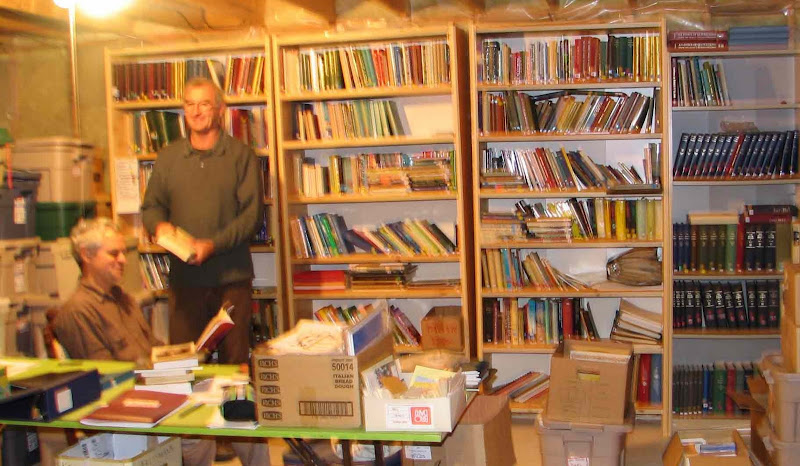
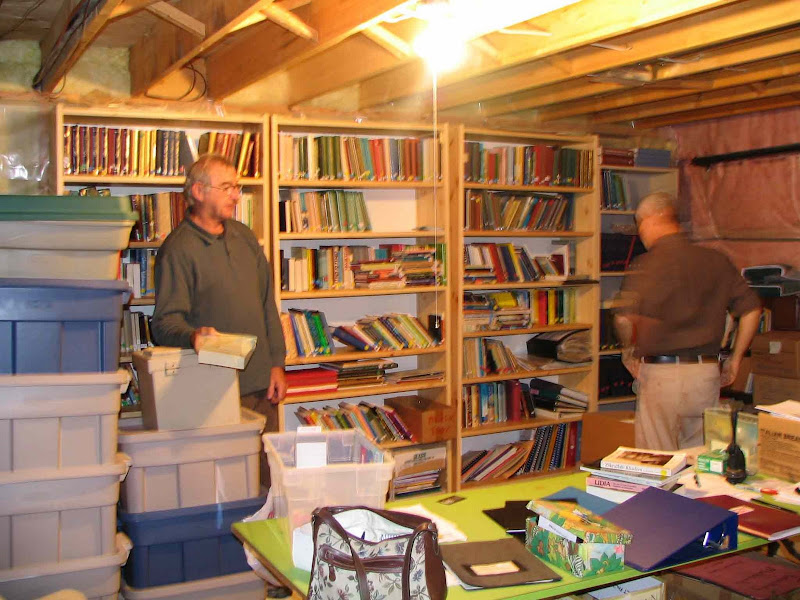
Peter Gardner visits the Hamilton Baha'i Library, Joe Jones, the librarian, presides.


Hamilton Baha'i Library, Joe Jones, Librarian, October 17, 2007

This library is especially good for scholars of the Faith because, as a result of an amalgamation of several communities, there are several copies of the most important Baha'i books. This is great for group study sessions, everybody can have a copy.

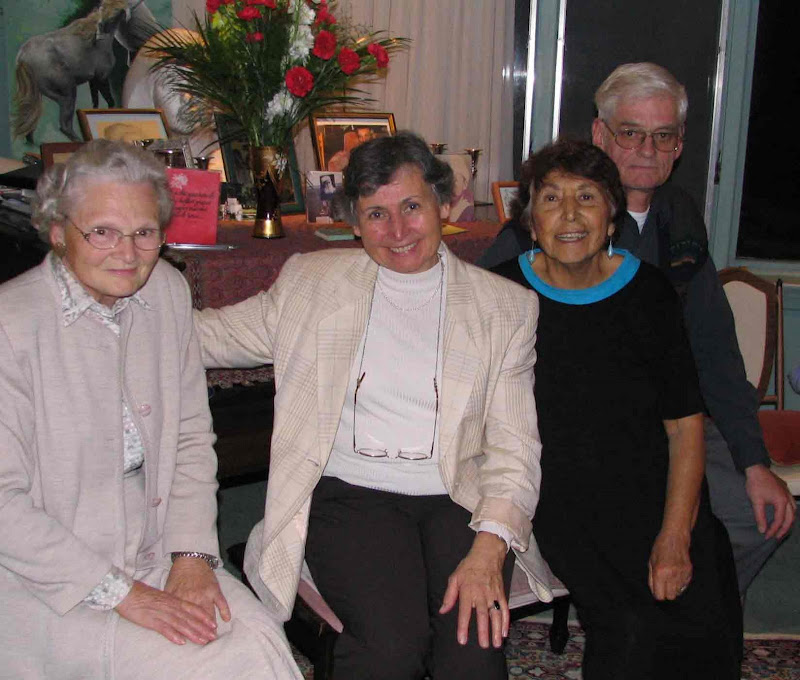
Mrs. Javid's Fireside October 17, 2007


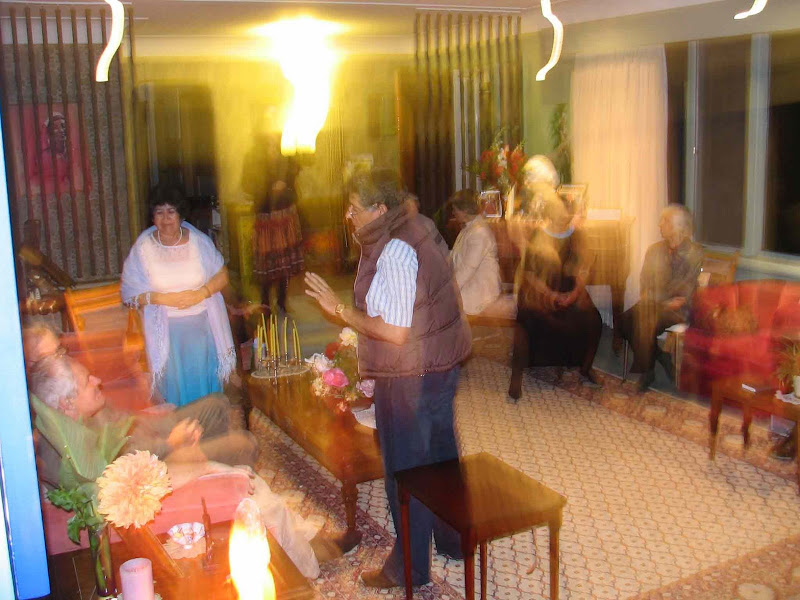
Before Mrs. Javid's Fireside October 17, 2007 This is an impressionistic view, caused by putting the wrong squiggly setting on the camera. The man in the center is a Baha'i from the Canary Islands.


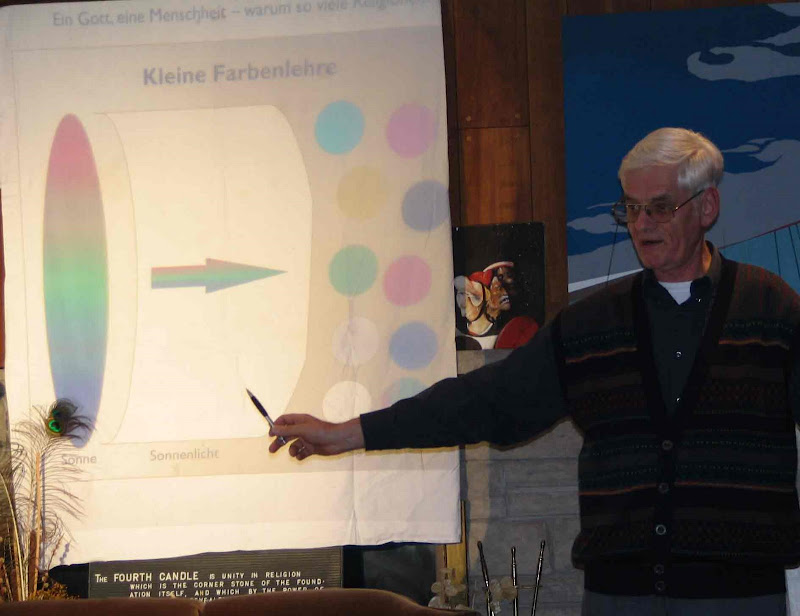
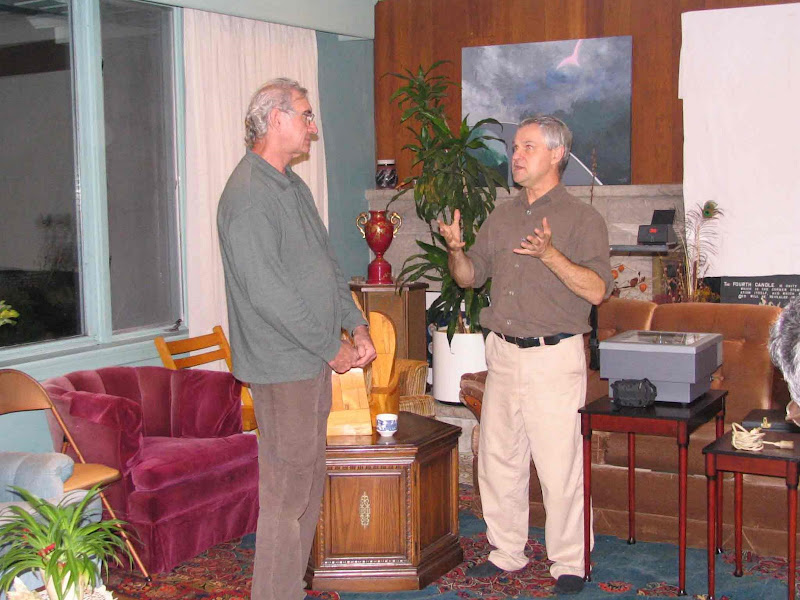
Hans Klapp discusses why there are so many religions. The talk was preceded by a metaphorical fairy tale based on the colours of the spectrum and the pieces of a chess set. As a chess player, I was very pleased to hear progressive revelation discussed in that way. Better still, as a computer specialist, he compared the revelations through history, major and minor prophets, to software, which is changed by minor releases and major upgrades, but they never contradict.

The overhead transparencies, you will note, are still in German.


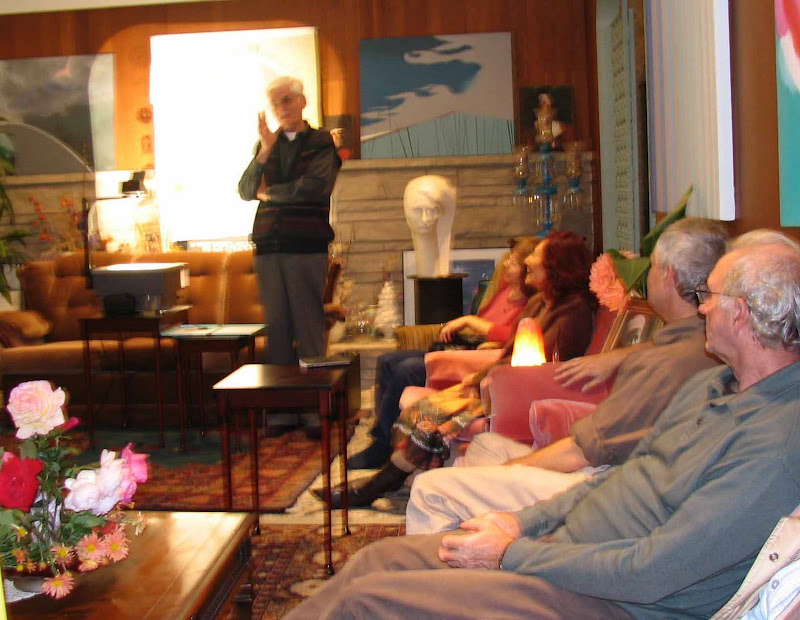
Mrs. Javid with German speakers at her fireside October 17, 2007 at center is Thoule Klapp, who read the fairy tale.


Joe Jones and Peter Gardner afterwards.

Wednesday, October 17, 2007

Birth II

The Birth of Sacrifice (Birth of the Bab, part II)

By John Taylor; 2007 October 16, 01 Ilm, 164 BE

As my regular readers know, I have my doubts about sports. They were confirmed this morning by an amusing and disturbing entry to George Monbiot's blog, called "Playing in the Rough." (monbiot.com, posted October 16, 2007). Before he retired from golf a few years ago, my father was a fanatical player. I played the devil's advocate with him, jokingly downplaying the benefits of what I refused to call a sport. Monbiot describes the atmosphere of a country club very aptly when he calls those idyllic park like surroundings "teletubbyland." And whether you call it a game or a sport, the health benefits of the activity are undeniable. My father at 87 is healthier physically than many men just entering middle age. Nonetheless, it does not take long for Monbiot to uncover the environmental drawbacks of the golf courses springing up in every poor, undeveloped part of the world.

"One study suggests that an 18-hole course requires, on average, 22 tonnes of chemical treatments (mostly pesticides) every year: seven times the rate per hectare for industrial farming. Another shows higher rates of some cancers, such as non-Hodgkins lymphoma (which has been associated with certain pesticides), among golf course superintendents. Courses consume staggering amounts of water. Many of them are built on diverse and important habitats, such as rainforests or wetlands. In some countries people have been violently evicted to make way for them." (http://www.monbiot.com/archives/2007/10/16/playing-in-the-rough/)

Another recent article in Macleans Magazine strikes closer to home for me. Steve Maich's October 22, 2007 article, "The concussion time bomb; New research suggests head injuries can trigger a descent into dementia, madness and maybe even murder," describes the ill effects of bops on the head in sports. It describes how former wrestler Bret Hart became an activist on behalf of professional wrestlers after the dire harm of his own concussions became evident. A concussion remains a difficult injury to assess and detect, even with all the recent advances in neurology and brain monitoring technology. It pretty much takes an autopsy, usually prompted by a former athlete's going insane, committing suicide while taking several other innocent souls to join the choir celestial along with him, to prove that the extensive brain damage characteristic of concussion actually existed in the first place. The article does not mention soccer, but the practice of "heading" by soccer players is now known to have similar ill effects on the brains of players of the world's most popular sport.

Why does all this strike home to me? Because I am convinced that my migraine disability was exacerbated, if not caused, by several concussions I suffered when I was a teenager and dedicated Judoka. I particularly remember one Judo match in Rochester, New York, against a large opponent, or more to the point, I do not remember it. I only recall bowing, connecting with him, and then finding myself in the change room dressing into my street clothes, on the way to the hospital.

I must have been about fifteen years old then, and a few years later I did something really insane, I became a Baha'i. I found that most Baha'is do not have a strong interest in sports, which suited me just fine. When I read about what happens to professional athletes after concussions, I am glad I quit Judo so young. I wish I had taken up table tennis right after quitting Judo, though, because in the past few years I have found how much I need the physical activity and competition that a sport offers. But body and soul depend upon it. As far as I can see, there are no harmful effects from ping pong, as there are from golf, judo or boxing. Only one possible drawback springs to mind. In China, where table tennis is king, this sport seems to take advantage of the fact that people there prefer to amuse themselves indoors. This tendency means that industry there pollutes the air with impunity. The people do not spend time outdoors and do not miss a clean atmosphere, which only makes things worse. For me as an individual, though, this is an advantage, since if I try something outside, like jogging or bicycling, a bad smog day will sicken me for days afterwards. For now, ping pong is my only choice.

The question in my mind is, why is it so hard to do anything on principle? If we know something is wrong, why not just stop it? There is no lack of alternative games, sports and activities to turn to if a present sport proves to do more harm than good. Even if there were not, we could easily invent any number of new sports that would avoid known harm and at the same time put to use new, and even useful, skills.

It is not that quitting an established but harmful practice has never been done. The British Empire did it when they abolished slavery, an institution that was extremely profitable to its elites. But was that the first and only time the human race stopped something on principle?

We know as a scientifically proven fact that violent sports harm their participants physically, and social scientists suspect that watching violent sports harms spectators mentally, spiritually and politically (by glorifying conflict over cooperation, not to mention exposing them to manipulative advertising), and, as Monbiot points out, even that most non-violent sport imaginable, golf, poisons the environment and abuses the rights of people living and working on golf courses and the land surrounding them.

So why not just stop it? Why not just move on?

I suspect that we do not want to give up profitable but harmful sports for the same reason that we do not want to give up one jot or tittle of present benefit in order to stave off the future benefit of not having to undergo climate change. Monbiot hit the nail on the head at the end of his book "Heat" when he pointed out that this climate crisis differs from other crises and protest movements in the past in one respect: the enemy is us. The only ones the people can pick placards and protest against are the people themselves. We know that we all have to make adjustments to our lifestyle in order to accommodate principle and the environment; we just do not want to give anything up in order to do it. It seems like too much effort. So we continue blithely on, business as usual, handcarts plummeting to hell.

This is the age of responsibility, and responsibility demands sacrifice.

I think that the underlying reason we are so unwilling to change or sacrifice, even when we know we must do it for our own survival, is hidden in the Holy Day we are about to celebrate, my favorite among all Baha'i holidays, the Birth of the Bab. The birth of the Bab is all about one thing, the birth of sacrifice. That was what His life was all about. The Bab wrote of his early years,

"And when I attained full maturity Thou didst cause Me to bear allegiance unto Thine inaccessible Remembrance, and enabled Me to advance towards the designated station, where Thou didst educate Me through the subtle operations of Thy handiwork and didst nurture Me in that land with Thy most gracious gifts." (Selections, 174)

He is speaking of His surroundings, the city of Shiraz, the sacred House of the Bab. One day, when the dark clouds of evil and superstition have dispersed, every male Baha'i will be required once in a lifetime to go there and visit that house, that house where the "subtle operations" of God's "handiwork" nurtured the Bab and prepared Him to make the ultimate sacrifice. "Greater love hath not a man than this, that he give his life for his friends."

And let there be no mistake, it is men who are mostly obsessed with sports now, men who drive a few elite athletes to sacrifice the very goal of sports, physical well being, for their obsessive pleasure. Somehow that rather barren, desert-like land, the province of Fars, sunk down now into a world center for fundamentalist fanatics, gave birth to a sacrificial spirit that took the Bab to the high station of sacrifice.

That is why, I think, Baha'u'llah decreed that pilgrimage to this place is obligatory for male Baha'is, and not for females. Girls and women are usually more perceptive of spiritual, invisible matters, and the pilgrimage is not obligatory for them. Men have spatial-oriented brains, "show me" minds that lock onto motion and physical presence. Men must go and see this House, go there and feel it, hear it, touch it, before we will ever understand in our bones what sacrifice is, and what the Bab was about in His sacrifice.

By all human standards, the life of the Bab which began on this holy day was a sad life. It was tragic, and all the more so since, being Whom He was, he must have seen what would happen from His very first day on earth. The poignancy of His story will inspire a thousand Sophocles and Shakespeares to portray it and bring it home. The more you feel the love of the Bab, the sadder the events of His life become in eye and heart. I can hardly bear to think of the disasters and violence that His person and His Revelation initiated. The revolution, the torture, the massacres, the state and religion sponsored terrorism, the lies and suppression, the violent death of all His friends and most of His believers, the relentless rejection of a whole nation, people, clergy and government combined.

What sports contest, what last minute victory by an underdog team can ever compare with the drama of this story? The Bab's early marriage and the tragic stillbirth of their only child, His dramatic declaration to eighteen disciples in His own rooms -- for the first time in religious history the Letters of the Living had to find Him, not be picked out and taught by Him -- then His forced exile and eventual martyrdom in Tabriz. Nor did the story stop with His physical martyrdom. The Mullahs decreed that His remains be cast out of the city walls as a meal for the dogs, but dedicated followers secretly stole it away, hid them and eventually smuggled them to the Holy Land. Abdu'l-Baha, was assigned by His Father the task of building a suitable resting place for the Bab. Under great danger and difficulty, He eventually succeeded in erecting a sturdy building, the inner part of the present Shrine of the Bab.

"Every stone of that building, every stone of the road leading to it," He, many a time was heard to remark, "I have with infinite tears and at tremendous cost, raised and placed in position." (Shoghi Effendi, God Passes By, p. 275)

In a 1909 tablet Abdu'l-Baha triumphantly announced,

"The most joyful tidings is this ... that the holy, the luminous body of the Bab ... after having for sixty years been transferred from place to place, by reason of the ascendancy of the enemy, and from fear of the malevolent, and having known neither rest nor tranquillity has, through the mercy of the Abha Beauty, been ceremoniously deposited, on the day of Naw-Ruz, within the sacred casket, in the exalted Shrine on Mt. Carmel... By a strange coincidence, on that same day of Naw-Ruz, a cablegram was received from Chicago, announcing that the believers in each of the American centers had elected a delegate and sent to that city ... and definitely decided on the site and construction of the Mashriqu'l-Adhkar." (quoted in, Shoghi Effendi, God Passes By, 276)

Though I have mentioned that pilgrimage to the House of the Bab in Shiraz is obligatory to men, it is significant perhaps to note that while the Master spent His efforts on the Shrine in Palestine, it was the women of the holy household, especially Munirih Khanum and Bahiyyih Khanum, who expended the lion's share of time and effort seeing to it that the House in Shiraz was suitably preserved and decorated for visitation by pilgrims. And it was here that the bile of the fanatic directed its full fury. On August 20, 1955, the Guardian sadly described the latest assault on this precious structure.

"In Shiraz, in the province of Fars, the cradle of the Faith, the House of the Bab, ordained by Baha'u'llah in His Most Holy Book as the foremost place of pilgrimage in the land of His birth, was twice desecrated, its walls severely damaged, its windows broken and its furniture partly destroyed and carried away. The neighboring house of the Bab's maternal uncle was razed to the ground." (Shoghi Effendi, Citadel of Faith, 135)

Nor, as we all know, was that the end of it. I will not describe the details of the eventual complete destruction of the structure known in our scripture simply as "the House." That would sadden us, and the birth of the Bab is not a sad occasion, it is happy.

It is happy because knowing of His suffering and the inexplicable hatred directed against Him and anything associated with Him permits us to understand that our happiness is not in superficial victory, it lies in sacrifice. Superficial victory, like that of the Iranian persecutors, is as ephemeral as last year's title race. Life itself only comes about through sacrifice, and sacrifice of the spirit has endless results that never will be seen by physical eyes, but never are forgotten by those in touch with soul.
 

Tuesday, October 16, 2007

Birthday I

The Birth of the Bab, Part I

By John Taylor; 2007 October 16, 01 Ilm, 164 BE

This is one of the most joyous times of the Baha'i year. Every year on the 20th of October -- the 5th day of Ilm, or Knowledge, the twelfth month in the Badi' calendar, a calendar that the Bab Himself invented -- Baha'is around the world stop our daily routine, take a day off work, and celebrate the birthday of the Bab.

This holy day celebrates one of the most momentous events in the spiritual history of the human race, the birth of Manifestation of God, specifically, the One Who would break the dawn, give His life to usher in our collective spiritual maturity. The Bab, at his birth in Shiraz, Iran, was named Siyyid Ali Muhammad. His family, now called Afnan, were direct descendants of the Prophet Muhammad, known as Siyyids, or "chiefs." In spite of this high religious heritage, they had no official place in the religious hierarchy of their country. They made their living as merchants, what we might call today a combination of importer and shopkeeper. The Bab's birth took place early in the morning, reportedly before dawn, on this day in 1919. A dawn prayer prescribed in the Qu'ran seems to foreshadow this early morning event because it mentions Ali Muhammad's title, the "Bab," or gate. The Qu'ran asks that all Muslims say this invocation "in the small watches of the morning" so that soon the Lord will raise them "to a station of Praise and Glory,"

"Say: `O my Lord! Let my entry be by the Gate of Truth and Honour, and likewise my exit by the Gate of Truth and Honour; and grant me from Thy Presence an authority to aid (me).' And say: `Truth has (now) arrived, and Falsehood perished: for Falsehood is (by its nature) bound to perish.'" (Q17:80-81, tr: Yusuf Ali)

Later in His life the Bab even adopted another dawn prayer, written by one of the twelve Imams, focusing on over nineteen attributes of God, as the framework for His calendar, which is known today as the Badi' or Baha'i calendar. In spite of this strong association with pre-dawn events, Baha'is are mercifully left free to pick a convenient time celebrate the happy occasion, as long as it takes place at some time during the twenty four hour period beginning at sunset of the 19th and ending on sunset the next day.

A recurrent theme in the Writings of the Bab is -- appropriately enough, in view of when His birth took place -- the image of a rising sun at dawn. He says, for example,

"Verily, the sun is but a token from My presence so that the true believers among My servants may discern in its rising the dawning of every Dispensation." (The Bab, Selections, 159)

In this insight we discern glimmerings of the new idea that divine revelation is progressive, that the sun dawns at diverse points on the horizon but always remains one sun. This is the essence of monotheism. The sun's dawning points vary, they progress through different points of the horizon as the seasons progress, and in different constellations through the millennia, but there is ever only One God. This God is not defined by where His light originates, but stands Independent. This idea later became central to Baha'u'llah's teaching in the Iqan, and Abdu'l-Baha gave it tremendous emphasis in His own expositions of Baha'i belief.

It is perhaps for this reason that Baha'u'llah spoke of the Bab in His Ishraqat as the Point from where all knowledge grows,

"Praise be to God who manifested the Point [the Bab] and caused to proceed therefrom the knowledge of all that was and shall be.... He is that Point which God hath made to be an Ocean of light unto the faithful among His servants, and a Ball of Fire unto the deniers among His creatures and the impious among His people. (Tablets, 102)

We are fortunate to have the story of His birth and childhood in the Bab's own words, albeit tersely described. In a prayer the Bab wrote:

"Thou art aware, O My God, that since the day Thou didst call Me into being out of the water of Thy love till I reached fifteen years of age I lived in the land which witnessed My birth [Shiraz]. (Selections, 180-181)

We cannot know whether His peculiar expression, "called into being out of the water of God's love," refers to His conception or His birth, but the idea that God's love is life giving water is echoed in all scriptures, and especially the Qu'ran. It says, for instance,

"And God has created every animal from water: of them there are some that creep on their bellies; some that walk on two legs; and some that walk on four. God creates what He wills for verily God has power over all things." (Q24:45, Yusuf Ali)

Just as our physical bodies consist mostly of water, so the soul depends upon pure waters flowing to and from the love of the Creator. Jesus’ story of Lazarus, a beggar callously left by the rich master of the house to starve at his door, speaks of this. Even the dogs try to help Lazarus by licking his sores, but the rich man, though pious, cares nothing, does nothing. Christ depicts the plight after death of this heartless member of the elite; he is stricken by unquenchable thirst and cries, "Father Abraham, have pity on me and send Lazarus to dip the tip of his finger in water and cool my tongue, because I am in agony in this fire." Some passages of the Qu'ran, like the following, stress this same lesson about our need for watery love in the next world:

"The Companions of the Fire will call to the Companions of the Garden: "Pour down to us water or anything that God doth provide for your sustenance." They will say: "Both these things hath God forbidden to those who rejected Him." (Q7:50, Yusuf Ali)

The idea that life and love are born of water extends back into the ancient mists of mythology. For example, Sandro Botticelli's famous painting, The Birth of Venus, depicts the birth of Venus, the goddess of love, which has just taken place in the midst of the sea. Similarly, the life and Revelation of the Bab are depicted in His own Writings as a mountain stream that gushes out, disappears, but in doing so invisibly irrigates the "delight of His eyes," that is, Baha'u'llah and His Cause:

"O Qurratu'l-'Ayn! Say: Verily I am the `Gate of God' and I give you to drink, by the leave of God, the sovereign Truth, of the crystal-pure waters of His Revelation which are gushing out from the incorruptible Fountain situate upon the Holy Mount. And those who earnestly strive after the One True God, let them then strive to attain this Gate. (Q83:25-6) Verily God is potent over all things..." (Qayyumu'l-Asma', Selections from the Writings of the Bab, 50)

So, we know by the Bab's own testimony that He was born out of the pure waters of God's love. However, that only tells us whence He came. The question remains: who was He? We will take that up in the second part of this series.


Sunday, October 14, 2007

RKG Interview

 Results of an Interview with Ronald Glossop

 By John Taylor; 2007 October 14, 18 Mashiyyat, 164 BE

 I started off asking Dr. Ronald K. Glossop what he thinks about Noam Chomsky. Answer: mild approval of Chomsky's scholarship but not of the solutions he offers (if, indeed, any are discernable).

 Dr. Glossop started his interest in peace studies when he was on the debating team in High School. The rules required every debater to alternate, taking one side of every issue and then, later, the other side. This was just after World War Two and the new United Nations was a common topic of debate. He found that he preferred to be on the side of world federalism. Later he attended Carthage College, now in Kinosha, Wisconsin. He was studying for the Lutheran ministry when in a Christian education class a crucial turning point arrived. The question at issue was whether Christian education involved spoon-feeding ready-made conclusions or only giving out the ingredients, offering food for thought and letting the laity make up their own minds. The class members took the former side, he and one other student stood alone in disagreeing; to Glossop that was not education but propaganda. So ended his dream of being a minister, and so began his study of philosophy.

 Ronald Glossop got his doctorate at Washington University, specializing in David Hume's ethical theory. At the time, the academic fashion was what was termed the emotive theory of ethics, as exemplified by A.J. Ayer, and especially by Charles L. Stevenson's "Ethics and Language."

 The idea of the emotivists was that when I say "That is wrong," what I am really saying is "I do not like that," or "I get a bad feeling from that." RKG felt the inadequacy of that. There has to be a factual element in ethical judgments and Hume, centuries earlier, had laid out exactly that idea. Both are involved in moral judgment, factual and emotive factors. We start off in empathy, but we need to combine that with information.

 He was teaching at Portland State in 1966 when, like so many in his generation, the Vietnam conflict got RKG politically involved. A professor was needed to lead a discussion about the Kent State and other shootings, and he took on the job. In 1969 he headed the World Federalists, and still does, though last year they changed their name to "Citizens for Global Solutions." He worked for the Mundialization of his college campus, and he was instrumental in having it qualified to fly the flag of the United Nations, and it still does. In 1973 he initiated a department of Peace Studies in his school, one of the first in the world.

 It is RKG's core belief that there is a crucial distinction between conflict and war. War is large scale, violent conflict. But there are many good and positive expressions of conflict. It need not be violent. Such paths to peace are what democracy is designed to work out. Democratic government channels conflicts into positive, constructive ends.

 It was while RKG was researching his widely used textbook on peace, "Confronting War," that he found out about Esperanto and decided to try to learn it. Esperanto, it seemed to him, would solve the toughest barriers blocking the world off from true, lasting peace. So he began to pull strings to get a course in Esperanto taught at his school. If he got twelve names, including his own, the course would sail and he could learn the language while he was at it.

 As the result of an odd concatenation of circumstances they got a visiting professor who had been invited to teach a Shakespeare course, Pierre Janton, at the last minute to teach the course. He happened to be one of the most prominent scholars of Esperanto in the world. RKG had been arguing with a colleague in the language department -- an expert in Italian who was slated to teach the course -- about the pronunciation of the word in Esperanto for "today," hodiaŭ." RKG held that it should be sounded out literally, directly, and Janton said that he was right. Janton held that RKG's lack of qualification in languages was an advantage in Esperanto, and that he should not hesitate in taking over the teaching of introductory courses. (that is what RKG was doing most of the weekend in Silver Bay, teaching the introductory course)

 At one point in teaching the Esperanto course at the university level, RKG asked for a show of hands: how many of the students knew another language? Most knew a couple, many knew several foreign languages. He realized that teaching Esperanto as a specialized linguistic curiosity was not what the language is all about. It is designed to be learned early and used to build the bases of peace. He was reaching them too far along in their education.

 So he turned to the earlier grades. He happened to have a cousin in the local junior high school, so he volunteered to go there early in the morning before school started and teach the language to a class of gifted children. This, he found to be the most rewarding experience of his teaching career. While teaching introductory Esperanto, he saw the need to connect classes and teachers on an international level, so he started "Infanoj cxirkaux la mondo," or, Children Around the World, (www.icxlm.org) which publishes a magazine and mediates pen pals among classes of beginners in various lands. He recently made this part of the American Esperanto group, formerly called ELNA, now renamed "Esperanto USA." It has a full time secretary running the organization and website, which promotes an introductory textbook for kids called "La Bela Planedo," by Charlotte Kohrs. (http://www.icxlm.org/bela/index.htm)

 It was getting late and my handwriting at this point became an illegible scrawl. The only thing I can make out is the following comment Dr. Glossop gave about the history of Esperanto as the world language. Not very many people know this, but it was Francophones, not Americans or other Anglophones, who quashed Esperanto at its birth. When the League of Nations formed the first resolution on the table was whether to adopt Esperanto as an international auxiliary language to be taught in every school. It was about to be passed when the French delegation, who felt that French should be the international language, sent a philosopher, Henri Berson, an Esperanto speaker himself, to go to the deliberations and have it killed. He succeeded.

pv plans

Post Vacation Plans

By John Taylor; 2007 October 14, 18 Mashiyyat, 164 BE

 The uprooting and moving of my office and filing system, then our little vacation in New York and Quebec allowed me to withdraw from my rut and think about what to do with the rest of my life. On the night of our return I came across the following gem, which seemed to sum up my writing mission. The 160th paragraph of the Aqdas starts off saying:

 "Promote ye the development of the cities of God and His countries, and glorify Him therein in the joyous accents of His well-favoured ones." (Aqdas, p. 77)

 First I note that the little known academic discipline of development studies will, according to this, not remain obscure. It certainly is important to me, as my unfinished work, Earth Order, testifies. As the Revelation of Baha'u'llah gains prominence, progress and development (not necessarily growth) will surely become a central focus for all careers and avocations.

 In the second phrase in this sentence, Baha'u'llah talks of development as an expression of worship, as the "joyous accents" of saintly people. Think the loving attitude promulgated in the public talks of the Master. In other words, I think this implies that development will become a central religious and artistic expression, not only a scientific or political concern. Then Baha'u'llah brings in what made my heart leap, a clear expression of the mission of the Baha'i, and of the writer in particular.

 "In truth, the hearts of men are edified through the power of the tongue, even as houses and cities are built up by the hand and other means."

 In this Baha'u'llah is telling us that material improvement is only half the battle; we need to reform our tongues every bit as much as we need to improve our physical circumstances. As Jesus said, what profiteth it a man to gain the world and lose his soul? And we get our soul back by speaking good words, by praising our Lord, by speaking and writing positive, edifying speech. In this age, a writer or speaker must become a heart builder.

 Yes, things are looking bad for the future. The more prosperous we get (for a mere twenty bucks I walk to Dunnville's Giant Tiger or Food Basics stores and get so much food I can barely carry it home. Such prosperity, in the broad view of history, is rare indeed) the more worrisomely "apres moi le deluge" our times seem. You look at the world as a whole, not just our privileged places, and the processes of disintegration are clearly accelerating.

 Let me mention only how the world's crisis-slash-opportunity affects our family: 8 year old Tomaso wants to dress up for Halloween this year as "toxic waste," or at least he did until I mentioned that nuclear waste is even worse than toxic waste. Now he wants to mix them, toxic nuclear waste; and 13 year old Silvie is planning the scariest costume she could think of, which she calls "global warming." When I questioned her choice, she said that I should dress up as the greenhouse effect. "And why is that?" I asked. "Because the greenhouse effect is the father of global warming."

 Finally, Baha'u'llah in the last sentence of this paragraph comes to the nub of it all: action, faith, initiative, execution. I have never been very good at nubs, but there it is staring me in the face. I cannot turn aside.

 "We have assigned to every end a means for its accomplishment; avail yourselves thereof, and place your trust and confidence in God, the Omniscient, the All-Wise."

 This was the question that preoccupied me during our vacation, what is the means to my end? I have twenty five years of writing under my belt, much of it written under duress and chronic migraine. Surely God had a purpose, it was some kind of preparation for something. It is early to articulate what I came up with, let that be expressed in action. But there will still be a place for the Badi Blog, though different in focus.

 Let me conclude with the promised interview with Dr. Ronald K. Glossop. I had a digital recorder ready to record the interview, but as so often happens with this top-of-the-line Panasonic atrocity given to me by my father (who could not figure it out), it had burned up its batteries and failed at the last minute. In future I will stick to the older technology of the mini-cassette tape recorder. The notes I took were scribbled and inadequate, but that, and a feeble memory, is all I have. Sorry.

Saturday, October 13, 2007

2 talks

Two Talks To Esperantists, 1913

By John Taylor; 2007 October 13, 17 Mashiyyat, 164 BE

As promised, here is the text of the talks given by the Master to the Esperantists of Edinburgh, and one more He gave in Paris as a bonus. At the end I include the Esperanto translation of the Edinburgh address. But first, a selection from an essay I wrote a couple of years ago that detailed some background on this address, which I was studying at the time. I include the first part of the essay because it may be of interest to Richard.

p01 Search for Truth; The Hard Part (Part One); 15 June, 2004

Baha'u'llah assures us that we owe all the wonders of creativity, of art and science to the sacrifice of Jesus on the cross. As a Baha'i, then, you get used to giving Jesus credit for much more of a real revolutionary impulse than his own followers, who tend to be preoccupied with mere psychological uplift, "Jeysus Saaaved me!" Any second-rate inspirational speaker can pump us up with that sort of feeling with little effort ... but that thrill passes quicker than a one-night stand. The creative accomplishments of genius, though, are permanent accomplishments.

... The penultimate paragraph of the Kitab-i-Aqdas suggests two problems the resolutions of which will be the sign of the maturity of the human race. These are the language barrier and (a footnote explains) the long-sought elixir, the ability to transmute elements from one metal to another.

For now I have only one observation about the language challenge. When 'Abdu'l-Baha visited Edinburgh His first address was to Esperantists and it did not mention anything substantive about the Baha'i Faith. He talked only about the language problem, to such an extent that even non-Baha'is complained in print that He did not provide details about Baha'i. We speakers of the Language of Imperialism ignore this but certainly it is a fact that the language barrier is the greatest structural injustice in the world, disenfranchising billions and keeping them permanently from hope of access to prosperity and education.

'Abdu'l-Baha addresses the Esperantists of Edinburgh and Paris

Address delivered in Edinburgh January 7, 1913 under the auspices of the Edinburgh Esperanto Society

From The British Esperantist, February, 1913 Star of the West, April 9, 1913; Vol. 4, p. 34

EVERY movement which promotes unity and harmony in the world is good, and everything which creates discord and discontent is bad. This is a century of illumination, surpassing all others in its many discoveries, its great inventions, and its vast and varied undertakings. But the greatest achievement of the age in conferring profit and pleasure on mankind is the creation of an auxiliary language for all. Oneness of language creates oneness of heart. Oneness of language engenders peace and harmony. It sweeps away all misunderstandings among peoples. It establishes harmony among the children of men. It gives to the human intellect a broader conception, a more commanding point of view.

Today the greatest need of humanity is to understand and to be understood. With the help of the International Language, every individual member of a community can learn of world happenings and become in touch with the ethical and scientific discoveries of the age. The auxiliary international language gives to us the key the key of keys which unlocks the secrets of the past. By its aid every nation henceforth will be able easily and without difficulty to work out its own scientific discoveries.

It is a well known fact that the Oriental student coming to the West, in his efforts to acquaint himself with the discoveries and achievements of western civilization, must spend precious years of his life in acquiring the language of the land to which he comes before he can turn to the study of the special science in which lie is interested. For example, let us suppose that a youth from India, Persia, Turkistan or Arabia comes to this country to study medicine. He must first struggle with the English language for four years, to the exclusion of all else, before he can even begin the study of medicine. Whereas, if the auxiliary international language were taught in all the schools during his childhood, he would learn the language in his own country, and afterward wherever he wished to go, he could easily pursue his specialty without loss of some of the best years of his life.

Today if one wishes to travel abroad, even though possessed of several languages, he is likely to be seriously handicapped because lie does not know the particular language of some one people. I have studied oriental languages profoundly and know the Arabic better than the Arabians themselves. I have studied Turkish and Persian in my native land, besides other languages of the East, nevertheless, when I visited the West I had to take an interpreter with me quite as if I knew no language. Now if the International Language were generally spoken, that and the Persian language would be sufficient for me in every country of the world.

Only think how the International Language will facilitate intercommunication among all the nations of the earth. Half of our lives are consumed in acquiring a knowledge of languages, for in this enlightened age every man who hopes to travel in Asia and Africa and Europe must learn several languages in order that he may converse with their peoples. But no sooner does he acquire one language than another is needed. Thus one's whole life may be passed in acquiring those languages which are a hindrance to international communication. The International Language frees humanity from all these problems.

In a word, to understand and be understood, there must be an international medium. The teacher and the pupil must know each other's language, in order that the teacher may impart his knowledge and the pupil receive it. In all the world there is nothing more important than to be understood by your fellow men, for upon this depends the progress of civilization itself. To acquire a knowledge of the arts and sciences one must know how to speak, to understand and at the same time to make himself understood, and this matter of understanding and being understood depends on language. Once establish this auxiliary language, and all will be enabled to understand each other.

I recall an incident which occurred in Baghdad. There were two friends who knew not each other's language. One fell ill, the other visited him, but not being able to express his sympathy in words resorted to gesture, as if to say, "How do you feel?" with another sign the sick replied, "I shall soon be dead;" and his visitor, believing the gesture to indicate that he was getting better, said, "God be praised!"

From such illustrations you will admit that the greatest thing in the world is to be able to make yourself understood by your friends and to understand them, and that there is no greater handicap in the world than not to be able to communicate your thoughts to others. But with an auxiliary language all these difficulties disappear.

Now, praise be to God, that language has been created Esperanto. This is one of the special gifts of this luminous century, one of the most remarkable achievements of this great age.

His Holiness Baha’u’llah many years ago wrote a book called "The Most Holy Book," one of the fundamental principles of which is the necessity of creating an International Language, and He explains the great good and advantage that will result from its use. Now let us thank the Lord because the Esperanto language has been created. We have commanded all the Bahais in the Orient to study this language very carefully, and erelong it will spread all over the East. I pray you, Esperantists and non-Esperantists, to work with zeal for the spread of this language, for it will hasten the coming of that day, that millennial day, foretold by prophets and seers that day when, it is said, the wolf and the lamb shall drink from the same fountain, the lion and the deer shall feed in the same pasture. The meaning of this holy word is that hostile races, war ring nations, differing religions, shall become united in the spirit of love.

I repeat, the most important thing in the world is the realization of an auxiliary international language. Oneness of language will transform mankind into one world, remove religious misunderstandings, and unite East and West in the spirit of brotherhood and love. Oneness of language will change this world from many families into one family.

This auxiliary international language will gather the nations under standard, as if the five continents of the world had become one, for then mutual interchange of thought will be possible for all. It will remove ignorance and superstition, since each child of whatever race or nation can pursue his studies in science and art, needing but two languages -- his own and the International. The world of matter will become the expression of the world of mind. Then discoveries will be revealed, inventions will multiply, the sciences advance by leaps and bounds, the scientific culture of the earth will develop along broader lines. Then the nations will be enabled to utilize the latest and best thought, because expressed in the International Language.

If the International Language becomes a factor of the future, all the Eastern peoples will be enabled to acquaint themselves with the sciences of the West, and in turn the Western nations will become familiar with the thoughts and ideas of the East, thereby improving the condition of both. In short, with the establishment of this International Language the world of mankind will become another world and extraordinary will be the progress. It is our hope, then, that the language Esperanto will soon spread throughout the whole world, in order that all people may be able to live together in the spirit of friendship and love.

Address Delivered in Paris (Star of the West, Vol. 4, p. 36)

From Persian notes; translated by Mirza Ahmad Sohrab Abdul-Baha addressed the Paris Esperanto group February 12th, at a banquet which was tended him at the Hotel Modern, in that city. M. Bourlet, President of the Paris Esperanto Society, introduced `Abdu'l-Baha briefly, stating that one of the revealed principles of this great Peace Prophet's world religion was the establishment of a universal language.

There was a deep silence as `Abdu'l-Baha rose majestically. His remarks were punctuated by cheers and applause as he walked up and down the banquet hail, stopping to emphasize with frequent gesture. He spoke in Persian, M. Hippolyte Dreyfus Barney of Paris interpreting into French. Here and there one noted that the French translation was under going still further interpretation by Esperantists who had neighbors that did not under stand French but knew Esperanto: the occasion itself offering a noteworthy argument for the great necessity of a universal tongue.

Address by `Abdu'l-Baha

 In the material world of existence, human undertakings are divided into two kinds universal and specific. The result of every universal effort is infinite and the outcome of every specific effort is finite.

 In this age, those human problems which create a general interest are universal; their results are likewise universal, for humanity has become interdependent. The international laws of today are of vast importance since international politics are bringing nations nearer to one another. It is a general axiom that in the world of human endeavor, every universal affair commands attention and its results and benefits are limitless. Therefore let us say that every universal cause is divine and every specific matter is human. The universal light for this planet is from the sun and the special light here tonight, which is electric, illumines this banquet hail through the invention of man. In like manner the activities which are trying to establish solidarity between the nations and infuse the spirit of universalism in the hearts of the children of men are like unto divine rays from the Sun of Reality, and the brightest ray is the coming of the universal language. Its achievement is the greatest virtue of the age, for such an instrument will remove misunderstandings from among the peoples of the earth and will cement their hearts together. This medium will enable each individual member of the human family to be informed of the scientific accomplishments of all his fellowmen.

 The basis of knowledge and the excellencies of endeavor in this world are to teach and to be taught. To acquire sciences and to teach them in turn depends upon language and when the international auxiliary language becomes universal, it is easily conceivable that the acquirement of knowledge and instruction will likewise become universal.

 No doubt you are aware that in the past ages a common language shared by various nations created a spirit of solidarity among them. For instance, 1,300 years ago, there were many divergent nationalities in the Orient. There were Copts in Egypt, Syrians in Syria, Assyrians and Babylonians in Baghdad and along the River Mesopotamia. There existed among these peoples rank hatred, but as they were gradually brought nearer through common protection and common interests, the Arabic language grew to be the means of intercommunication, and they became as one nation. They all speak the Arabic language to this day. In Syria if you ask any one of them he will say, "I am an Arab," though in reality he is not some are Greeks, others Jews, etc.

 We say "This man is a German, the other an Italian, a Frenchman, an Englishman," etc. All belong to the great human family, yet language is the barrier between them. The greatest working basis for bringing about unity and harmony among the nations is the teaching of a universal tongue. Writing on this subject years ago, His Holiness Baha’u’llah said that complete union between the various sections of the world would be an unrealized dream as long as an international language was not established.

 Misunderstandings keep people from mutual association and these misunderstandings will not be dispelled except through the medium of a common ground of communication. Every intelligent man will bear testimony to this.

 The people of the Orient are not fully in formed of the events in the West and the West cannot put itself into sympathetic touch with the East. Their thoughts are closed in a casket -- the universal language will be the master key to open it. Western books will be translated into that language and the Easterner will be informed of the contents; likewise Eastern lore will become the property of the West. Thus also will those misunderstandings which exist between the different religions be dispersed. Religious prejudices play havoc among the peoples and bring about warfare and strife and it is impossible to re move them without a language in common.

 I am an Oriental and on this account I am shut out from your thoughts and you like wise from mine. A mutual language will be come the mightiest means of universal progress toward the union of the East and West. It will make the earth one home and become the divine impulse for human advancement. It will upraise the standard of oneness of the world of humanity and make the earth a universal commonwealth. It will be the cause of love between the children of men and create good fellowship between the various creeds. Praise be to God, that Dr. Zamenhof has constructed the Esperanto language. It has all the potential qualities of universal adoption. All of us must be grateful and thankful to him for his noble effort for in this matter he has served his fellowmen well. He has constructed a language which will be stow divine benefits on all peoples. With untiring efforts and self sacrifice on the part of its devotees it gives promise of universal acceptation. Therefore every one of us must study this language and make every effort to spread it so that each day it may receive a wider recognition, be accepted by all nations and governments of the world and become a part of the curriculum in all the public schools. I hope that the business of the future conferences and congresses will be carried on in Esperanto. In the future two languages will be taught in the schools, one the native tongue, the other the international auxiliary language. Consider today how difficult is human communication. One may study languages and yet travel through a country and still be at a loss. I, myself, know several of the Oriental languages, but know no Western tongue. Had this universal language pervaded the globe, I should have studied it and you would have been directly informed of my thoughts and I of yours and a special friendship would have been established between us.

 Please send some teachers to Persia, if you can, so that they may teach Esperanto to the young people. I have written asking some of them to come here to study it. I hope that it will be promulgated very rapidly then the world of humanity will find eternal peace; all the nations will associate with one another like mothers and sisters, fathers and brothers, and each individual member of the body politic will be fully informed of the thoughts of all.

 I am extremely grateful to you and thank you for these lofty aims, for you have gathered at this banquet to further this language. Your hope is to render a mighty service to the world of humanity and for this great aim I congratulate you from the depths of my heart.

On February 7, 1921 Star of the West re-published the first of these talks in both English and Esperanto, apparently from a copy given them by the Esperantists of Scotland. Here is the Esperanto text published at that time:


Internacia Lingvo; Parolado de Abdu’l-Baha al Edinburgh Esperanto Socio, Skotlando, Jan 17, 1913

La personon de Abdu’l-Baha kaj lian laboron, ni tre alte estimas: mi vidas en li unu el la plej grandaj bonfarantoj de la homaro. – L. L. Zamenhof

Ĉiu movado en la mondo de la homaro kiu portas kun si unuecon kaj konkordon estas bona; kaj ĉiu afero, kiu kreas malkontenton kaj malharmonion, estas malbona. Ĉi tiu jarcento estas hela jarcento. Ĝiaj eltrovaĵoj estas multaj; ĝiaj elpensitaĵoj estas grandaj; ĝiaj entreprenoj estas multmultaj. Pro tio ĉi tiu jarcento superas ĉiujn aliajn jarcentojn. Sed la plej granda entrepreno estas la unuiĝo de lingvo; ĉar tio estas pli bonefika kaj plezurdona ol iu alia entrepreno de la epoko. La unuiĝo de lingvo efektivigas grandan kunecon inter koroj. La unuigo de lingvo estas kaŭzo de konkordo. Ĝi forbalaas ilian malkomprenon inter la popoloj; ĝi starigas konkordon en la homidaro. Ĝi donas pli vastan konceptpovon kaj pli grandan vidpovon al la homa intelekto.

Hodiaŭ la plej grava laboro en la mondo de la homaro estas, kompreni kaj komprenigi. Ĉiu individua membro de la komunumo, pro la disvastigo de helpa internacia lingvo, povos sciigi pri okazantaĵoj kaj rilatiĝi kun etikaj kaj sciencaj eltrovaĵoj de la epoko. Helpa universala lingvo donos al ni la ŝlosilon -- la ĉefŝlosilon -- por la komprenigo de la sekretoj de pasintaj tempoj. Per internacia lingvo ĉiu nacio en la estonteco povos elserĉi tre facile kaj senpene siajn sciencajn eltrovaĵojn.

Estas bone sciate inter vi, ke Orientanoj, junuloj venantaj al la Okcidento, penegantaj studadi la eltrovitajojn de la Okcidento, devas dediĉi jarojn el sia vivo, por laborege akiri la lingvon de la lando al kiu ili iras, kaj nur poste ili povas sin turni al la studado de la speciala scienca fako, pri kiu ili interesiĝas. Ekzemple, ni supozu, ke junulo, el Hindujo aŭ Persujo aŭ Turkestano aŭ Arabujo, deziranta studadi la medicinon, venas al ĉi tiu lando. Li devas lernadi dum kvar jaroj la anglan lingvon, kaj nenion alian; kaj poste li povas komenci la studadon pri medicino. Sed, se ĉi tiu internacia helpa lingvo estus parto de la programo de instruo en ĉiuj lernejoj, dum sia infaneco li lernus tiun lingvon en la propra lando; kaj poste, en kiu ajn lando, al kiu li dezirus iri, li povus studadi sian specialan fakon de scienco tre facile, ne perdinte jarojn de sia vivo.

Hodiaŭ, eĉ se ĉiuj el ni lernus lingvojn, tamen, se iu deziras vojaĝi alilanden, tiu povus esti grave malhelpata pro tio, ke li ne scias la specialan lingvon de unu lando. Mi tre profunde studadis orientajn lingvojn, kaj scias la araban lingvon pli bone la Araboj mem, kaj studadis la turkan, kaj la persan en mia propra nasklando; kaj tamen, sciante ankaŭ aliajn lingvojn de la Oriento, kiam mi vojagis okcidenten, mi devis venigi kun mi tradukiston, kvazaŭ mi scius neniun lingvon. Nu, se ekzistus internacia lingvo ĝenerale parolata, la persa lingvo kaj la internacia sufiĉus por mi en ĉiuj landoj de la mondo. Pensu, kiel la internacia lingvo faciligos interkomunikadon inter ĉiuj nacioj de la mondo! Duono de niaj vivoj eluziĝas en la akiro de lingvoj, ĉar en ĉi tiu epoko de klereco ĉiu homo devas lerni lingvojn, por ke, se li esperas vojaĝi en Azio kaj Afriko kaj Europo, li povu interparoli kun la popolo; sed tuj, kiam li akiris unu lingvon, jen alia estas bezonata. La tuta vivo do forpasas en la akirado de tiuj lingvoj, kiuj estas malhelpo al internacia komunikado. Ĉi tiu internacia lingvo liberigos la homaron el ĉiuj ĉi tiuj problemoj.

Mallonge, por kompreni kaj sin komprenigi, devas esti internacia ilo. La instruisto kaj la stndento devas scii la lingvon unu de la alia, por ke la instruisto povu transdoni sian scion kaj la studento povu akiri tiun scion. En la mondo de la homaro estas nenia pli granda afero, ol vin komprenigi al viaj kunhomoj; ĉar la civilizeco mem, la progresado de la civilizacia, dependas de tiu ĉi procedo. Por akiri artojn kaj sciencojn, oni devas scii paroli, sin komprenigi, kaj kompreni samtempe. De ĉi tiu interkompreno dependas la akiro de sciencoj, kaj ĝi igos ĉiujn homojn kompreni pri ĉiuj aferoj de la vivo; kaj ĉi tiu procedo de kompreno kaj komprenigo dependas de la lingvo. Se, do, ĉi tiu helpa lingvo stariĝos, ĉiuj membroj de la homaro ricevos la eblon kompreni unu la alian.

Dum mi parolas, venas en mian cerbon epizodo, kiu okazis en Bagdad. Estis tie du amikoj, kiuj ne sciis la lingvon unu de la alia. Unu malsaniĝis; la alia vizitis lin, sed ne povis parole esprimi sian simpation, kaj do faris geston, volante diri: "Kiel vi fartas?" Per alia signo la malsanulo respondis: "Mi estas tuj mortonta"; kaj la vizitanto, kredante ke li diris ke li ekresaniĝas, diris: "Dank' al Dio!" El tiaj ilustraĵoj vi konstatos, ke la plej bona afero en la mondo estas povi vin komprenigi al viaj amikoj kaj ankaŭ ilin kompreni ; kaj ke ne estas io pli malbona en la mondo, ol ne povi komuniki viajn pensojn al aliaj. Sed, se estus helpa lingvo, ĉiuj tiuj malfacilaĵoj estus forigitaj.

Nu, laŭdo estu al Dio! ĉi tiu lingvo Esperanto elpensiĝis. Tio estas unu el la specialaj donacoj de ĉi tiu brilega jarcento: unu el la plej grandaj entreprenoj de ĉi tiu granda epoko. Antaŭe la homaro rnalsukcesis efektivigi tian elpensaĵon. Ĉi tiu unuigo de lingvoj preskaŭ neniam prezentis sin al la pensuloj de pasintaj epokoj; kaj vere ĝi estis neeblaĵo en tiuj tempoj, car tiam ne ekzistis libereco iri kaj reiri, kaj nenia intervojagado nek intertraktado inter la diversaj landoj. Jam nun, kiam la rimedoj por interkomunikado kaj transportado multe pligrandiĝis, estas nepre necese, kaj estas fareble, efektivigi la uzadon de internacia lingvo.

Lia Sankta Moŝto Baha’u’llah antaŭ rnultaj jaroj verkis libron, nomatan "La Plej Sankta Libro," kaj en tiu libro unu el la fundamentaj principloj estas, ke devas esti elpensiĝo de helpa lingvo; kaj li klarigas la bonon kaj profiton, kiuj venos per tia ilo. Nu, ni danku la Sinjoron pro tio, ke ĉi tiu lingvo Esperanto estas kreita. Ni do ordonis al ĉiuj Bahaanoj en la Oriento, studadi ci tiun lingvon tre zorge, kaj post ne longe gi disvastiĝos tra la tuta Oriento. Mi petas ankau al vi, Esperantistoj kaj ne-Esperantistoj, energie klopodadi por la disvastigado kaj propagandado de ci tin lingvo; ĉar ĝi akcelos la alvenon de tiu tago, tiu miljara tago, kiun antaŭdiras profetoj kaj viduloj, tiu tago en kiu, estas dirite, « la lupo kaj la ŝafido trinkos el la sama fonto, la leono kaj la cervo sin paŝtos sur la sama herbejo. » La signifo de ĉi tiu sankta Skribo estas, ke la batalantaj rasoj, militantaj nacioj, malamikaj religioj, alproksimiĝos unu al la alia en la spirito de amo, kaj kunligiĝos unu kun alia.

Kiel ni jam diris, plej grava afero en ĉi tiu mondo estas la efektivigo de helpa internacia lingvo. La unuigo de lingvo aliformigos la homaron en unu mondon; forigos la malkomprenon inter la religioj; kaj kunigos la Orienton kaj la Okcidenton per la spirito de frateco kaj amo. La unuigo de lingvo ŝanĝos ĉi tiun mondon el multaj familioj en unu familion. Tiu ĉi helpa internacia lingvo kolektos la naciojn sub unu kovrilon, kvazaŭ la kvin kontinentoj de la mondo fariĝus unu kontinento; car tiam ili povos interkomuniki siajn pensojn unu al la alia. La internacia helpa lingvo forigos nescion kaj superstiĉon, pro tio, ke ĉiu infano, el kiu ajn raso au nacio, povos sekvi siajn studaĵojn pri la scienco kaj la arto, car tiam li bezonos lerni nur du lingvojn -- unu, lia nacia lingvo, kaj la alia la internacia helpa lingvo. Ni esperu ankaŭ al tiu tago, kiam eĉ la limoj de la naciaj lingvoj foriĝos, kaj la tuta mondo ĝuos unu lingvon.

Kia pli granda donaco povus esti, ol tio? Kia pli malavara bonfaro povus esti, ol tio?

Tiam la mondo de la homaro fariĝos rava paradizo, ĝuste kiel estas dirite, ke en la ĉielo estas unu lingvo. La materia mondo fariĝos la esprimado de la interna mondo. Tiam eltrovaĵoj malkaŝigos; elpensaĵoj multobliĝos: la sciencoj antaŭeniros per saltoj; la scienca terkulturado disvolviĝos laŭ pli vasta grado; ĉar tiutempe la nacioj povos rapide asimili la pensojn esprimatajn, kaj ĉar ĉiuj tiuj pensoj esprimiĝos per la universala 1ingvo. Se ĉi tiu internacia lingvo estas faktoro por la estonteco, ĉiuj landoj en la Oriento povos rapide akiri la sciencojn de la Okcidento, ĉar iliaj loĝantoj povos legi la librojn kaj kompreni ilian signifon; kaj la Okcidentaj nacioj povos akiri la pensojn kaj ideojn de la Oriento: kaj per tio ambaŭ povos plibonigi sian staton. Mallonge, pro la starigo de ĉi tiu internacia lingvo, la mondo de la homaro fariĝos alia mondo, kaj eksterordinara estos ĝia progreso. Ekzemple, pripensu pri familio, kies diversaj membroj parolas diversajn lingvojn; kiel malfacile estas por ili komuniki siajn pensojn unu al alia, kaj kiel mirinde estas, kiam ili povas facile kompreni reciproke siajn pensojn. Ĉar, se ili scias ĉiu la lingvojn de la aliaj, ili progresos rapide. Do estas nia espero, ke la lingvo Esperanto disvastiĝos post ne longe tra la tuta mondo, por ke ĉiuj popoloj povu vivi kune en la spirito de amikeco kaj amo.
 

Friday, October 12, 2007

trip

What We Did on our Vacation

By John Taylor; 2007 October 12, 16 Mashiyyat, 164 BE

We just got back from our epic annual fall voyage, first to upper New York State, where we attended ARE, the Auxtuna Renkonto de Esperantistoj, at the Silver Bay YMCA Resort (photos are already available at: http://www.flickr.com/photos/limako/sets/72157602368084841/). There are two separate schedules of events there, one for the YMCA resort, and one of the Esperantists. Among the sports offered is archery. We took up the hobby of archery with great enthusiasm, the entire family; the resort featured a good teacher, who showed us the ropes. We are all anxious to try the activity here at home. As always, the children were greatly impressed by the abundance of chipmunks at Silver Bay. They are rare and very timid in this neck of the woods. Thomas enthusiastically suggested that they change the name of the United States to "Chipmunk Land." We also went on a boat tour of Lake George, one of the cleanest lakes in the world, according to the New York Times. Having read that, when I used up my distilled water I drank straight from the tap. It was good water.

After the weekend was over, we drove to Sherbrooke, Quebec where we stayed with Marie's Czech friends, Olga and Vashek, with their new baby, Tadeash. For a non-Czech speaker like myself, the visit was tedious; Marie caught up by internet telephone connection with the family of her godmother, with whom she spent most of her childhood. On the first day we drove to a labyrinth in Magog, but it had closed for the season. On our bike excursions, though, I was very impressed with the parks and path system of Sherbrooke. We were there on a weekday and the place was full of pedestrians and bicyclists. The town is a living demonstration of how eager people are, given the chance, to escape from the despotism of the automobile. The washrooms of the park even had those new-fangled urinals that do not waste water (according to the label, each one saves over a 150,000 liters a year); I had read about them but never saw one before. In Ontario you are lucky if the park even has a bathroom, and when it does, to find it open. The tap water of Sherbrooke seemed good and was tasty; I did not miss the distilled water I have to live on at home.

Yesterday, we got up at 5 AM and drove home from Sherbrooke, easily the furthest I have ever driven in one shot; after several rest stops we finally arrived at nine in the evening. It was especially difficult because these kids get into catfights at the drop of a hat. What saved my bacon as we entered the trial-by-fire of Toronto traffic was a recording of Lynn Redgrave reading aloud a youth oriented fantasy novel called Inkheart, which I had put onto the kids' Ipod blaster. They happily listened to that interminable story, and since I am no fan of fantasy, I was free to concentrate on getting us home in one piece. Although the book is to be found on the teen shelves of the library, Thomas (8) was every bit as captivated by the story as was Silvie (13).

From a Baha'i teaching point of view, the highlight of the trip was a talk I gave early Sunday morning on the travels of the Master. Although I have what I think is an impressive collection of photos and documentation, much of it never before seen in public, all my attempts to show it to an English-speaking audience have turned up duds. I pushed myself onto our local monthly fireside proclamation meeting in the Dunnville Library in September, and nobody turned up to see it. Even Ron, who has the key and opened the room, was sick that day and had to leave after a few minutes.

But I have no problem getting onto the program and presenting to the Esperantists at ARE, who are not even Baha'is. I had quickly translated the Powerpoint captions into Esperanto for this event. I showed photos and drawings of early Babi history and Abdu'l-Baha's western voyages; then Marie read aloud the text of an address the Master gave in Edinburgh, Scotland to the Esperanto Rondo there. He did give several talks to Esperantists, but as far as I know this is the only one whose Esperanto text was published at the time and is available. Marie's reading may have been the first public airing of that talk since it was originally given almost a century ago. I will share the text with you here on the Badi' Blog.

Surprisingly, the Master does not talk about God or anything religious in this address; He barely mentions Baha'i or Baha'u'llah. His sole concern is with the practical problem of overcoming the language problem, what Esperantists call the "interna ideo de Esperanto." The internal idea is the use of Esperanto not as a language like any other but as an official auxiliary world language, called in Esperanto a "helplingvo." Listening to Marie read the talk, I was thrilled to hear that a little personal anecdote that the Master tells at one point about an occurrence in Baghdad between friends who did not speak the same language still got a laugh. A hundred year old bit of humor from our Exemplar that still goes over with a live audience.

After it was all over, a veteran Esperantist, also named Marie, asked me to send her a copy of the talk in English so that she can show it to her English-speaking Baha'i friends, all of whom refuse to consider learning Esperanto. Good luck to her. You would have an easier time persuading neo-Nazi party members to take a sexual and racial sensitivity training course. (In my opinion, what English speakers need is to take a forced tour of the world's linguistic concentration camps, as was done by the liberating armies to the "innocent" nearby villagers after WWII.) Anyway, in an upcoming Badi' blog entry I will include the talk in both English and Esperanto (it is in an old Star of the West, as well as Khursheed's "Seven Candles of Unity," if you have that book). Only one other Baha'i turned up at ARE this time, Magnolia, a young French Canadian believer from Montreal, who was taking the beginner's course. Her first statement to me was, "These Esperantists are really open to the Faith, aren't they?" You bet.

Also attending this gathering, and teaching the "Introductory Esperanto" Courses, was Dr. Ronald Glossop, a prominent figure in the discipline of peace studies. He wrote the text book that I studied with a fine toothed comb when I was taking correspondence courses back in the early 1990's. He was kind enough to agree to an interview on his life, which we conducted after the Socia Renkonto on Saturday night. The notes I made on that occasion will be the subject of an upcoming Badi blog entry.